conservancy •
conservación
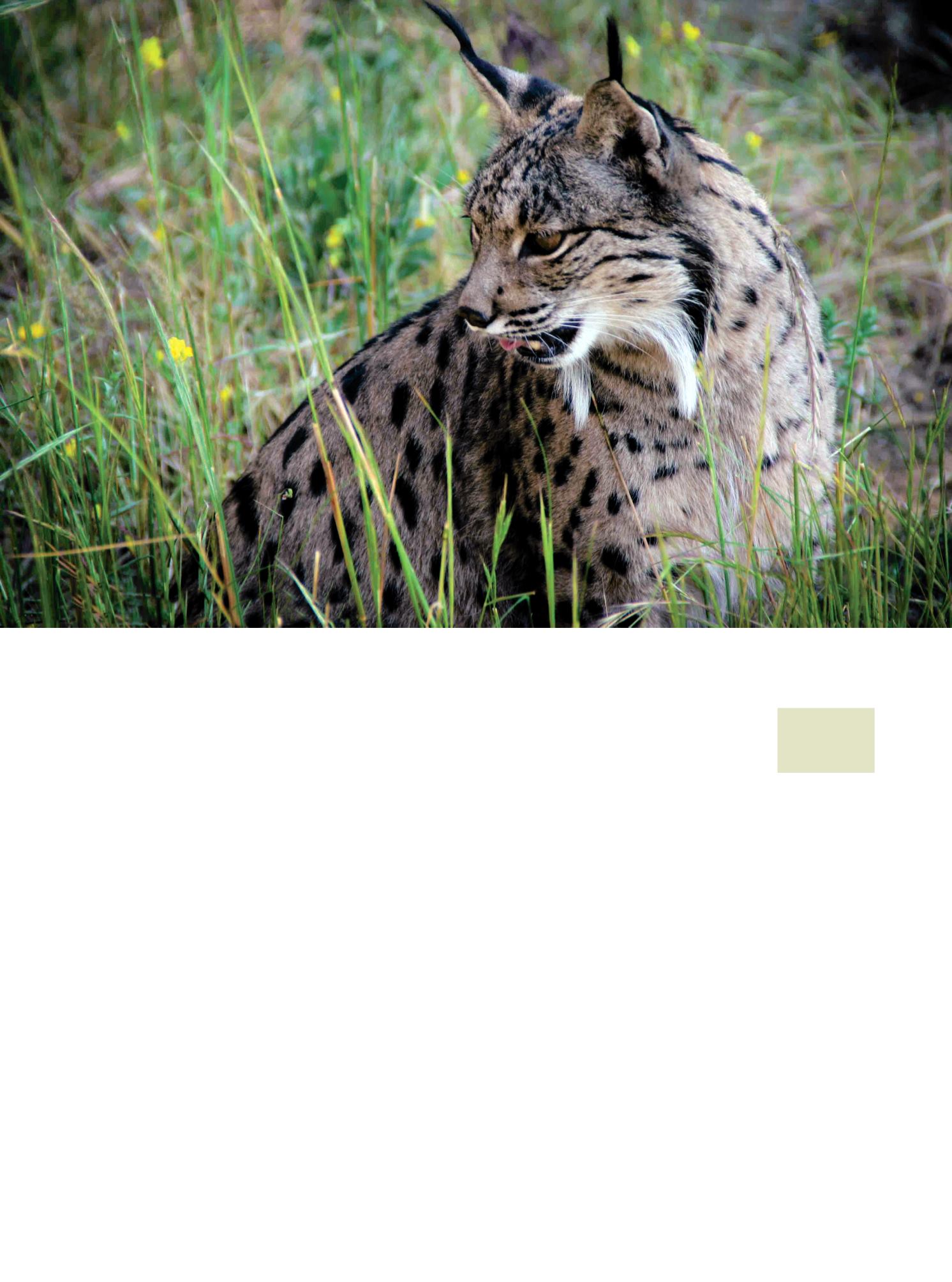
4. Las patillas que
cuelgan de sus
mejillas aumentan
de tamaño con
la edad. /
The
sideburns hanging
from his cheeks get
bigger with age.
Según el Fondo Mundial para la Naturaleza (World
Wildlife Fund), este felino sólo vive en la penínsu-
la Ibérica donde, según los últimos censos, resisten
unos 320 ejemplares, repartidos en cuatro poblacio-
nes: el de Doñana, su entorno y las población de Sierra
Morena distribuida en tres núcleos; Andújar-Cardeña
(Jaén-Córdoba); a los que se suman las recientes po-
blaciones de Guadalmellato (Córdoba) y Guarrizas
(Jaén) creadas en los últimos años con animales libe-
rados procedentes de otras poblaciones y de centros
de cría en cautividad.
Existe un gran escepticismo entre los biólogos
de campo y los conservacionistas respecto a la cría
en cautiverio y la reintroducción. Por un lado, la cría
en cautividad puede “sobreexplotar” las poblaciones
silvestres, mientras que por el otro, las reintroduccio-
nes son difíciles de llevar a cabo y conllevan una alta
probabilidad de fracaso. De hecho, las experiencias de
reintroducciones realizadas con linces euroasiáticos
y canadienses extraídos de poblaciones silvestres,
han sido ambivalentes, y los proyectos de reintro-
ducción de felinos nacidos en cautividad tampoco
son concluyentes. Sin embargo, se puede aprender
de estas experiencias, la situación del lince es tan
crítica que es necesario un enfoque que abarque el
máximo rango de posibilidades.
·amura·
89
The World Wildlife Fund states that this fe-
line only lives in the Iberian Peninsula where,
according to the last census, around 320 cats are
living in four populations: the one of Doñana, its
surroundings and the population of Sierra More-
na distributed in three nuclei; Andújar-Cardeña
(Jaén-Córdoba); to which the recent populations
of Guadelmellato (Córdoba) and Guarrizas (Jaén),
created both in recent years with animals freed
from other populations and in-captivity breed-
ing centers, are added.
There is great skepticism amongst the field bi-
ologists and the conservationists with regard of
the in-captivity breeding and the reintroduction.
On one hand, the in-captivity breeding may “over-
exploit” the wild populations, while, on the other
hand, the reintroductions are hard to achieve and
carry a high probability of failure. In fact, the ex-
periences with reintroductions performed with
Eurasian and Canadian lynxes extracted from wild
populations have been ambivalent and the projects
of reintroduction of felines born in captivity have
not been very conclusive. However, it can be learned
from these experiences that the actual situation of
the lynx is so critical that a scope that includes the
maximumamount of possibilities is required.
4


