
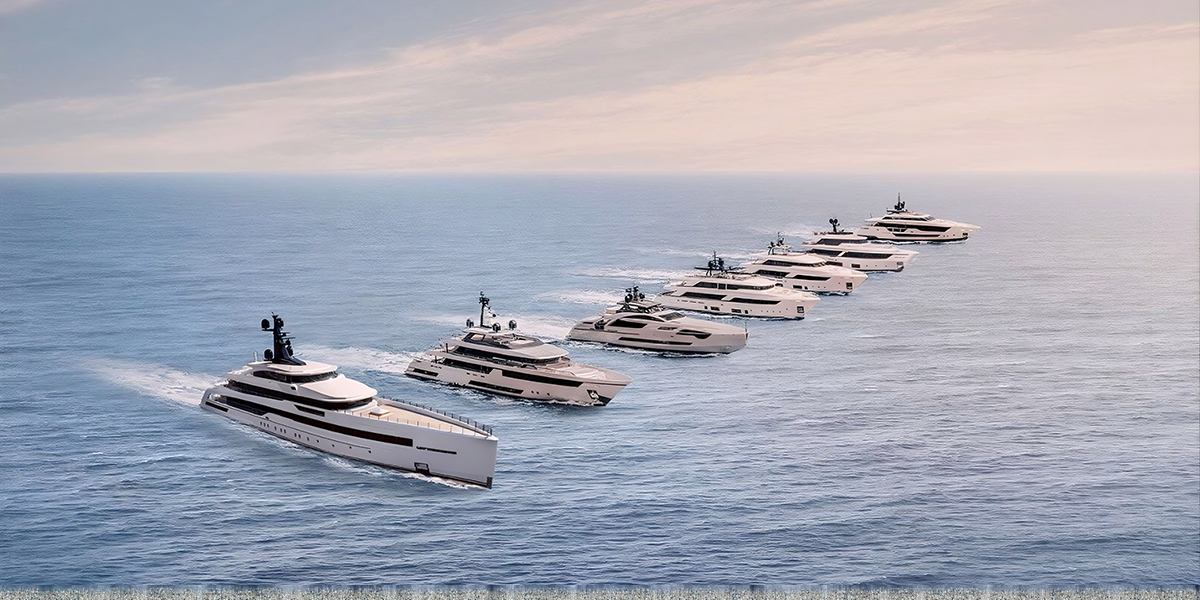
The former Tubimar plant, located in the heart of Ancona's port area, will be transformed into a new production center dedicated to building Ferretti Group superyachts.
This initiative is part of the Group's growth strategy and responds to the increasing international demand in the large vessel segment, especially for steel and aluminum superyachts between 40 and 55 meters.
The project includes the construction of five new industrial buildings, doubling the Group's production capacity in the semi-custom metal superyacht segment.
This initiative is part of an investment plan with a total value of almost €30 million, which will be implemented progressively over the next three years. The development of the new center will be carried out in a modular fashion, with production areas becoming operational gradually. The first opening is planned for 2028. The first plot granted to the Group covers an area of 16,175 m2.
For Mirco Carloni, president of the Central Adriatic Sea Port System Authority, Ancona has everything it needs to play a leading role in the international nautical industry: “Approximately 20% of all Made in Italy yachts are built here, and shipbuilding in the Marche region generated revenues of one billion euros in 2024,” added Carloni.
The supply chain in Ancona employs around 4,000 people throughout the region, almost double the figure recorded ten years ago. The strength of this sector is also reflected in export figures: in the first half of 2026, exports from the Marche region increased by 9.2%, more than double the national growth rate (+4.5%), driven largely by sales of yachts and boats.
“These figures demonstrate the importance of the nautical industry as an engine of the region's economy and competitiveness. As the global market continues to grow at an annual rate of 6%, our goal is to translate this potential into new investments, job opportunities, and greater competitiveness for the area,” concluded Mirco Carloni.
The project will not be limited to the construction of the new production facilities, but will also include the functional and architectural regeneration of the former Tubimar site.
Furthermore, special attention will be paid to environmental sustainability, through solutions that meet Minimum Environmental Criteria, the use of recycled and certified materials, energy-efficient systems, the installation of solar panels, and measures aimed at reducing environmental impact.