
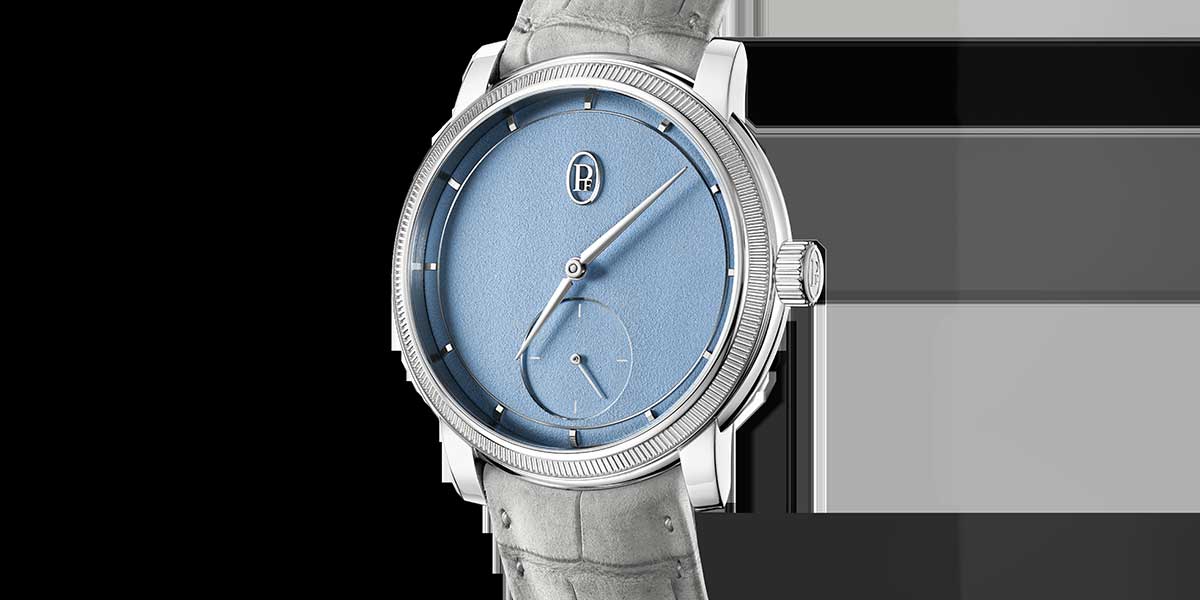
Morning Blue describes not a color, but a moment: that elusive interval when night begins to recede, yet day has not fully revealed itself.
On the hand-finished white gold dial, the color is never entirely fixed. It reveals itself through light, shifting from cool tones to brighter hues depending on the angle of the wrist. The gently sloping chevée dial and slender alpha-shaped hands preserve the sense of space and visual serenity that define the Toric. This same discipline extends to the strap. Its six-layer Akoya Grey construction requires approximately 20 manual operations over the course of two days, mirroring the tactile softness of the dial itself. Platinum
At first glance, the Toric Petite Seconde appears almost self-evident: hours, minutes, and small seconds held within the quiet density of platinum.
Look closely, and another world emerges. Its dial revives grainage—a historic technique that Michel Parmigiani personally passed on to the Maison’s watchmakers. Because silver is photosensitive, the dial is crafted by hand in dim light, with the grain becoming finer with each pass of the brush. The artisan knows when the surface is ready not only by sight but also by touch: a subtle change in resistance signals that tiny silver particles have begun to adhere to the gold.
Beneath the serenity of the dial lies another, less visible testament to the watch’s ambition. The manual-winding PF780 caliber is crafted from 18-karat rose gold, placing Parmigiani Fleurier among the few watchmakers that still uphold the unique tradition of creating mechanical movements from solid gold. Its two visible barrels embody a principle rooted in Michel Parmigiani’s work as a restorer: energy must be transmitted more evenly, thereby reducing tension and wear over time. The Côtes de Fleurier are engraved using an antique cam-operated guilloché machine, completing an architecture that remains fully exposed to view.