
At the 31st Captains' Forum held at the Yacht Club de Monaco, the focus was on which available or developing technologies and fuels could realistically be implemented as "future energy sources on board ships and yachts." From wind and solar power to batteries, HVO, methanol, and hydrogen, discussions quickly ruled out the idea of a single solution. A total of 128 captains participated.
Camille Lopez (HY-Plug) highlighted another key point: simply labeling a fuel "clean" is not enough; it is crucial to consider how it was produced and from what energy source or feedstock. A molecule used on board can have a vastly different environmental impact across the supply chain.
The first panel focused on wind power, solar energy, electric propulsion, diesel-electric hybridization, and batteries. María Rosa Milà Martínez (Siemens Energy), Jean Guyon (Aeroforce), Marek Hasenkopf (ICON Yachts), and Francesco Giudice (Volvo Penta) compared their experiences. The example presented by Aeroforce illustrates the logic behind an energy mix. After covering approximately 17,000 nautical miles—primarily in the Atlantic and Mediterranean—data from their electric catamaran reveals that 30–35% of the energy comes from solar power, with the remainder derived from hydro-generation while under sail.
Regarding HVO (Hydrotreated Vegetable Oil), practicality is a key factor. Sash Koonjul (Peninsula) noted that their distribution network has expanded significantly, although coverage remains sparser in some regions. Tobias Kohl (Rolls-Royce) confirmed that HVO can be used without restrictions in compatible engines—with no observed loss of power—and can be blended with conventional diesel. Florian Keiler (Everllence) presented dual-fuel engines designed to run on methanol when available while retaining diesel as an alternative—a flexible approach that addresses current limitations in the refueling network.
The Forum then turned its attention to solutions that are more complex to integrate, such as LNG (liquefied natural gas), ammonia, nuclear power, and hydrogen. Here, too, a cautious view was taken regarding standardized solutions. Giovanni Brescia (Fincantieri) emphasized that experience gained in the merchant shipping sector must be considered within the context of the recreational boating industry.
Nuclear power featured prominently in the discussions. While maritime nuclear technology is not new, the reactors currently under development differ from those for which the existing regulatory framework was designed. Engel-Jan de Boer (Lloyd's Register) highlighted this discrepancy: the IMO (International Maritime Organization) nuclear code exists but is based on older technologies and must evolve to accommodate new reactor types. The current challenge is both regulatory and technical, requiring coordination among the IMO, nuclear authorities, flag states, ports, and insurers. Lloyd's Register is working on several vessels ranging from 65 to 120 meters in length, while Derek Munro (NOxFree Ltd) presented a 1 MW micro-reactor currently being developed using low-enriched uranium. The first demonstration is scheduled to take place in the United States in 2028.
Hydrogen has already moved beyond the laboratory phase. Andreas Boden (PowerCell Group) highlighted advances in fuel cell technology and its application across various sectors. At sea, it generates no NOx, CO₂, or polluting particulates at the point of use, yet its volume poses a significant limitation for the maritime industry.
Regarding infrastructure, Philippe Esposito (DH2 Energy) illustrated this challenge using the example of a hydrogen-powered vessel under 8 meters in length that has been in operation for over two years. In his view, the vessel itself is no longer the bottleneck: "The problem today isn't the vessel, but the infrastructure—how to refuel the boats and get the hydrogen to the marinas."
A key takeaway from the discussions is that the energy transition in recreational boating will not hinge on a single winning technology that replaces all others. Instead, decisions regarding onboard systems will be shaped by a combination of factors, including usage patterns, desired range, available space, infrastructure, technological maturity, regulations, and cost.
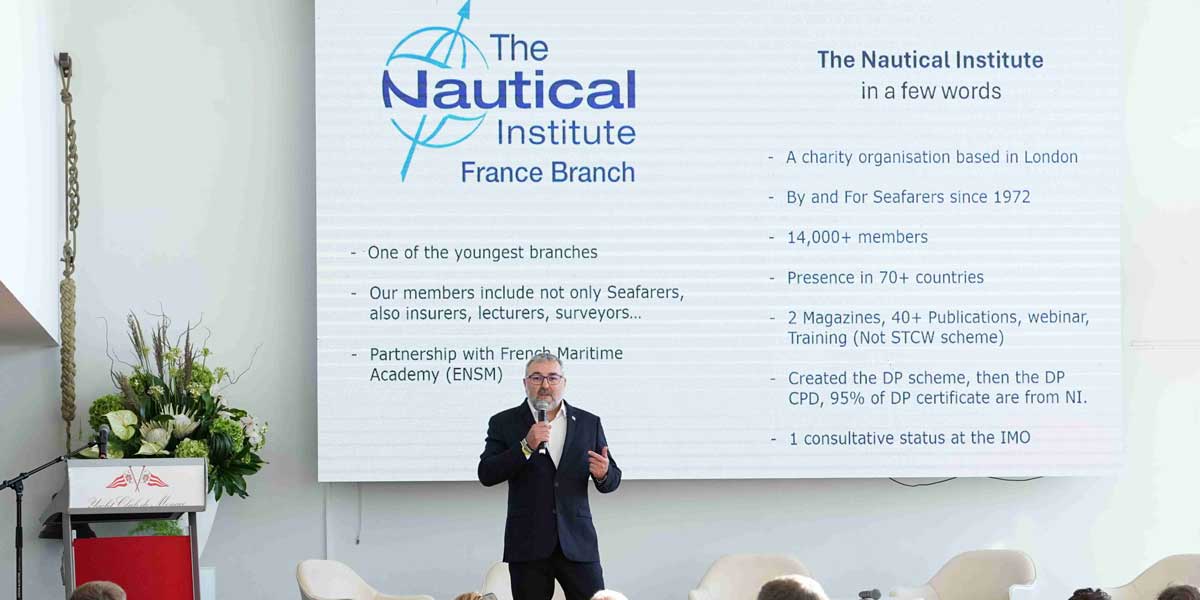
The final remarks steered the discussion back to the people who will actually have to implement these changes. Chris O'Flaherty (of the Nautical Institute and its representative to the IMO) noted that only about 15% of the participants in the Organization's discussions have professional maritime experience. This highlights the importance of including seafarers in the conversation to ensure that regulations remain practical to implement.
...at sea.