
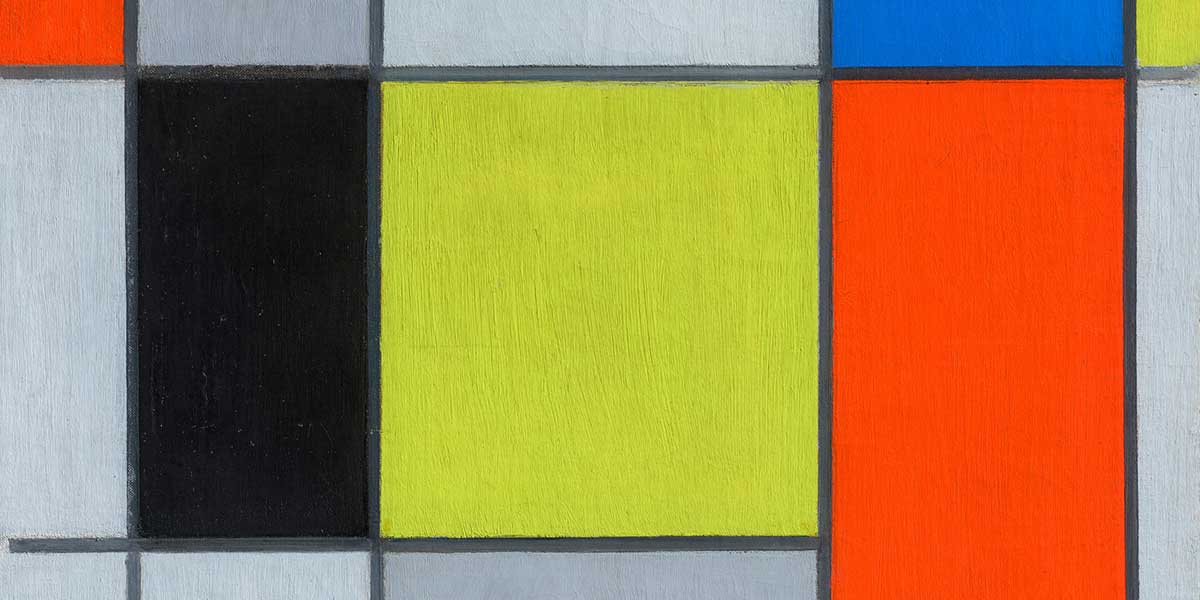
Composition III, offered at auction for the first time by Christie’s, is one of eight paintings Piet Mondrian completed in 1920, shortly after returning to Paris following a five-year absence. These works not only represented a pivotal moment in the artist’s practice but also marked a fundamental shift in Western art as a whole.
In the summer of 1914, Mondrian returned to the Netherlands from Paris to visit his ailing father. He intended to stay in his homeland for only a few weeks. However, the outbreak of World War I resulted in him staying for five years.
Back in the French capital—by then approaching the age of forty—Mondrian produced a body of work that represented a remarkable advance not only in his own practice but in Western art as a whole. Adhering to the rules of Neoplasticism, an abstract language he pioneered, Mondrian reduced painting to what he considered its fundamentals: pure color and line.
Composition III consists of a sequence of colored planes arranged within a grid of straight lines. These planes are square or rectangular, and the interplay between them draws the viewer’s attention.
Roughly in the center of the canvas lies a large, square panel painted yellow, which is the first thing to catch the eye. Above and below, there are two rectangles painted in different shades of gray. At the top of the central column, a thin red strip draws the eye to panels of the same striking color located in the upper-left corner and the center-right of the painting.
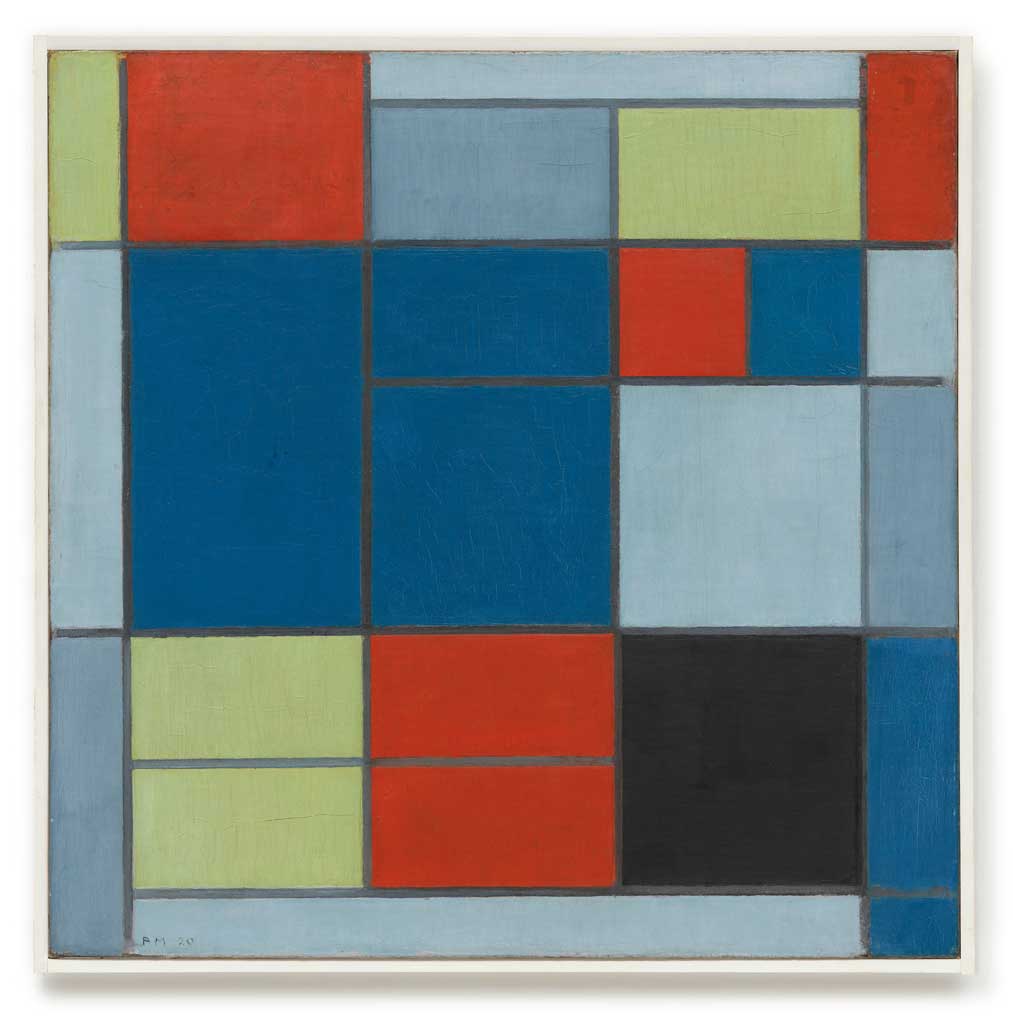 Piet Mondrian (1872–1944), Composition C, 1920. Oil on canvas. 60.3 × 61 cm. The Museum of Modern Art, New York. Acquired through the Lillie P. Bliss Bequest (by exchange). Photo: The Museum of Modern Art, New York / Scala, Florence.
Three black strips also stand out; one of them serves as the axis for the entire composition at the base of the central column. Mondrian applied a layer of varnish over these strips, giving them both a sense of depth and a distinctive sheen.
Grid patterns were already part of his repertoire when he arrived in 1919. However, they tended to be modular—grids such as those in Composition with Grid 9: Checkerboard Composition with Bright Colors (1919)—featuring a more uniform and repetitive structure than the grids he had painted in Paris.
He worked on Composition III roughly between December 1919 and May 1920; his adjustments included adding small traces of blue pigment to the three yellow planes, which helped achieve a cool, almost acidic color. The dark lines forming the grid are also noteworthy. They are the result of layers of delicate overpainting. Many stop just short of the canvas edges; their borders are soft rather than sharp, fading out gradually.
With Composition III and his other paintings from 1920, Mondrian marked a milestone in art history: the definitive rejection of traditional representation in favor of pure geometric abstraction. Composition with Red and Blue, which the artist completed shortly after arriving in New York, fetched $23 million when offered at Christie’s New York in 2025.