los conquistadores •
the conquerors
134
·amura·
atmosphere that radiates light and graduates dark
by dispersing and concentrating its density. The
solitary characters, involved in their work are the
result of the permeable aesthetic of all Seurat’s work;
the aesthetic of silence.
There is amutism in the atmospheric fields of his
drawings. His anonymous subjects lack facial fea-
tures and are always in danger of becoming a pure
form or decorated in the background. The darkness
of their faces seems to be continually dissolving,
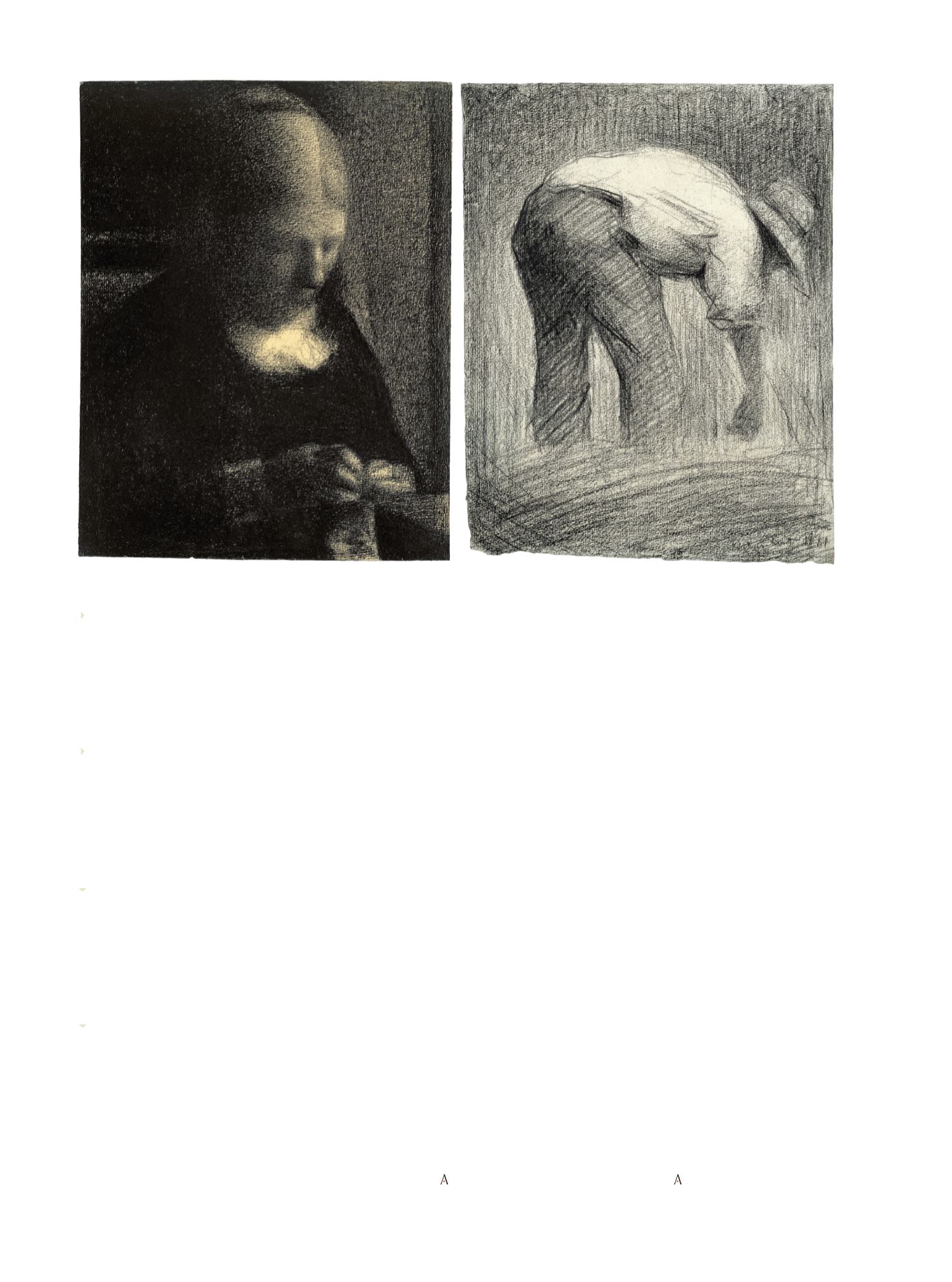
veiled over them. As in the case of
Embroidery
(1882-
83), a portrait of the artist’s mother sewing. This
silence of daily life is shared with Johannes Vermeer:
two greats of light, silence and the daily grind.
In
Birth of the tragedy
, written in 1872, Nietzsche,
talks of Apollo andDionysius as the great artistic forces
that face each other. On the one hand, the Appollan
instinct is a principle of representation and individua-
tion. A dream-like state that watches over life turning
the terrible into the beautiful. And on the other hand,
the Dionysian instinct as an non-figurative force that
breaks the principle of individuation and flooded
everything with the same material, returning to the
sludge fromwhich life emerges, returning to the origi-
nal indistinction. Dionysius is the god of drunkenness,
the unity of all things, the suppression between the
limits of the finite and the infinite.
The dramatics of light and dark of Seurat incar-
nate these two principles of the Nietzschean aes-
thetic. On the one hand, the atmospheric veil of the
representation in his drawings, which invites the
glance to open the curtain and discover the object,
but on the other, this same veil is transformed into
an ethereal and disturbing miasma that submerges
background and figure into the terrain of what can-
not be represented.
atmósfera que irradia luz y gradúa oscuridad, disper-
sando y concentrando su densidad. Sus personajes
solitarios, sumidos en sus labores, son el resultado de
la estética permeable a toda la obra de Seurat: la esté-
tica del silencio.
Hay un mutismo en el campo atmosférico de sus
dibujos. Sus anónimos sujetos carecen de rasgos
faciales y siempre corren peligro de convertirse en
pura forma o decorado de fondo. La oscuridad de sus
rostros parece estar continuamente disolviéndolos,
velándolos. Como el caso de
Embroidery
(1882-83),
retrato de su madre sumergida en la labor de la cos-
tura. Este silencio de la vida cotidiana lo comparte
con Johannes Vermeer: dos grandes de la luz, del
silencio y de lo cotidiano.
En el
Nacimiento de la tragedia
, escrita en 1872,
Nietzsche, habla de Apolo y Dionisio como las dos
grandes fuerzas artísticas que se enfrentan. Por un
lado el instinto de lo apolíneo como el principio de
representación y de individuación. Estado onírico
que vela la vida, transfigurando en belleza lo terri-
ble. Y por el otro, el instinto de lo dionisiaco como la
fuerza a-figurativa que rompe el principio de indivi-
duación inundando todo de la misma materia, vuel-
ta al fango del que surge la vida, vuelta a la
indistinción originaria. Dionisio es el dios de la
embriaguez, la unidad de todas las cosas, la supre-
sión entre los límites de lo finito y lo infinito.
El dramatismo de la luz y la oscuridad de Seurat
encarnan estos dos principios de la estética nietzs-
cheana. Por un lado el velo atmosférico de la repre-
sentación en sus dibujos, que invita a la mirada a
descorrer la cortina y descubrir el objeto; pero por
otro ese mismo velo se transforma en un miasma
etéreo e inquietante que sumerge fondo y figura en
el terreno de lo irrepresentable.
Harvester
1881
Crayón Conté sobre papel
Conté crayon on paper
12 3/16 x 9 1/2" (31 x 24.1 cm)
Collection André Bromberg
Pág. anterior /
Last Page
Seated Woman with a Parasol (study for
A Sunday on La Grande Jatte)
c. 1882-85
Crayón Conté sobre papel
Conté Crayon on Paper
18 3/4 x 12 3/8" (47.7 x 31.5 cm)
The Art Institute of Chicago. Bequest of
Abby Aldrich Rockefeller, 1999.7
Photo courtesy The Art Institute of
Chicago
Lighthouse at Honfleur
1886
Crayón Conté y gouache sobre papel
Conté crayon and gouache on paper
9 1/2 x 12 1/8" (24.1 x 30.8 cm)
The Metropolitan Museum of Art, Robert
Lehman Collection, 1975 (1975.1.705)
© 1990 The Metropolitan Museum of Art
Embroidery (The Artist’s Mother)
c. 1882-83
Crayón Conté sobre papel
Conté crayon on paper
12 5/8 x 9 7/16" (32 x 24 cm)
The Metropolitan Museum of Art,
Purchase, Joseph Pulitzer Bequest, 1951;
acquired from The Museum of Modern
Art, Lillie P. Bliss Collection (55.21.1)
© 1989 The Metropolitan Museum of Art
En esta página /
On this Page


