·amura·
94
planeta azul •
blue planet
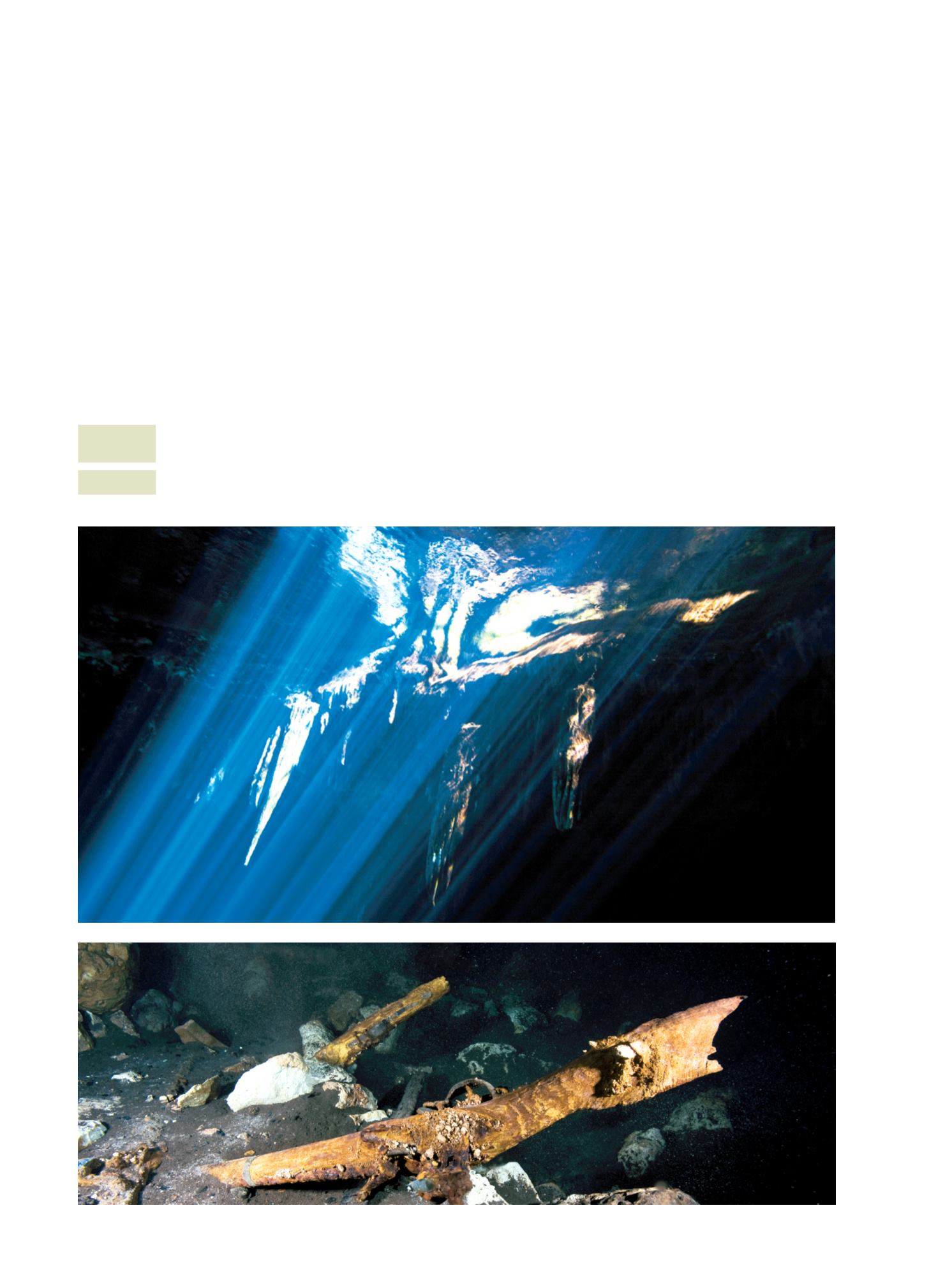
1. Formación de
estalactitas por la
filtración del agua en
el techo de la caverna.
Stalactites formation
by the filtration of
water through the
ceiling of the cave.
2. Mosquetes de la
“Guerra de castas”.
Mosquets of the
“CastsWar”
one out of all the sites in the Peninsula. This
site is the “Sacred Cenote”. The echo archaeo-
logical park houses the cenote Ik Kil and the
“Sacred Cenote Azul” which is spectacular,
with 26m (28.44yd.) depth and surrounded
by lush vegetation, and crystal clear waters,
ideal for diving.
• KEKEN or DZITNUP lies within an under-
ground chamber, where huge formations of sta-
lactites and stalagmites can be seen. There is a
hole in the roof through which light penetrates
and illuminates the turquoisewaters. It is found
7km (4.34miles) southwest of Valladolid.
• ZACÍ: at the heart of Valladolid, city founded in
1543, in the area which once was the pre-His-
panic site ZACÍ, which means “White Hawk.”
The most impressive aspect of the cenote is its
dome, from which enormous stalactites hang,
and through which sunlight filters, illumi-
nating the lush vegetation surrounding the
turquoise water tank, home to species of cat-
fish and an eyeless black catfish called “Lub”.
Theweakwater flowand its temperature, oscillate
between 24 ° C (75.2° F) and 25 ° C (77° F) make these
holes spectacular.
En este sitio se encuentra el “Cenote Sagrado”.
Localizado en un parque eco arqueológico se
encuentra el cenote Ik Kil y demás también
se encuentra el cenote “Sagrado Cenote Azul”
el que es espectacular, ubicado a 26m de pro-
fundidad y rodeado de espesa vegetación, de
aguas cristalinas ideales para bucear.
• DZITNUP o KEKEN Se localiza dentro de una
cámara subterránea, donde se pueden observar
enormes formaciones de estalactitas y esta-
lagmitas. En el techo hay un hueco por donde
penetra la luz e ilumina las aguas azul turquesa.
Se encuentra a 7km al suroeste de Valladolid.
• ZACÍ En el corazón de la ciudad de Valladolid,
fundada en 1543, que fuera la zona prehispánica
de Zací “Gavilán Blanco”. Lo más imponente
de este cenote es su bóveda, del que cuelgan
enormes estalactitas, a través de las cuales se
filtran los rayos del sol, iluminando la exube-
rante vegetación que rodea al depósito de agua
turquesa, donde habita una especie de pez gato
y bagres negros sin ojos llamados “Lub”.
La débil corriente de las aguas, así como la tempe-
ratura de las mismas, entre 24° y 25° los convierten
en paraísos espectaculares.
1
2


