fuera de borda •
outboard
114
·amura·
Texto /
Text
: Amura • Foto /
Photo
: Las Brisas
L
egend says that, many years ago, sailors who
passed the Santiago Peninsula, in Manzanillo,
saw from afar shimmering silhouettes that
floated above the water and thought they were see-
ing fairies. That is why this place is known as Las
Hadas (The Fairies) and why fantastic tales were told
here.
Even today is it possible to see these luminous
shapes. However, now we know why they occur: they
are produced by the presence of phosphorus on the
surface of the water that, in turn, is caused by the
bones of people of ancient civilizations whose
remains lie at the bottom of the sea.
Antenor Patiño, a bolivian dreamer known as
“the tin king”, wanted to build a completely differ-
ent private club, a place filled with magic and fanta-
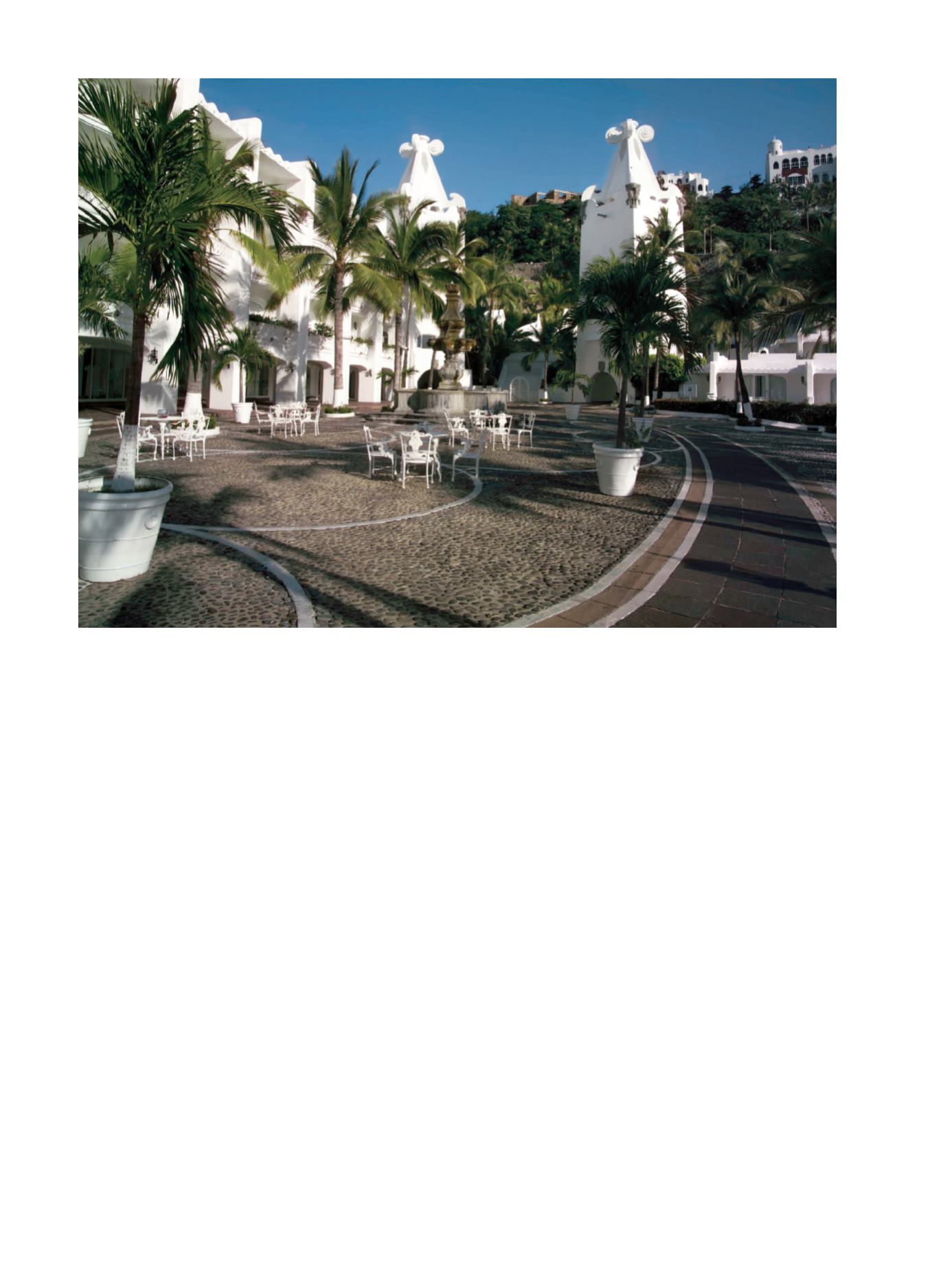
sy. He found in Las Hadas a unique natural setting
with exceptional weather year ‘round and the most
peaceful beach in the world.
The bolivian and the spanish architect José Luis
Ezquerra dedicated a decade (from 1964 to 1974) to
the construction of this magnificent place, in which
Patiño invested 33 million dollars, and built this
C
uenta la leyenda que hace muchos años los nave-
gantes que pasaban por la Península de Santiago, en
Manzanillo, veían a lo lejos siluetas iluminadas que
flotaban sobre el agua y decían que lo que veían eran ha-
das. Por esta razón bautizaron a este lugar con el nombre
de “Las Hadas”, en esos momentos se tejieron relatos fa-
bulosos, como los de los cuentos de fantasía.
Aún hoy es posible admirar las siluetas luminosas en
dicho sitio, pero por supuesto que ya se sabe cuál es la
causa de estas fosforescencias. Esto es producido por
la presencia de fósforo sobre la superficie del mar, que
proviene de los huesos de gente perteneciente a anti-
guas civilizaciones, cuyos restos se encuentran en el
fondo del mar.
Un soñador, Antenor Patiño, de origen boliviano y cono-
cido como “El rey del estaño”, deseaba hacer un club total-
mente privado, diferente, un lugar que recreara la magia y
la fantasía. Este millonario encontró en Las Hadas un esce-
nario natural único, con un clima excepcional todo el año y
la playa más tranquila del mundo.
Este boliviano y el arquitecto español José Luis Ezque-
rra se dedicaron durante 10 años (1964 a 1974) a la cons-
trucción de este magnífico lugar, en la cual Patiño realizó
Donde las hadas andan
Where fairies tred
Las Hadas


