·amura·
120
catadores •
tasters
los conquistador s •
the conquerors
Varios artistas han comenzado a diferentes lo-
caciones como emisarios oficiales de los gobiernos
occidentales, o por su propia iniciativa, con el fin de
documentar las culturas que se consideran intactas.
Algunos de ellos se establecieron ahí permanente-
mente. Por ende, sus pinturas y fotografías se fomen-
taron a través del turismo, y formaron una peculiar
imagen del Oriente fuertemente influenciada por una
motivación colonial. Algunos soñaron con los placeres
sensuales de Las Mil y Una Noches, las cuales se
reflejan en las numerosas descripciones de fantasías
de drogas y harén. Otros fueron fascinados por la fuer-
za emocional de una cultura restrictiva que se había
considerado “bárbara” hasta ese entonces. Durante el
siglo XIX, las ciudades islámicas fueron redescubiertas
en el sur de España, detonando una enorme cantidad
de curiosidad por el Oriente. Para los artistas académi-
cos, la búsqueda por las raíces de la civilización era de
suma importancia; Esto no solo incluía los clásicos
monumentos, pero también los paisajes que se con-
sideraban intocables desde los tiempos de Jesucristo,
con el fin de presentar pinturas históricas, y bíblicas,
con mayor realismo. La infinita expansión del desierto
ofrecía un reto artístico único, y el avance de las ciencias
etnográficas y antropológicas también fueron reflejadas
en arte. La exhibición concluye con las obras de varios
artistas modernos, los cuales no fueron capaces de
resistir el encanto del Oriente, e interpretar el tema
con una nueva expresión pictórica.
Es un reto identificar con la percepción de una
audiencia contemporánea de estas obras de arte e
Many artists now started actually travelling to
various locations as official emissaries of western
governments or on their own initiative in order
to document cultures that were considered to be
unspoiled. Some of them even settled there perma-
nently. In turn, their paintings and photographs
fostered further tourism and shaped a particular
image of the Orient that was strongly influenced
by colonial motivations. Some dreamt of sensual
pleasures from the Tales of 1,001 Nights, which
are reflected in the numerous depictions of drug
and harem fantasies. Others were fascinated by
the emotionality of a forbidding culture that had
been considered “barbaric” until then. During the
19th century, Islamic cities were rediscovered in
southern Spain, thereby sparking off a great deal
of curiosity for the Orient. For academic artists, the
search for the roots of civilization was of prime im-
portance; this included not only the classical monu-
ments but also those landscapes that were considered
unchanged since the time of Jesus Christ, in order to
represent historical and biblical paintings more re-
alistically. The infinite expanse of the desert offered
a unique artistic challenge, and the developing
sciences of ethnography and anthropology were
also reflected in art. The exhibition concludes with
works by several modern artists who were equally
unable to resist the allure of the Orient and who in-
terpreted the topic with a new pictorial expression.
It is a challenge to identify with the perception
of the contemporary audience of these artworks
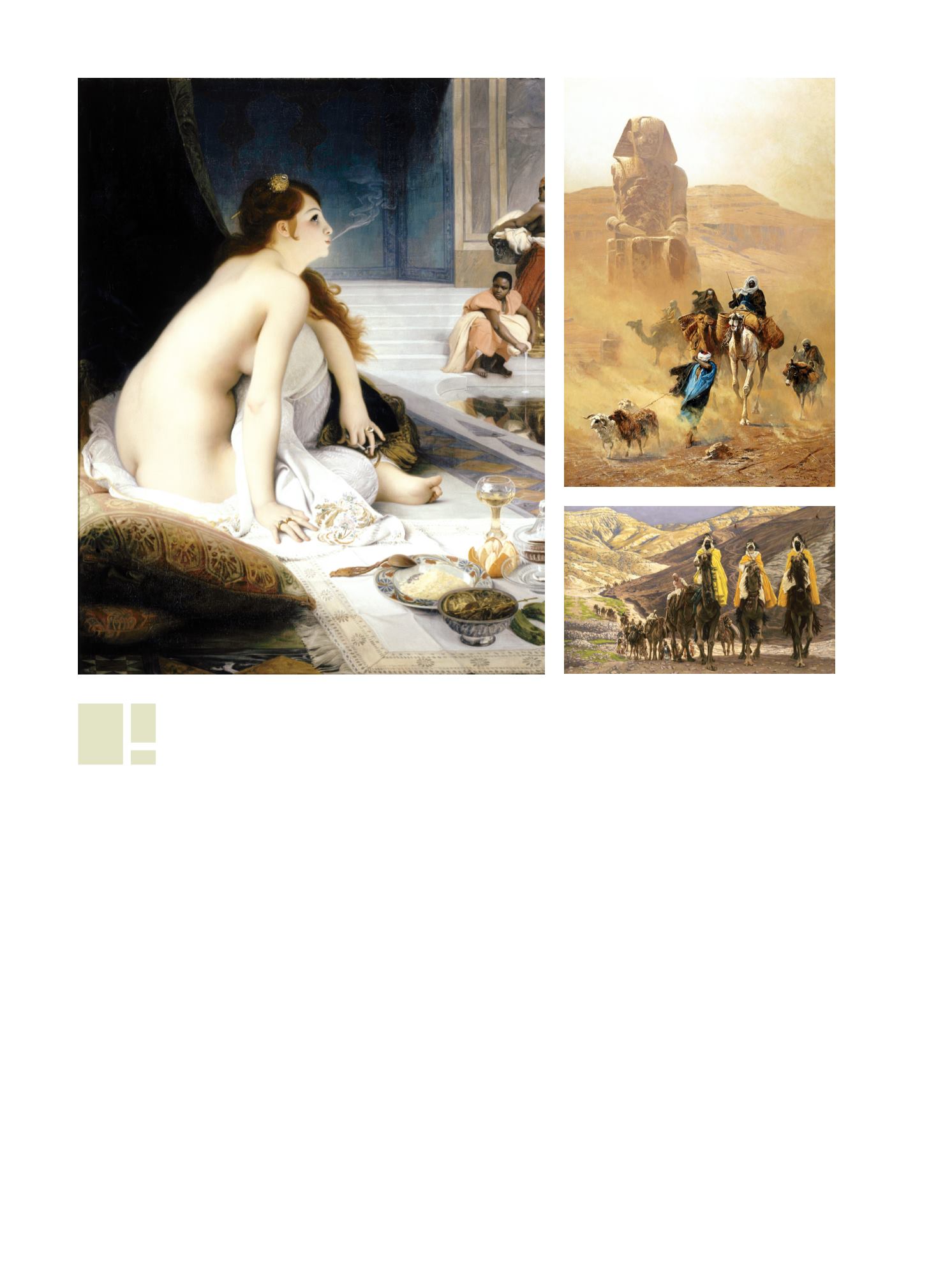
1.
Jean Lecomte
du Nouÿ
TheWhite Slave, 1888
Oil on canvas,
149,5 x 118,3 cm
MuséedesBeaux-Arts
de Nantes, Nantes
©RMN / Gérard Blot
2. Ludwig Hans
Fischer
Bedouins in a sand-
storm, around 1891
Oil on canvas, 175,9 x
116,8 cm
Private collection
©Vincent Everarts
Photografy
3. James Tissot
Journey of the Magi,
around 1894
Oil on canvas, 70,8 x
101,6 cm
The Minneapolis
Institute of Arts,
TheWilliamHood
Dunwoody Fund,
Minneapolis
©Minneapolis Insti-
tute of Arts, TheWil-
liamHood Dunwoody
Fund, Minneapolis
1
2
3


