·amura·
119
catadores •
tasters
los conquistadores •
the conquerors
de artistas de menor nombre como Lawrence Alma
Tadema, Gustav Bauernfeind, Jaroslav
C
ermák, Henri
Evenepoel, Fabio Fabbi, Osman Hamdi Bey, John
Frederick Lewis, Alberto Pasini, Edward Poynter and
José Villegas y Cordero.
No es necesario mencionar que cualquier exhibi-
ción dedicada a un tema tan complejo y multifacético
es obligada a considerar los aspectos sociales, polí-
ticos, éticos y religiosos, además de las numerosas
perspectivas artísticas. La fascinación con esta región
geográfica, a lo largo de tres continentes gobernados
por el Imperio Otomano, ha abundado en el mundo
occidental desde que el conocimiento de sus culturas
y el comercio con ellas han existido. Aun así, durante el
siglo XIX, la situación cambiaria drásticamente. Hasta
este punto, el orientalismo como una forma de arte
cortesano se expresaba en su mayoría a través de los
llamados Turqueries, o Chinoiseries, pero muy pocos
artistas habían viajado a tales distancias. Luego, la
Campaña Egipcia de Napoleón desato un episodio de
“Egyptomania” por toda Europa. El ejército Francés
fue acompañado de 167 académicos y artistas los
cuales, consecuentemente, dieron paso hacia una
nueva disciplina científica, pero también a un nuevo
orientalismo en el arte.
works by lesser known artists like Lawrence Alma
Tadema, Gustav Bauernfeind, Jaroslav Cermák,
Henri Evenepoel, Fabio Fabbi, Osman Hamdi Bey,
John Frederick Lewis, Alberto Pasini, Edward Poynter
and José Villegas y Cordero.
It goes without saying that any exhibition that
is dedicated to such multifaceted and complex
subject matter is compelled to consider the social,
political, ethnical and religious aspects in addi-
tion to the numerous artistic perspectives. Fasci-
nation with this geographical region, spanning
three continents and ruled by the Ottoman Empire,
has abounded in the western world for as long as
knowledge of their cultures and trade with them
has existed. However, during the 19th century, the
situation would change dramatically. Until this
point, orientalism as a courtly art form was largely
expressed in so-called Turqueries or Chinoiseries,
yet very few artists had actually travelled that far
afield. Then Napoleon’s Egyptian Campaign her-
alded a veritable “Egyptomania” all over Europe.
The French army had been accompanied by 167
scholars and artists who consequently gave rise not
only to new scientific disciplines but also to a new
orientalism in art.
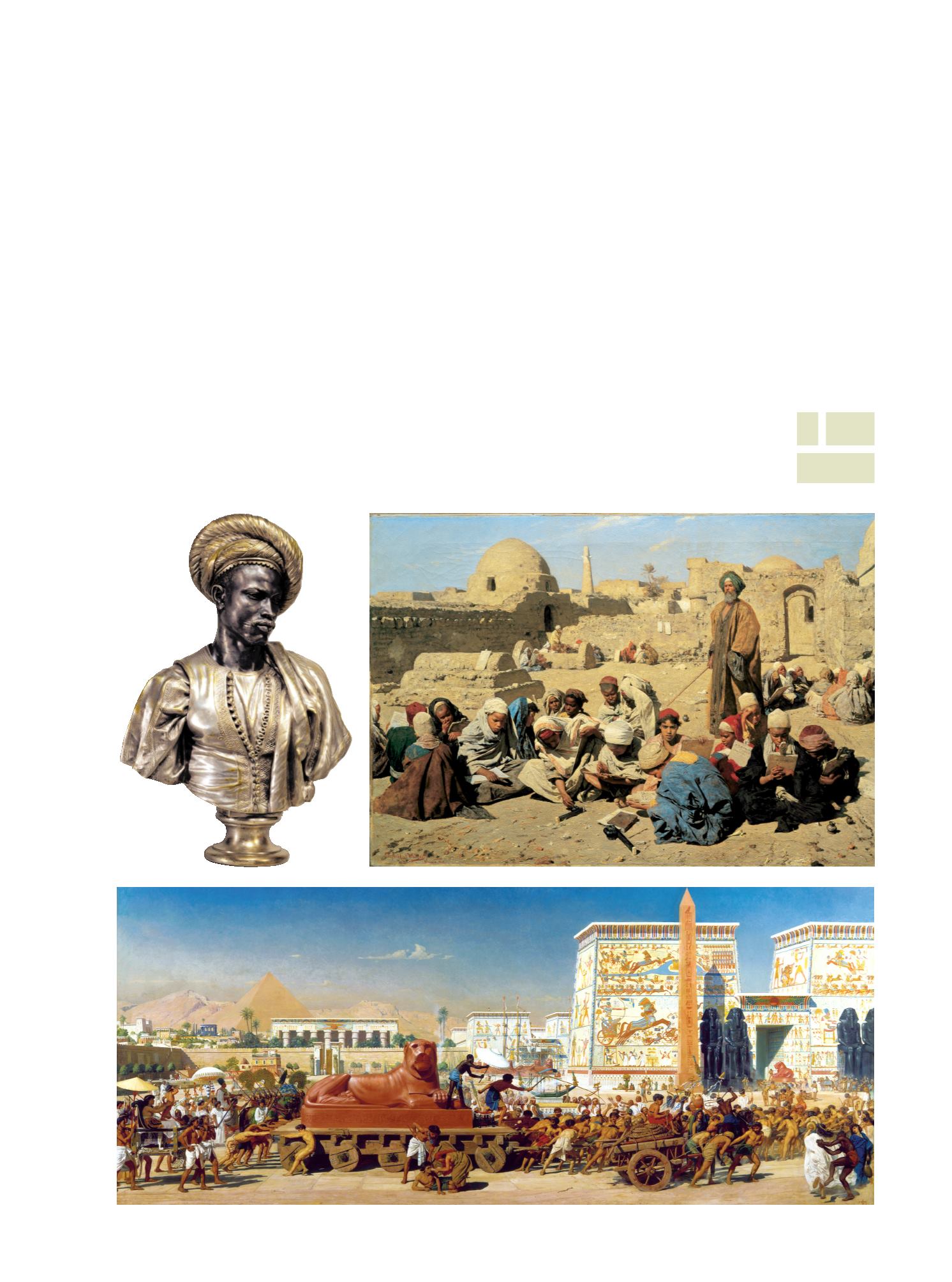
1. Charles Cordier
Negro from the Su-
dan, omstreeks 1857
Silver-plated bronze,
42,5 x 31,5 x 15,9 cm
DaheshMuseumof
Art, New York
©DaheshMuseum
of Art, New York, USA
/ The Bridgeman Art
Library
2. Leopold Carl Müller
Primary School in
Upper-Egypt, 1881
Oil on canvas, 77,5 x
127 cm
Belvedere, Vienna
© Belvedere, Vienna
3. Edward Poynter
Israel in Egypt, 1867
Oil on canvas, 137,2 x
317,5 cm
Guildhall Art Gallery,
London
© Guildhall Art Gal-
lery, London
1
3
2


