C
omo todos los años del mes de julio a no-
viembre, el “Gran Tiburón Blanco” (
Car-
charodon Carcharias)
visita nuestros mares
llegando a La Isla de Guadalupe, que es una isla de
origen volcánico, con una superficie total de 476 mil
971 hectáreas y se encuentra en el Pacífico Mexicano,
a 250 kilómetros de la costa de Baja California.
El 25 de abril del 2005 se emitió un decreto presi-
dencial por el que se declara ANP (Área Natural Prote-
gida), con la categoría de Reserva de la Biósfera, a la
zona marina y terrestre de Isla de Guadalupe.
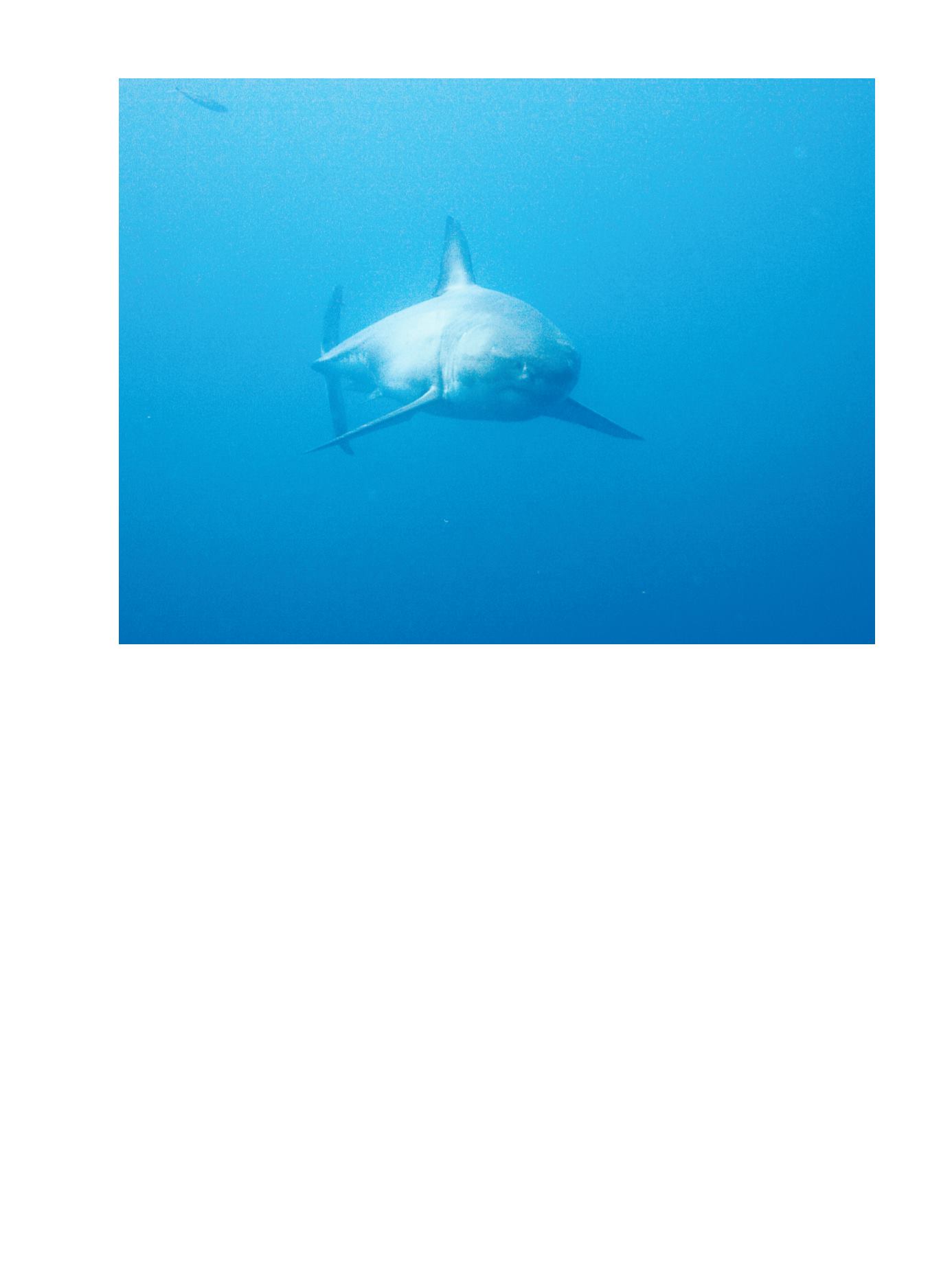
El Tiburón Blanco se caracteriza por su gran tama-
ño, ya que llega a medir de cuatro a siete metros y
puede pesar hasta dos toneladas. La nariz es cónica,
corta y gruesa, donde se encuentran esos puntos ne-
gros denominados ampollas de Lorenzini, que le per-
miten captar el más mínimo campo eléctrico. La boca
es muy grande y parece estar sonriendo al mostrar
sus dientes grandes, de forma triangular y aserrados;
los orificios nasales son muy estrechos, mientras
que los ojos son pequeños, circulares y completa-
mente negros. En los costados junto a las bránqueas
se ubican dos grandes aletas pectorales, detrás se
encuentran dos aletas pélvicas y el órgano reproduc-
tor, seguido de dos pequeñas aletas cerca de la aleta
caudal y, por último, la inconfundible aleta dorsal.
A pesar de su nombre, este tiburón es blanco sólo en
la parte del vientre, mientras que en el dorso es gris azu-
lado. Estos colores le sirven para confundirse con la luz
solar (en caso de mirarse desde abajo) o con las oscuras
aguas marinas (en caso de hacerlo desde arriba), consti-
tuyendo un camuflaje tan simple como efectivo.
L
ike every year, from July to November the
“Great White Shark” (Carcharodon Carchari-
as) visits our waters arriving to the “Isla Gua-
dalupe”, which is an island with a volcanic origin,
with a surface of over 476,971 acres and it’s located
in the Mexican Pacific 250 km away from the coast
of Baja California.
On April 25th 2005 a presidential decree was
emitted in which the maritime and terrestrial zones
of Isla Guadalupe were declared as Protected Natural
Areas, in the category of Biosphere Reserve.
The great white shark stands out for its great
size, it can measure from four to seven meters and
can weigh almost two tons; with a thick and short
cone shaped nose where those black dots called
Lorenzini blisters are located, allowing it to sense
the smallest electric field; the mouth is very big
and it would seem as it was smiling by showing its
huge teeth, triangular shaped and sawed, the nasal
cavities are very small, while the eyes are also small
round and completely black; on the sides next to the
gills two big pectoral fins are located, on the back are
two pelvic fins and the reproductive organ followed
by two more little fins near the caudal fin and last
the unmistakable dorsal fin.
Regarding its name, this shark is only white on
the stomach; while it’s dorsal side is gray-blueish.
This colors are meant for the shark to be confused
with the solar light (when looking at it from be-
low) or with the deep blue waters (when looking
at it from above), building this way an effective
yet simple camouflage.
·amura·
85
especies
•
species


