151
tips & tops
·amura·
especially, his or her personality. The idea is to
keep the wind exactly at your stern during every
moment of your jibe, with good speed, surfing if
possible, and passing the sail with your hand. The
blow of the sail on the bow makes the boat luff and
this must be countered aforehand with a drift. Once
we are on the other side we can luff in a new direc-
tion. With practice, this becomes fast and safe.
•
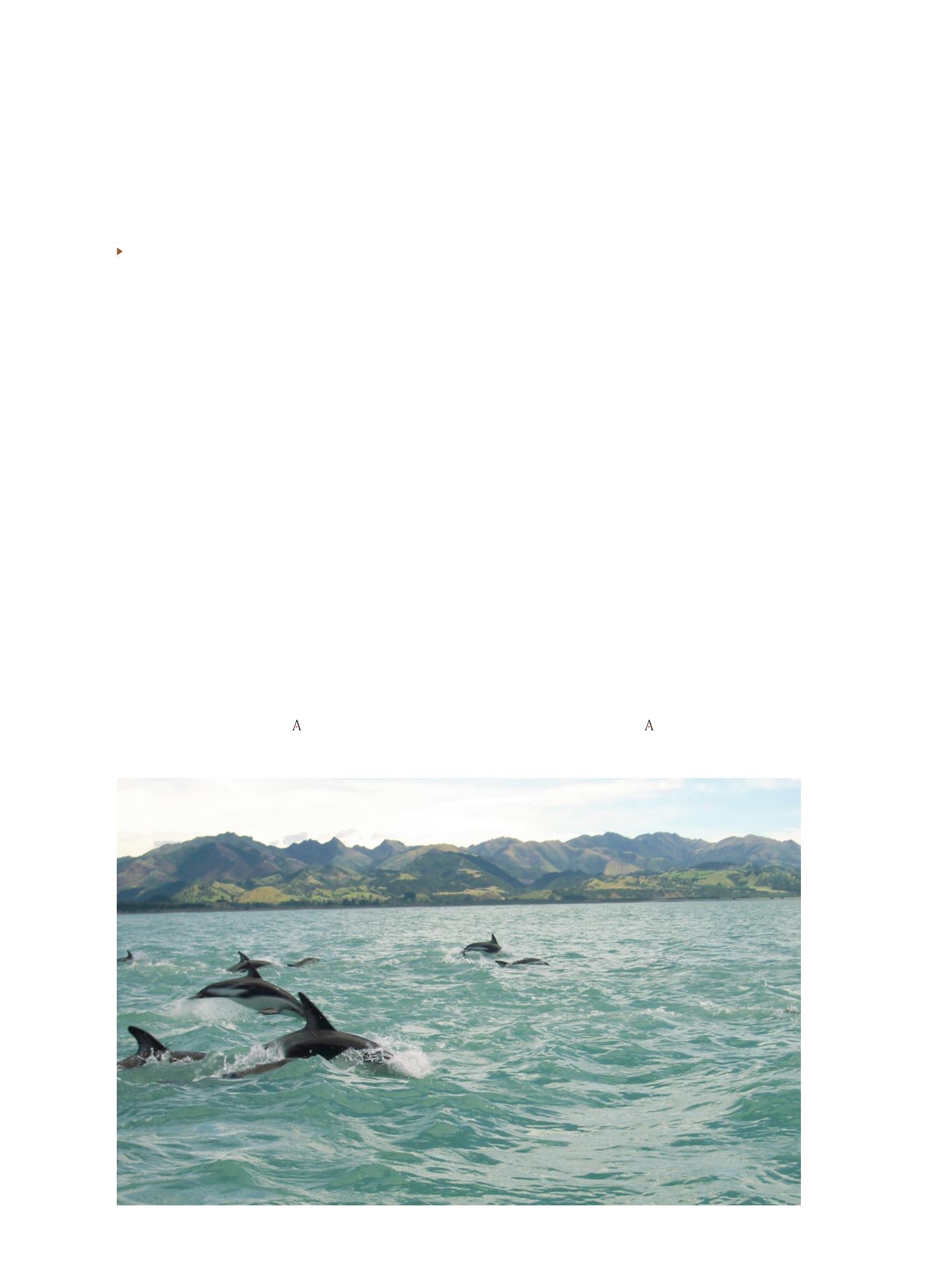
The Dusky, a dark dolphin frequently found in the
Patagonian area of Argentina, is known for perform-
ing themost spectacular leaps. It does amazing acro-
batics, whirling or somersaulting in the air several
times before noisily plunging into the water. This is
why it is inexplicable that they cannot escape when
they get caught in floating fishing nets. One theory
is that dolphins associate these leaps with a game
and are a sign of their good mood. Therefore, when
they are stressed, they do not comprehend that their
acrobatics can be a way to escape.
•
Once a month the sun and moon are lined up and
this is when the oceans are attracted by the com-
bined forces of the two and the tides are strong.
The phenomenon is called “live tide” and it is espe-
cially interesting to fishermen and to those who
like to stroll along the beach.
•
Even though asteroidea (starfish) have lived in all
the seas of theworld formore than500millionyears,
their evolution is an enigma. If a starfish is attacked
by a predator and looses one of its arms, the limb
regenerates, only shorter. If the arm is not eaten, it
continues to live but will die about a month later
because it cannot move or trap food. Even so, when
one of the species of the Linckia family looses anarm
it has the capacity to regenerate and does so by pro-
ducing four new, shorter limbs. These special indi-
viduals are known as “comets”.
popa en todo el momento de la trasluchada, con bue-
na velocidad, surfeando en lo posible y pasando la ve-
la con la mano. El golpe de la vela en la amura hace
que el barco tienda a orzar, esto lo contrarrestamos
adelantándonos con una derivada mínima antes que
porte. Una vez que estamos sentados del otro lado
podemos orzar al nuevo rumbo. Con la práctica esto
se convierte en algo rápido y seguro.
• El delfín oscuro o Dusky, asiduo de la Patagonia argen-
tina, es el más vistoso a la hora de saltar: ejecuta ma-
niobras increíbles, girando sobre sí mismo o dando
varias vueltas en el aire para volver a caer estrepitosa-
mente sobre la superficie del agua. Por eso es incom-
prensible que no puedan escapar al quedar encerrados
en redes de pesca flotantes. Se cree que los delfines
asocian estos saltos con un juego y son una muestra de
buen humor, por lo que no lo pueden relacionar con una
forma de escape al estar estresados.
• Una vez al mes el Sol y la Luna están alineados, enton-
ces los océanos se ven atraídos por las fuerzas combi-
nadas de los dos astros, y por ello la marea es más
fuerte. Este fenómeno se denomina "marea viva", y es
especialmente interesante para los pescadores y para
los que pasean por las playas.
• Aunque los astéridos (estrellas demar) proliferan en to-
dos los mares del mundo, desde hace más de 500millo-
nes de años, su evolución continúa siendo un enigma. Si
una estrella es atacada por un predador y pierde uno de
sus brazos lo vuelve a regenerar, sólo que el brazo que-
darámás corto. El brazo, si no es consumido, sigue vivo,
pero morirá en aproximadamente un mes por no poder
desplazarse ni atrapar presas. Sin embargo, las espe-
cies del género Linckia cuando pierden un brazo tienen
la capacidad de regenerarlo, y esto ocurre formando
cuatro nuevos brazos más cortos. A estos individuos
tan especiales se los conoce como "cometas".
Tesoros /
Treasures


