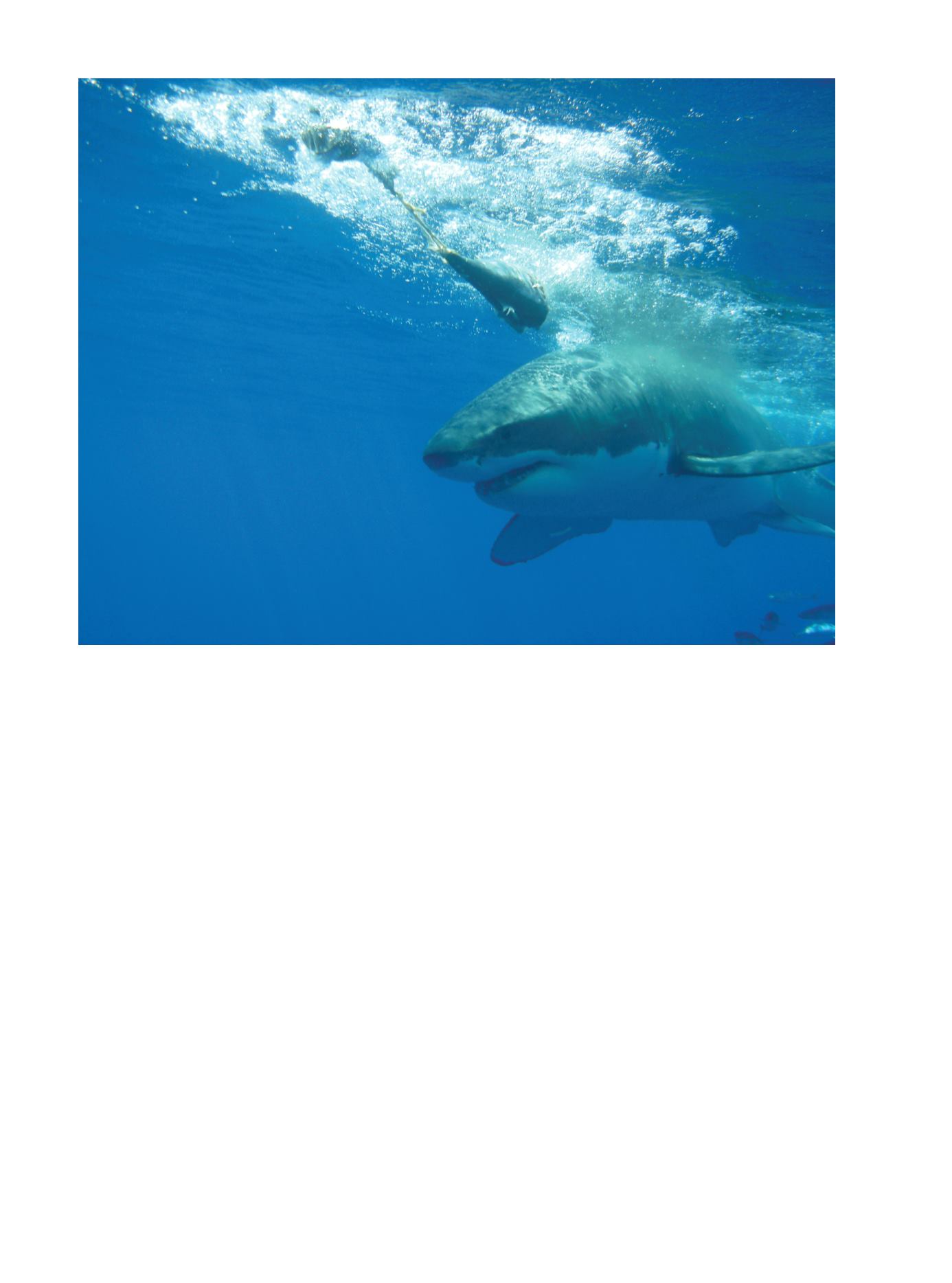
planeta azul •
blue planet
114
·amura·
Texto /
Text
• Foto /
Photo: Rodrigo Friscione / Anuar Heberlein / Armando Gasse / Rafa Nachón
W
hen we hear the word ‘shark’, we feel
scared; we imagine this beautiful animal
as being evil and that waits for humans
to enter its domain to attack and bite chunks out
of them with its powerful jaws full of sharp teeth.
Much of these feelings are due to the box office
cinema productions such as ‘Jaws’.
Recently during my career as a marine photog-
rapher, I have visited many places in the world in
search of these famous sharks, which are ever
more scarce due to indiscriminate fishing (more
than 100 million sharks are caught each year)
causing them to rapidly disappear from the ocean
depths.
The white shark is perhaps themost renowned
of all as it is the star of many movies and docu-
mentaries. Up to very recently, it was thought that
we could only observe the species in the far-off
seas of South Africa and Australia. So you can
C
uando escuchamos la palabra “tiburón” senti-
mos miedo, nos imaginamos a este bello ani-
mal como un ser maléfico que está esperando
para abalanzarse sobre nosotros y despedazarnos
con sus poderosas mandíbulas, llenas de afilados
dientes. Mucho de este sentimiento se debe a las
grandes producciones cinematográficas, como
Tiburón
. En los últimos años de mi carrera como
fotógrafo submarino he recorrido varios lugares del
mundo en busca de los famosos tiburones, los cuales
son cada vez más escasos, pues su pesca indiscrimi-
nada (se pescan más de 100 millones al año) está
haciendo que desaparezcan rápidamente de los fon-
dos oceánicos.
El tiburón blanco es quizá el más nombrado de
todos, pues es el protagonista de muchas películas y
documentales. Hasta hace poco tiempo se creía que
sólo lo podíamos observar en los lejanos países como
Sudáfrica y Australia. Grande fue mi sorpresa cuando
Isla Guadalupe,
territorio del tiburón blanco
White Shark Territory


