especies •
species
122
·amura·
estos delfines hace más de siete años y ya ha dado algu-
nos resultados, por ejemplo se descubrió que, como en
otros lugares donde se estudian, aquí también son resi-
dentes, es decir que no emigran y son fieles a su territo-
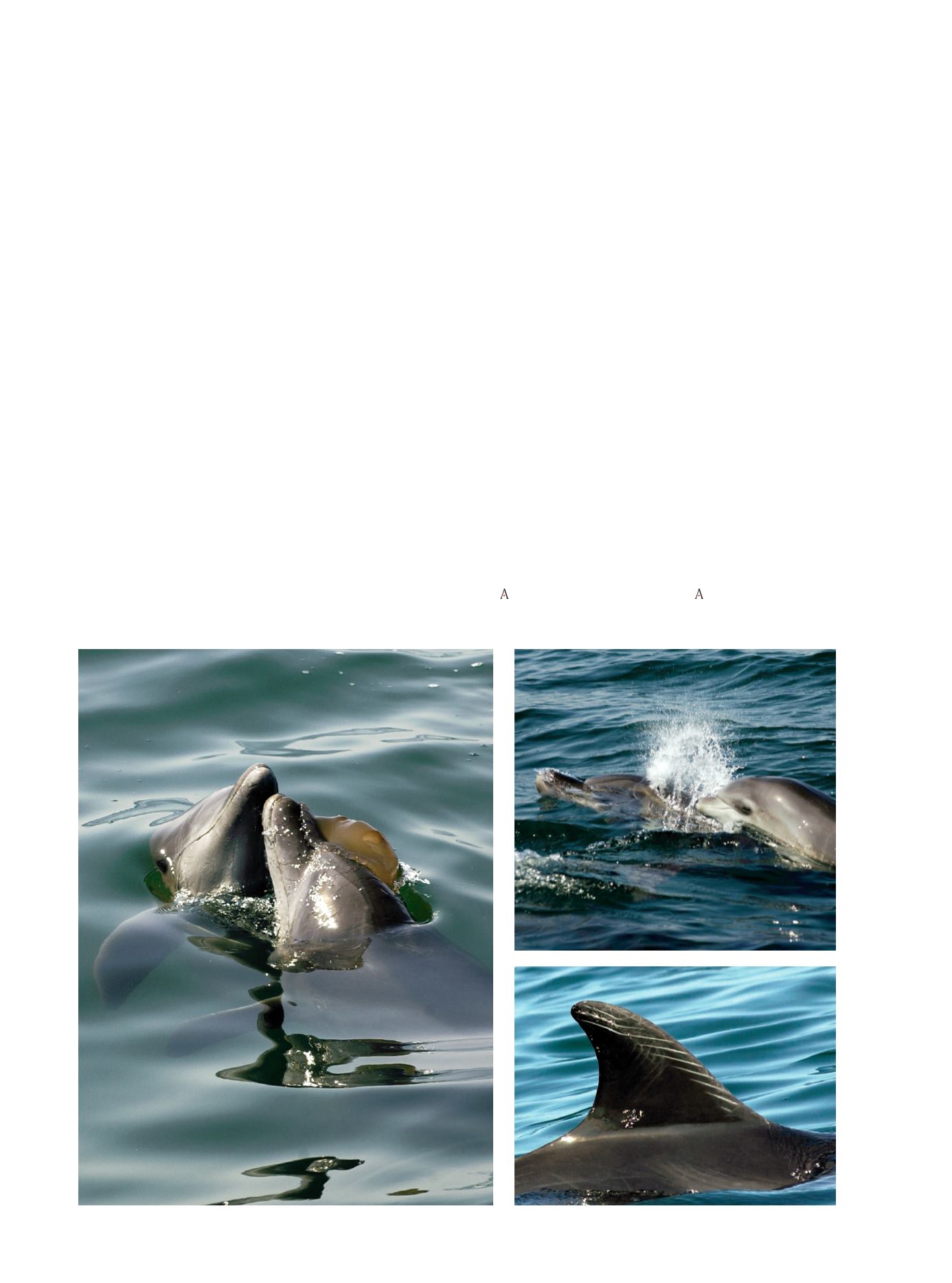
rio. Esto fue posible gracias a la foto-identificación, es
decir la identificación individual de los delfines, que se
logra fotografiando sus aletas dorsales en las que por su
forma y marcas representa un método tan eficiente como
el de las huellas digitales en nosotros.
Con estemétodo es como se ha descubierto que hay por
lo menos tres grupos distintos de la misma especie, con una
población de por lo menos 80 delfines en cada grupo. Se
empieza a conocer mejor cuál es el uso que le dan a las dife-
rentes áreas de la bahía y la interacción que tienen estos
grupos entre sí. Por ejemplo, durante seis años se ha segui-
do el desarrollo de algunas de sus crías para conocer cómo se
van integrando a la vida adulta de los delfines, esto desde
luego tomará mucho más tiempo debido a que los delfines,
como los humanos, tienen una larga infancia y adolescencia.
En algunos aspectos sus grupos familiares son como
los de los elefantes, en los que el núcleo del grupo lo com-
ponen hembras, crías y jóvenes, y los machos se mantie-
nen un poco al margen. Pero en otros aspectos son más
como los leones, en los que los machos son los responsa-
bles de mantener y proteger al grupo de hembras, espe-
cialmente de otros machos de diferentes grupos. Sin
embargo, es difícil describir todas sus actividades y con-
ductas debido a que la mayoría ocurre bajo el agua lejos
de las miradas de los investigadores, así pues toma
mucho más tiempo estudiar delfines que otros animales.
Pero con el fin de entenderlos y conservarlos mejor es
necesario continuar con este tipo de estudios.
and has produced some results. For example, it was
discovered that, as in other places studied, that
they are residents here since they do not emigrate
and are faithful to their territory. This was possible
through individual photo-identification of the
dolphins and was achieved by photographing the
marks on their dorsal fins that represent a way of
identification as efficient as fingerprints.
This method discovered that there are at least
three different groups of the same species, with a
population of a minimum of 80 dolphins in each
group. Researchers learned how the dolphins use
each area of the bay and how the groups interact
with each other. For example, the development of
some of the young was followed to see how they
integrate into adult life, which takes a long time
because dolphins, like humans, have a long infan-
cy and adolescence.
In someways, their family groups are like groups
of elephants, inwhich there is anucleus composed of
females, babies and young dolphins, while themales
remain on the margin. In some other aspects, they
are more like lions, where the males are responsible
formaintaining and protecting the group of females,
especially from the males from other groups.
However, it is difficult to discover all their activities
and behavior because most of their conduct occurs
underwater far from the view of the researchers, as
well as the time it takes to studydolphins as opposed
to other animals. But in order to understand and con-
serve them better, it is necessary to continue with
these kinds of studies.


