toys collection ›› business jets
82
·amura·
W
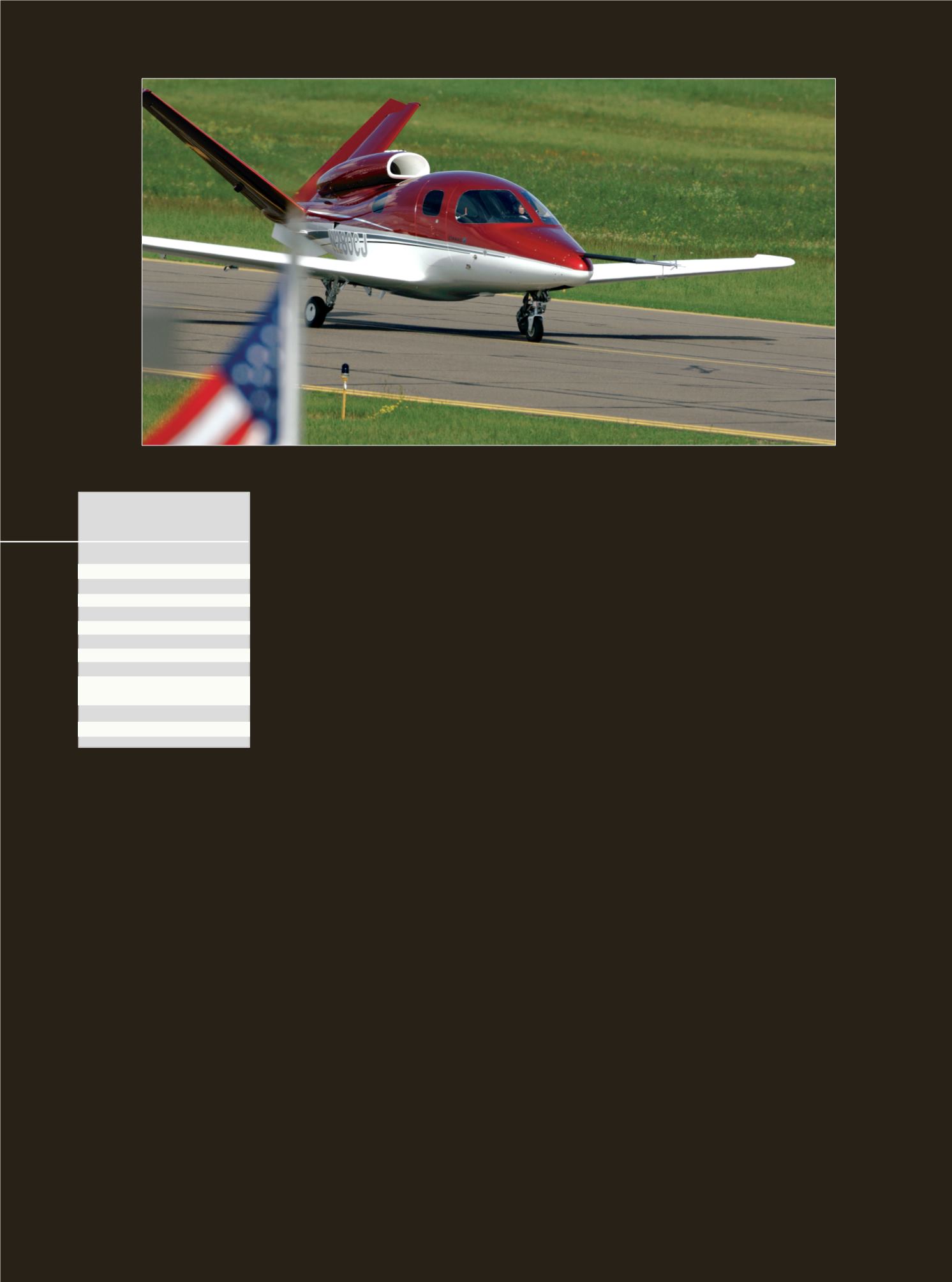
ith a new name, the American company
Cirrus Design Corporation celebrated the
first flight of the Cirrus Vision SJ50, a per-
sonal jet previously known as “The Jet”.
The Cirrus Vision SJ50 is slightly over the VLJ
(Very Light Jet) category on the interior’s space,
also its efficiency in gas consumption due to its
engine mounted on the rear end, outside the fuse-
lage’s structure, characterized by its V shape, and
the seat’s flexibility having space for up to seven
passengers. It also has the latest in new genera-
tion avionics and flight systems, and all the safety
attributes associated with Cirrus.
This first 45 minutes flight was the result of
the work of over 125 engineers and technicians
who made possible this plane could fly.
With the successful opening flight, the next
phase of the program is initiated, that will support
the rigorous certification program from the FAA
(Federal Aviation Administration). To this date this
plane has over 120 test hours.
Everything Kept as a Secret
In 2007, before the presentation of the Cirrus
Vision SJ50’s scale model, a group of clients was
invited to be part of a selected group of people who
would be the first ones to posses the new models.
Each of the clients gave a 100 thousand dollars
check; which was used to finance this project.
During previous months to the presentation, the
company was completely hermetic in reference to
the project, and only those who worked directly
where up to date in the matter. The rest of the
employees found out about the jet only a few hours
before its presentation in Duluth, Minnesota.
Spherical Design
This model can fit one pilot and four passen-
gers, one sited next to the pilot and the rest in 3
central seats. The spherical design of the pres-
surized cabin can comfortably fit up to seven
passengers, with a flexible seat configuration of
5 plus 2 when including a pair of child seats. The
central seat can be slided and lifted; the child
seat can also be lifted for a larger space for the
legs or for placing objects.
C
on un nuevo nombre, la constructora estadou-
nidense Cirrus Design Corporation celebró el
primer vuelo del Cirrus Vision SJ50, un jet per-
sonal conocido anteriormente como “The-Jet”.
El Cirrus Vision SJ50 sobrepasa el espacio inte-
rior de un modelo de la categoría VLJ (Very Light Jet),
además de su eficiencia en el consumo de combusti-
ble, por su motor montado en la parte posterior
fuera de la estructura del fuselaje caracterizado por
el estabilizador en forma de V, además de la flexibili-
dad de los asientos al tener cupo para siete pasaje-
ros. Además, posee lo más avanzado en aviónica de
última generación y sistemas de vuelo, y de todos
los atributos de seguridad asociados con Cirrus.
Este primer vuelo de 45 minutos fue el resultado
del trabajo de un equipo de más de 125 ingenieros y
técnicos, que lograron que este hito volara.
Con el exitoso vuelo inaugural se inicia la siguiente
fase del programa, que apoyará el riguroso programa de
certificación de la FAA (Federal Aviation Administration).
Ha sumado más de 120 horas de prueba.
Todo bajo secreto
En 2007, antes de la presentación de la maqueta
de lo que sería el Cirrus Vision SJ50, un grupo de
clientes fue invitado a formar parte del selecto grupo
de personalidades que poseerían los primeros mode-
los. Cada uno extendió un cheque por 100 mil dóla-
res, lo cual sirvió para financiar el proyecto.
Durante los meses previos a la presentación, la
compañía mantuvo total hermetismo respecto al
proyecto y sólo quienes trabajaron directamente
estuvieron al tanto de él. Los demás empleados de la
compañía supieron del jet unas horas antes de la pre-
sentación oficial en Duluth, Minnesota.
Diseño esférico
El modelo tiene cabida para el piloto y cuatro pasa-
jeros, uno de ellos al lado del piloto y tres asientos
centrales. El diseño esférico de la cabina presurizada
alberga cómodamente hasta siete pasajeros, con una
flexibilidad de configuración de asientos de “5 más 2”,
al incluir un par de pequeños asientos para niños.
Datos Técnicos
Tripulación
1+4 (+2 niños)
Motor
Williams International FJ33-4A-19
Velocidad crucero
555 km/h (345 mph, 300 nudos)
Altitud máxima
25,000 pies
Rango meta
1,852 km (1,000 millas náuticas),
con carga media
Seguridad
Cirrus Airframe Parachute System


