
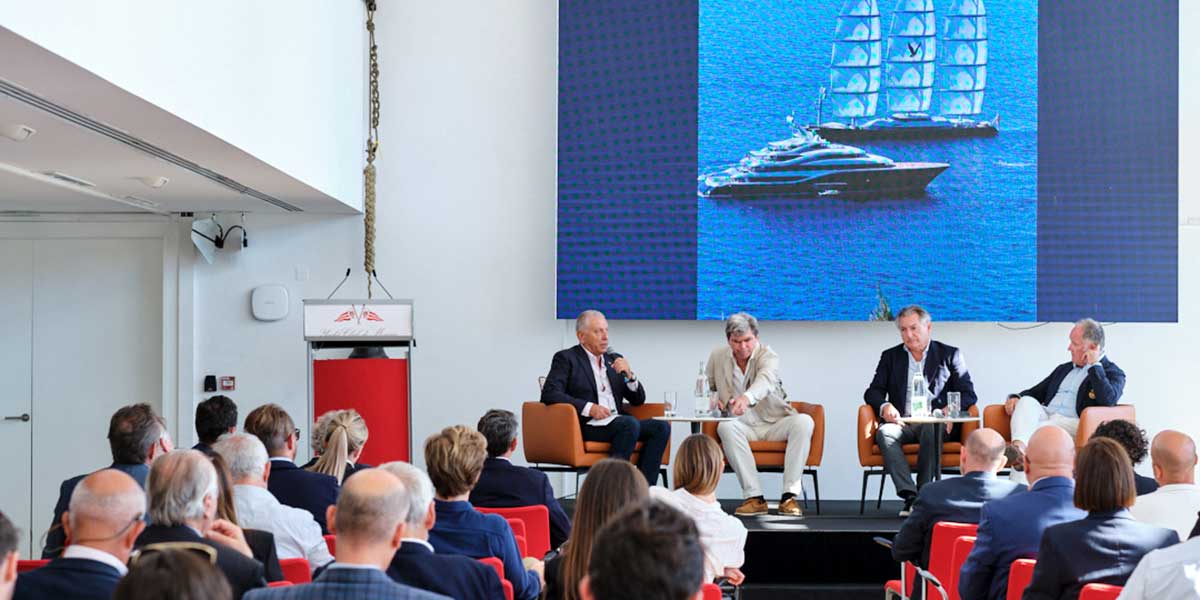
Market trends, with topics ranging from geopolitics to the economic impact and the future of sailing superyachts were presented at the Winter Pop-Up, organized by the Cluster Yachting Monaco, which attracted close to a hundred professionals (agents, captains, owners and companies) to the Yacht Club de Monaco.
The panel, chaired by Rachel Fisher (JMS Yachting), analyzed the tangible impacts of the geopolitical climate on the market, including customs tariffs, international sanctions, compliance restrictions, inflation and geopolitical instability, and highlighted new areas of development. Omer Malaz, founder of Numarine, identified the Red Sea, specifically Saudi Arabia and Egypt, while noting that Europe and the United States remain priority markets for now. Saudi Arabia is investing heavily in marinas, infrastructure and destinations, with the aim of building a comprehensive nautical ecosystem. This is a development that will take 10 to 15 years, according to Maxwell Andrews, executive advisor at Monaco House Saudi Arabia. but it is already creating opportunities for international companies and experts.
The geography of shipbuilding is also changing. As Turkey moves up the market and competes more effectively on quality, the price gap between its shipyards and European ones is narrowing: “I think that in the near future, shipbuilding will shift to the East,” predicts Omer Malaz, citing Turkey, Dubai and Poland.
The nautical sector of Monaco under the magnifying glass of IMSEE
The latest statistics from IMSEE, Institute of Economic and Statistical Studies of Monaco, were highly anticipated. Pascal Ferry and Benjamin Cauquil presented the results of the maritime economy and the nautical industry of the Principality.
Key indicators show growth in a sector that currently generates €659.7 million in revenue (excluding financial and insurance activities), 16.3% more than in 2022.
It comprises 475 establishments (+15.6%) and generates 1,495 jobs (+4.6%), a growth that significantly exceeds that of the Monegasque economy as a whole.
A detailed analysis reveals that wholesale trade remains the main contributor, generating €361 million in revenue in 2025. Professional, scientific and technical activities also stand out, with an increase of more than 30% in the number of establishments in these categories in three years.
The future of large sailing superyachts
In the final session, the focus was on sailing. While reducing environmental impact is a crucial issue for the yachting industry, sailing superyachts still represent a small minority compared to motor yachts. The panel, chaired by Carlo Torre (CEO of MYT), brought together Germán Frers Jr. head of design at Frers Naval Architecture), Burak Akgül (CEO of Turquoise Yachts) and captain Pascal Berger of the S/Y Atmosphere, a yacht certified by the SEA Index, a pioneering initiative to evaluate and reduce the environmental footprint of pleasure craft.
The price remains one of the main obstacles. Twenty years after the S/Y Maltese Falcon project, discussions highlighted the impact of rigging costs on the sailing superyacht market. The search for greater performance has increased costs, sometimes to the point of discouraging some projects.
Owners spend more time on board and want more space, stability, deck terraces and direct access to the sea. To compete with large motor yachts, sailboats must evolve to meet these expectations. Comfort is essential, as illustrated by the owner of the S/Y Atmosphere, who lives on board “at least five months a year,” says Pascal Berger, and “would like to stay there all year round.”
The carbon footprint is also an important factor. For some owners, the desire to reduce their impact has become the main reason for choosing boating. However, it's not just about the design of the boat. The conversations also highlighted the lack of nautical knowledge among the new generation of professionals, particularly agents and crew members, which presents a real challenge for a market that requires greater technical expertise. Still, despite costs, complexity and a more specialized market, the passion for sailing remains deeply rooted.
As proof, Burak Akgül highlighted the owners who continue to commission custom projects, even if it means spending huge sums to build a replica of a 120-year-old ship, an effort driven by passion, since “it has to be sustainable because it is something extraordinary,” he said.