
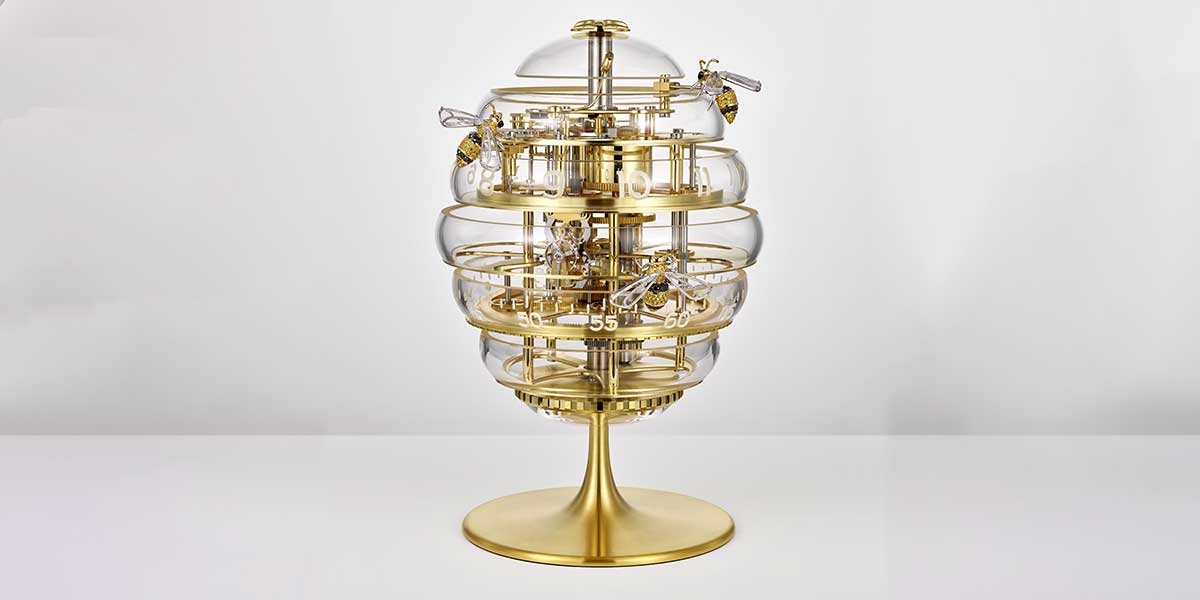
The Beehive Table Clock stands as a direct expression of the values that form the essence of Chopard Manufacture: energy, precision, and collective savoir-faire.
This symbolism was revived in 1996 when Karl-Friedrich Scheufele chose the bee as the emblem for Chopard Manufacture in Fleurier, paying tribute to the legacy of Louis-Ulysse Chopard, who had already used the beehive motif in the 19th century. On early pocket watches, beehives were delicately engraved onto movement bridges and hunter-style cases.
Today, the beehive also holds contemporary significance as a symbol of environmental responsibility, given the essential role bees play in natural ecosystems. This symbolism takes tangible form at Chopard Manufacture Fleurier—specifically in the gardens of the Forum Chopard, which are home to actual beehives.
All these meanings come to life in the Beehive Table Clock, starting with its crystal rings; these are curved on both their inner and outer surfaces to evoke the silhouette of traditional hives used in medieval European beekeeping. Unlike the precise geometry of natural honeycomb cells, these handcrafted hives—shaped like inverted baskets—bore the unique imprint of the artisans who fashioned them by hand.
 The Beehive Table Clock embodies the values that constitute the essence of Chopard Manufacture.
Sharing a unified aesthetic, both the brass movement plates and the steel base are gilded to evoke a hive brimming with honey—nature’s most diligent workers' golden treasure, renowned for its resistance to decay, rendering it virtually eternal. Standing 25.8 cm tall with a diameter of 16.5 cm at its widest point, the Colmena (Beehive) Table Clock consists of seven tiers of rounded glass rings arranged around a multi-bridge mechanical movement supported by a reinforced galvanized steel base. Borosilicate glass was chosen for its exceptional clarity, thermal resistance, and hardness. To preserve the pristine quality of the rings' outer surfaces, the hour and minute markers are engraved on the inside, with a matte finish ensuring optimal legibility.
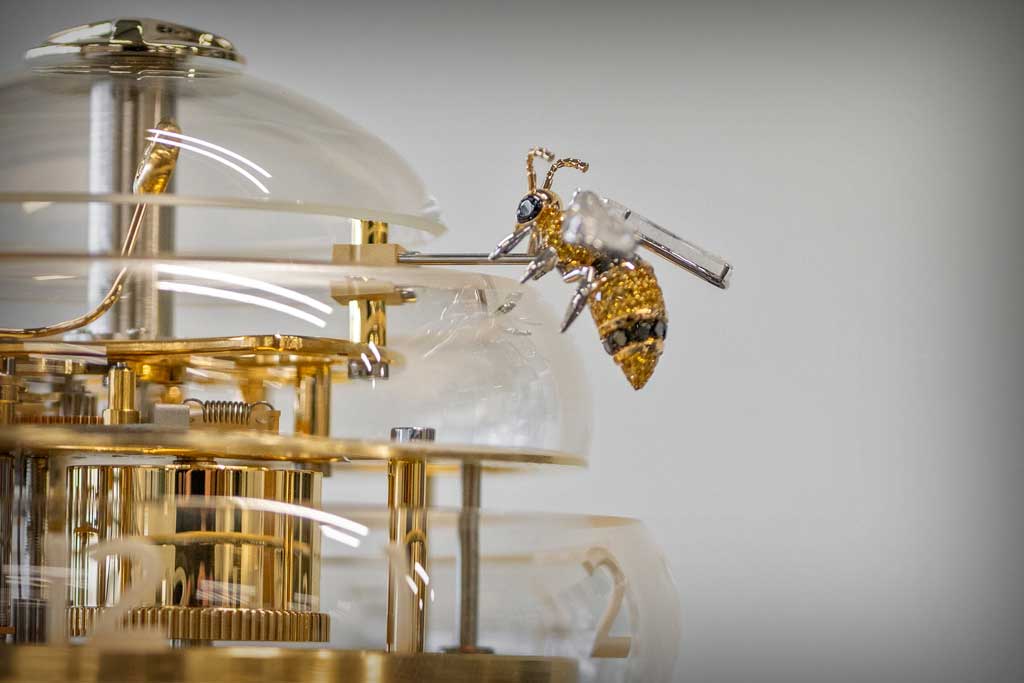
The clock’s exterior is adorned with three bees crafted from ethical 18-carat yellow gold, symbolizing the three generations of the Scheufele family. They are handmade in Chopard’s Fine Watchmaking workshop in Geneva. Each bee is cast using the traditional lost-wax technique, then meticulously hand-finished and set with alternating rows of yellow sapphires (6.45 carats) and black diamonds (6.29 carats) to form the stripes of the body, while black spinels (3.06 carats) form the eyes.
Their translucent wings, featuring veins set with brilliant-cut diamonds, are sculpted from rock crystal—a natural mineral chosen to evoke the Cannes Film Festival’s Palme d’Or, which has been crafted in the same workshop since 1998. Beyond their symbolic and decorative value, the bees serve a functional purpose. Two are positioned so that their stingers act as precise markers for the hours and minutes displayed on the rotating glass rings. The third bee perches near the top of the clock, its head pointing toward the active striking mode indicated by the selector.