



 109 / 142

·amura·
107
velas • Sails
I
t was on the 28th of August, 1926, when
sir Francis Chichester, sixty-five year
old aviator, navigator, and entrepreneur
(September 17th, 1901 -- August 26th,
1972), set out on the first attempt to sail
the world’s oceans on a solo trip aboard the 49-
foot Ketch sailing boat, names the “Gipsy Mothy
IV.” A boat specifically designed for this voyage, it
made its first and only stop in Sydney, Australia.
It’s important to remember that in that time, the
Suez and Panama Canals had yet to be built, and
so the quickest and most direct route was to to sail
the Southernmost point of the Atlantic Ocean via
the Equator, circling the Cape of Good Hope, navi-
gating vast swaths of the Arctic Ocean, crossing
through Cape Horn, and head back into the Atlan-
tic Ocean. A route that was considered the most
difficult as well as most dangerous, as it implies
spending long amounts of time at sea, far away
from the coasts and any rescue services. Today, it is
still considered as a supremely challenging route,
despite the advances in communication, naviga-
tion, naval constructions, and security.
50 years of prowess from sir Francis
Chichester, the lord of the seas.
C
orría el día 28 de Agosto de 1926 cuan-
do sir Francis Chichester, aviador, na-
vegante y empresario (septiembre 17,
1901-agosto 26, 1972) de 65 años de
edad, emprendía el primer intento de re-
correr los mares del mundo en solitario a bordo de su
velero Ketch de 16 m de eslora, llamado
Gipsy Mothy
IV
, especialmente diseñado para este viaje, zarpando
del puerto inglés de Plymouth.
Después de 107 días de navegación, hizo su prime-
ra y única escala en Sydney, Australia. Es importante
recordar que en esta época aún no se habían construi-
do ni el canal de Suez y ni el de Panamá, por lo que la
ruta más rápida y directa era tomar el sur del Océano
Atlántico a través del Ecuador, rodear el Cabo de Buena
Esperanza, navegar una gran parte del Océano Antárti-
co, cruzar Cabo de Hornos y volver a retomar el Océa-
no Atlántico. Una ruta considerada como la más difícil
y peligrosa. Pues implica un largo tiempo en alta mar,
lejos de las costas y de cualquier servicio de rescate. En
la actualidad sigue considerándose de gran dificultad a
pesar de los avances en la comunicación, navegación,
construcción naval y seguridad.
1
2
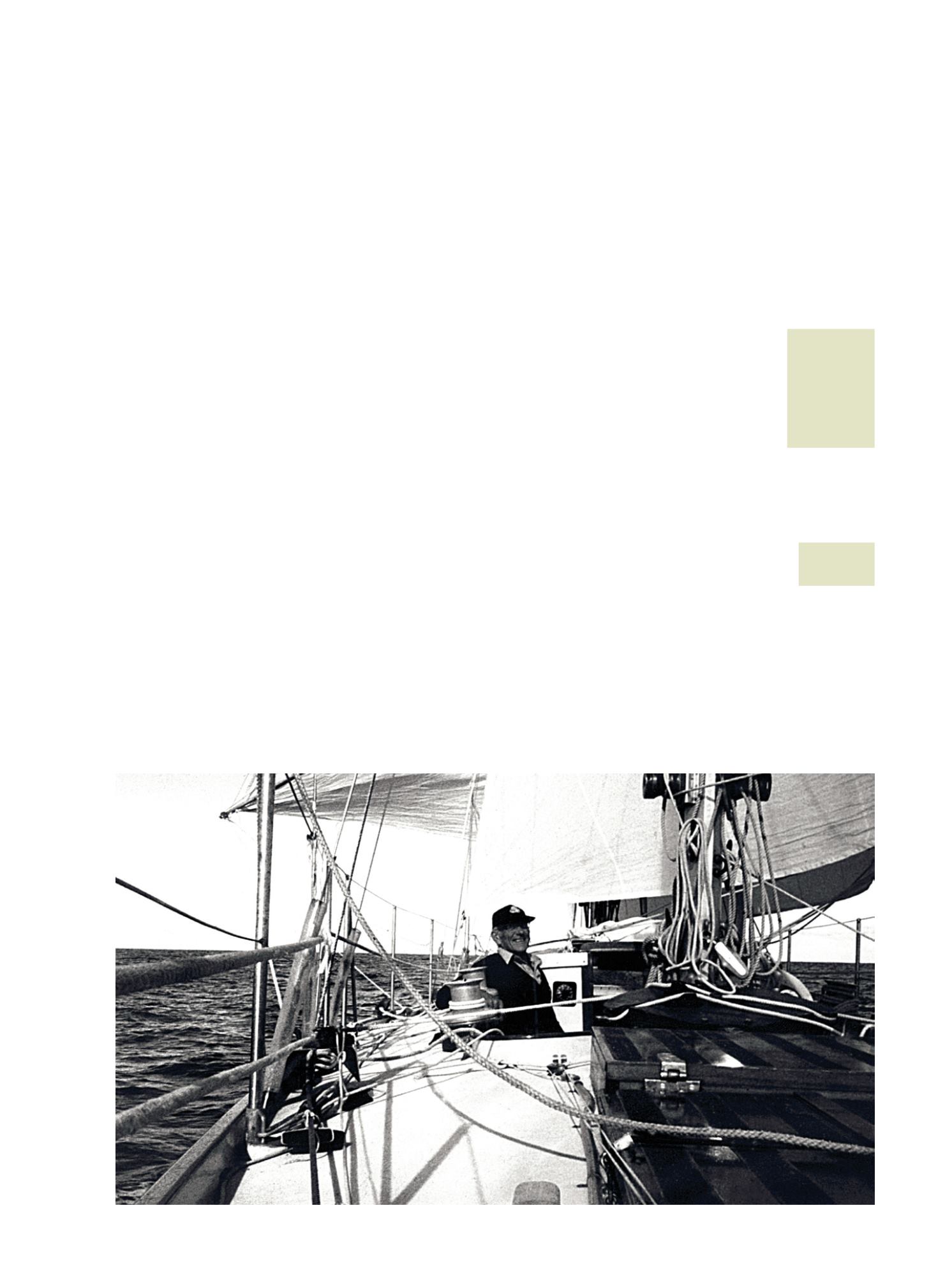
1.ElGipsyMonthy IV
rodeandoelCabode
Hornos./
Gipsy Moth IV'
rounding Cape Horn
.
2.SirFrancis
Chichesterabordodel
GypsyMonth IV./
Sir
Francis Chichester
onboard 'Gipsy
Moth IV.