·amura·
134
QMBOetB B[VM •
blue planet
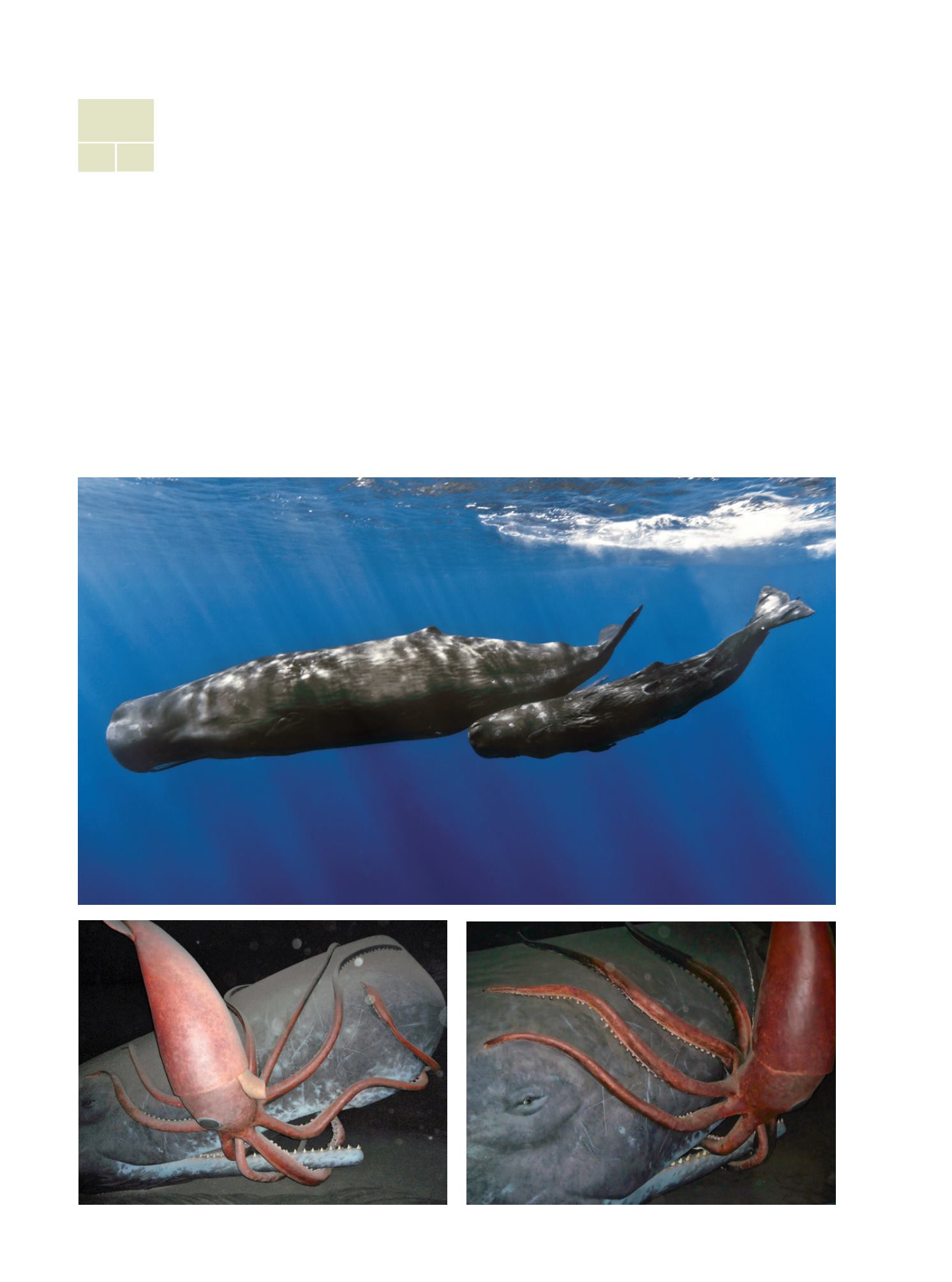
También es el depredadormás grande delmundo,
su alimentación está compuesta por peces, angui-
las y calamares. Se sospecha que sostiene batallas a
grandes profundidades con el calamar gigante, por
las marcas de ventosas que han sido encontradas en
diferentes especímenes. Asimismo, se encuentran
registros de haber encontrado un calamar gigante de
19metros ymedio, en el estómago de un cachalote.
Estas ballenas son un mamífero marino que no
tiene branquias, por ello emergen y ponen su ori-
ficio respiratorio en contacto con la atmósfera. De
esta forma, emiten un potente chorro de agua que
puede llegar a los cinco metros de altura, y poste-
riormente llenan sus pulmones de aire para poder
realizar prolongadas inmersiones, que pueden du-
rar hasta dos horas. Antes de hacer una inmersión
prolongada, el cachalote oxigena su organismo con
repetidas inhalaciones.
It is also the world’s biggest predator, their
diet comprises fishes, eels and squids. It is sus-
pected that it holds battles at great depths with
the giant squid, this is due to the sucker mark-
ings that have been found on different speci-
mens. Also, there have been records of finding
one giant squid of 19 and a half meters, inside a
sperm whale’s stomach.
These whales are a marine mammal that has
no gills, therefore they surface and get their
blowhole in contact with the atmosphere. In
this way, they eject a powerful water jet that can
reach up to 5 meters in height, and then they fill
up their lungs with air in order to be able to carry
out their long immersion dives, that can last up
to two hours long. Before taking a long immer-
sion dive, the sperm whale oxygenates its own
organism with repeated inhalations.
7.Estemamífero
marinosecomunica
consonidospara
detectarasus
presasagrandes
profundidades./T
his
marinemammal
communicateswith
soundstobeable
todetectitspreyat
greatdepths.
8y9.Calamargigante
ycachalote luchando
en lohondodel
océano./
Giantsquid
andcachalotfighting
inthedepthsof
theocean.
7
8
9


