·amura·
135
Industria y comercialización
Estos animales han sido perseguidos a lo largo de la
historia. Su caza y comercialización inició en el si-
glo XVII, para aprovechar su aceite como lubricante
paramotores, la elaboración de velas y lámparas, así
como para la iluminación de puertos y calles, antes
de que se descubriera la luz eléctrica. Otro producto
muy codiciado era el ámbar gris, que es una sustan-
cia que se produce en los intestinos del animal y se
usa como fijador para perfumes.
Por su tamaño, el cachalote se convirtió en el prin-
cipal objetivo de los balleneros entre los siglos XVII y
XIX. No obstante, el incremento en la caza de estas ba-
llenas se elevó demanera desmesurada en el siglo XX,
casi en un promedio anual de 30,000; por tal motivo
en 1984, se unieron junto con otros cetáceos a la lis-
ta de animales protegidos por la Convención Sobre el
Comercio Internacional de Especies Amenazadas y en
Peligro de Extinción (CITES), la cual prohíbe la caza de
esta especie, excepto para investigaciones científicas.
Sin embargo, Japón, Noruega e Islandia presentaron
objeciones oficiales, por lo que estos países actual-
mente poseenuna industria ballenera.
El cachalote y el hombre
A pesar de las diferencias que la evolución ha ejercido
en mamíferos marinos y terrestres, ambos han alcan-
zado cierto nivel de desarrollo comparable. Como ma-
míferos, comparten con los seres humanos algunas
características similares como: glándulas mamarias
para amamantar a sus crías; un corazón de cuatro ca-
vidades que bombea sangre caliente; una corteza fina
que recubre lazonaexternadel cerebro; sietevértebras
cervicales y un aparato auditivo constituido por mar-
tillo, yunque y estribomuy similar al del hombre
.
10
Industry and trade
These animals have been pursued throughout his-
tory. Their hunting and trade began in the XVII
century, to exploit their oil as engine lubricant, to
be used in the making of candles and lamps, also
for ports and streets lighting, before electric lights
were developed. Another coveted product was the
ambergris, which is a substance produced in this
animal’s intestines and is used as a fixative agent
in perfumes.
Because of its size, the sperm whale became the
main target of whaling ships through the XVII and
XIX centuries. However, the raise of the hunting of
these whales grew out of control in the XX century,
almost to a yearly average of 30,000; because of this
in 1984, they joined along other cetaceans to the list
of protected animals by the Convention on Interna-
tional Trade in Endangered Species of Wild Fauna
and Flora (CITES), that forbids the hunting of this
species, with the exception of scientific research
purposes. In spite of this, Japan, Norway and Iceland
presented official objections and therefore these
countries currently maintain a whaling industry.
The spermwhale andman
In spite of the differences that evolution has exert-
ed on sea mammals and land mammals, both have
reached certain level of comparable development.
As mammals, they share with human beings some
similar features like: mammary glands to feed their
offspring; a four cavity heart that pumps warm
blood; a fine covering layer that surrounds the ex-
ternal zones of the brain; seven cervical vertebrae
and a hearing apparatus consisting of hammer, an-
vil and stirrup very much like the one of men.
QMBOetB B[VM •
blue planet
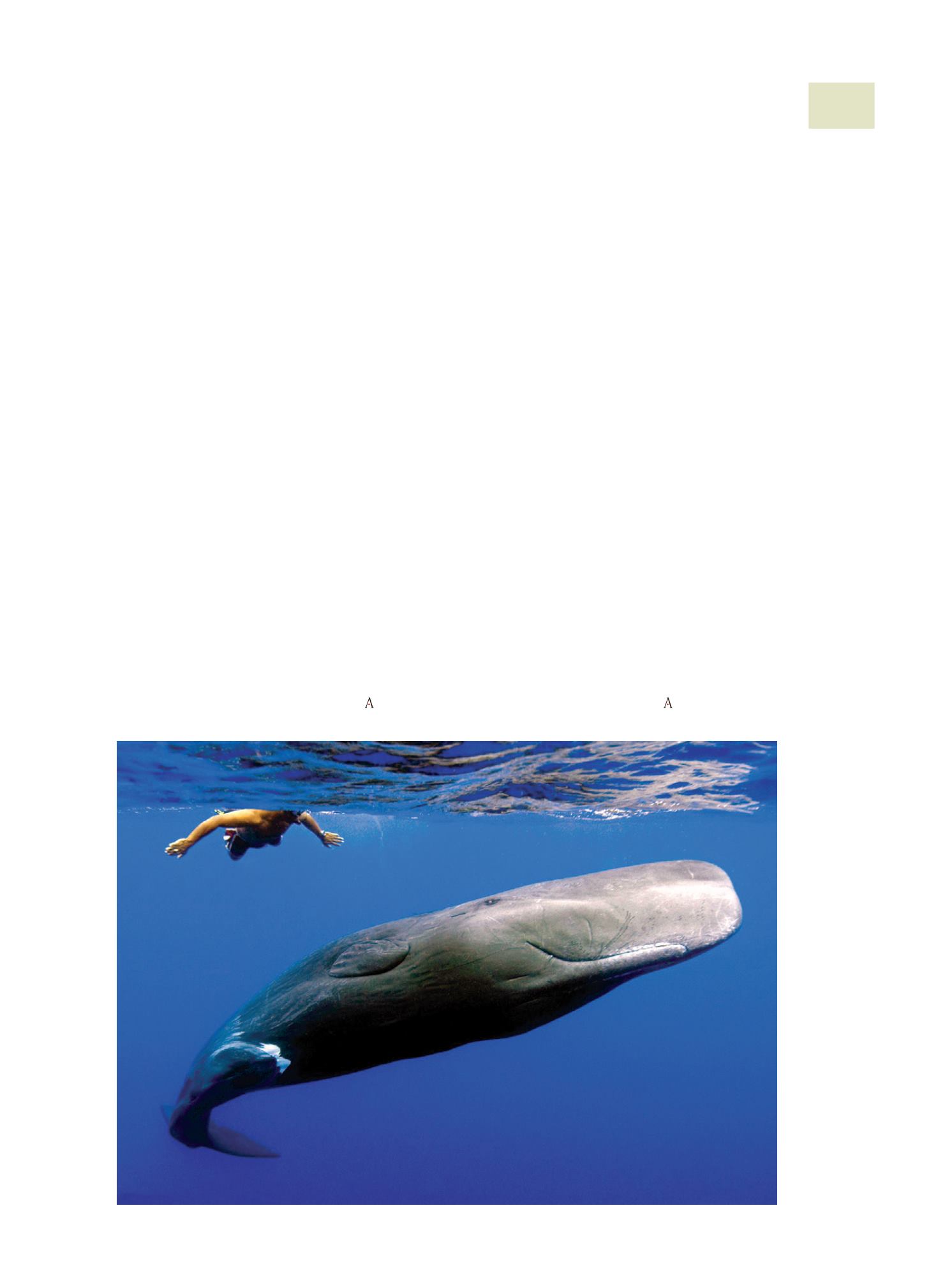
10.Escuriosover
laformaen laque
interactúanentre
ellos,ycómocuidan
de los jóvenesy los
lesionados./ I
tis
curioustoseehow
theyinteractwith
eachotherandtake
careoftheyoungand
disabledones.


