·amura·
132
QMBOetB B[VM •
blue planet
D
urante muchos años el cachalote for-
mó parte del folclore y de las leyen-
das de los marineros. Dos de estos
relatos, el primero sobre un ballenero
de Nantucket, Massachusetts que fue
atacado por una de estas ballenas en 1820 y el se-
gundo sobre el avistamiento de un cachalote albino
quemerodeaba la isla deMocha en Chile, inspirarían
una de las novelas más célebres del siglo XIX,
Moby
Dick
de Herman Melville.
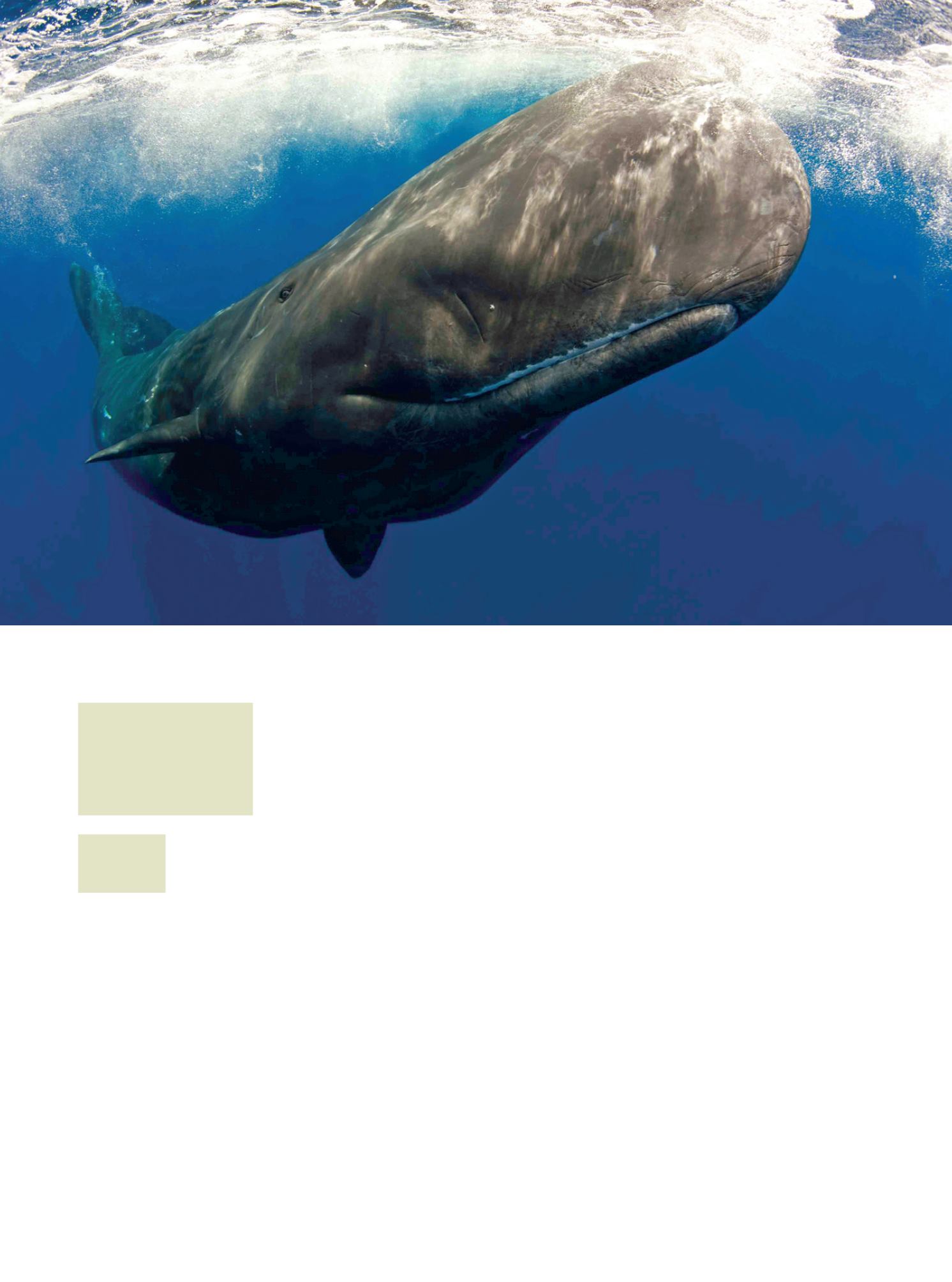
Los cachalotes son la especie de ballenas denta-
dasmás grande que existe. Se distribuye por todos los
océanos del planeta, sin embargo sólo a los machos
que ya han alcanzado la madurez se les suele ver con
más frecuencia por zonas frías. Esta especie puede su-
mergirse a grandes profundidades, los registros que
se tienen de mayor profundidad de una inmersión es
de aproximadamente 1,000 m, aunque se piensa que
pueden alcanzar los 3,000mbajo el nivel delmar.
Es uno de los grandes cetáceos presente práctica-
mente en todas las aguas del mundo, normalmente
se reproducen entre las costas de Argelia e Italia. Sin
embargo en los últimos años sus avistamientos son
más esporádicos a causa del impacto de las redes de
deriva situadas en Italia, donde quedan atrapados
con facilidad. El cachalote es uno de los cetáceos con
distribución más amplia por los océanos y latitudes
de todo el mundo, sólo superado por la orca. En fecha
reciente, en el Mar Caribe se conocen de más de 180
avistamientos de esta especie a la que también le
agradan las aguas de losmárgenes polares.
F
or many years the spermwhale was part
of the seaman’s folklore and legends.
Two of these tales, the first one about
a whale hunter from Nantucket, Mas-
sachusetts that was attacked by one of
these whales on 1820 and the second one about an
albino spermwhale that prowled around the Mocha
island in Chile, would inspire one of the most rec-
ognized novels of the XIX century, Moby Dick from
Herman Melville.
The spermwhales are the biggest species of the
toothed whales. It can be found all over the oceans
of the planet, nonetheless only the males that
have reached a mature age can be seen more fre-
quently around cold zones. These species can deep
dive into great depths, the records held of greatest
depth in a dive are for approximately 1,000 m, al-
though it is believed they can reach up to 3,000 m
under the sea level.
It is one of the biggest cetaceans is present
in all the seas of the world usually it reproduces
between the costs of Algeria and Italy. Nonethe-
less on recent years their sightings have become
scarcer due to the impact of the adrift fishnets
located in Italy, where they get easily caught.
The sperm whale is one of the most extensive
in the oceans and latitudes worldwide distribu-
tion, surpassed only by the orca. Recently, in the
Caribbean Sea known for more than 180 sight-
ings of this species which also pleasing polar
waters margins.
Texto/
Text
: XX • Foto /
Photo
: XX
1.Elnombre
científicodel
cachalotees
Physeter
macrocephalus
./
The
scientificnameof
thespermwhaleor
cachalotis
Physeter
macrocephalus
.
2.Las inmersiones
deestemajestuoso
cetáceoenelocéano
puedendurar
alrededorde90
minutos./
Thedives
ofthismajestic
cetaceanintheocean
canlastforabout90
minutes.
2
1


