119
·amura·
tor triangulates the image and establishes a rela-
tion with it, he becomes an operator. But in that
precise moment, when the memory is working
instead of perception; doubt, hesitation and
uncertainty appear.
We stare back at the original photograph loo-
king for the difference, the imperceptible trace
from the temporal flow. We inquire, without
knowing, memory failing, and the incapacity to
tell the difference.
Going through the series along the hall, a pic-
ture of a young person stands out, maybe a teena-
ger. It raises the uncertainty about its gender; it
could be a man, woman or an androgen.
The double picture shares with the landscape
the same mutation, change, of the temporal flow,
even if it’s imperceptible or not. The picture is con-
figured on the landscape as a part of a return, back
to the mud where life sprung in the first place.
The return of organic or inorganic material
animated or unanimated its continuous in
Roni Horn’s work.
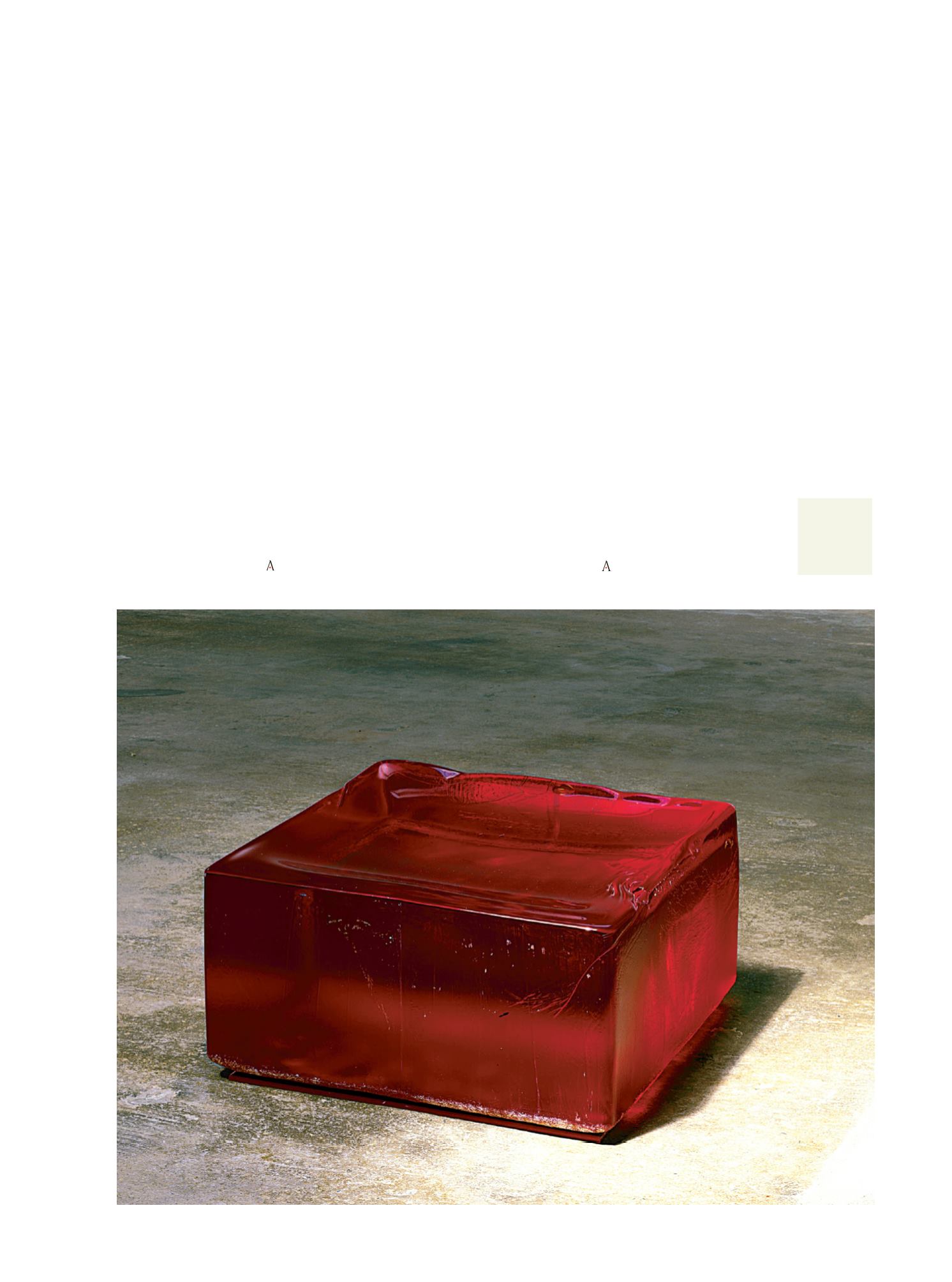
The exhibition unites the infinite showed on
the little things, on the imperceptible changes
on the material. Rubber, crystal, metal, paper
and photographs are the prime materials that
allow Roni Horn to transit through the picture
and the landscape, from writing to memory,
from weather to identity.
espectador triangula la imagen, establece una relación
gestáltica con la obra, se convierte en un operario. Pero
en ese preciso momento en que la memoria está fun-
cionando en el lugar de la percepción, aparece la duda,
la incertidumbre, la vacilación, el titubeo.
Uno vuelve la mirada a la fotografía original en
busca de la diferencia, del rastro imperceptible del
flujo temporal. Uno inquiere, aún sin saberlo, la
falla en la propia memoria, la incapacidad para
reconocer la diferencia.
Recorriendo la serie a lo largo de la sala de exhi-
bición, destaca el retrato de lo que parece ser una
persona joven, tal vez un adolescente. Incrementa la
incertidumbre sobre su género, bien podría ser hom-
bre, mujer o andrógino.
El doble retrato comparte con el paisaje el mismo
carácter perceptible o imperceptible de la mutación,
del cambio, del flujo temporal. El retrato se configu-
ra en el paisaje como parte de un mismo devenir, de
vuelta al fango de donde surgió la vida.
El devenir propio de la materia orgánica e inorgá-
nica, animada o inanimada entra en contigüidad a lo
largo del trabajo de Roni Horn.
La exposición reúne el infinito que asoma en las
pequeñas cosas, en los cambios imperceptibles de la
materia. Caucho, cristal, metal, papel y fotografía es
la materia prima que permite a Roni Horn recorrer el
tránsito que va del retrato al paisaje, de la escritura a
la memoria, del clima a la identidad.
1.
Untitled (Aretha) 2002-04
The Museum of Modern Art, New York; fractional
and promised gift of Kathy and Richard S. Fuld Jr.
© Roni Horn
Solid cast glass 15 x 30 x 30 in
(38.1 x 76.2 x 76.2 cm)
1


