101
·amura·
out to the streets to be photographed in night
clubs, shops and coffee shops.
His photographic job did not depend or was
subject to the volatile fashion world. He worked
also as a press photographer to the service of the
social causes and political events, which arouse
the sleepy conscience of the American society of
the 60’s and 70’s. He reported the Civil Rights
Movement in the United States, old slaves, pacifist
marches, and patients from psychiatric hospitals
victims of the napalm in Vietnam.
In the American West
The exhibition presents 40 impressions in large
format of the series “In the American West”, pro-
duced between 1979 and 1984, made by request of
the Amon Carter Museum of Fort Worth, in Texas.
The photographer wrote about it: “Beginning
in the spring of 1979 I spent the summer traveling
in the West, visiting truck stops, stockyards, walk-
ing through the crowds at a fair, looking for faces I
wanted to photograph. The structure of the project
was clear tome almost from the start and each new
portrait had to find its place in that structure. As
the work progressed, the portraits themselves
began to reveal connections of all kinds —psycho-
logical, sociological, physical, and familial—
among people who he had never met”.
The series “In the American West”, demystifies
the American West as the promised land of pio-
neers and conquerors, as Marta Gili point out,
director of the Jeu de Paume. However it leaves us
face to face with ordinary people: miners, oil well
workers, convicts, house wives, vagrants, trailer
drivers, farmers, waitresses, secretaries.
The photographs of this series were captured
outside the studio, placing his models on a white
background,whichthephotographer attached toany
building or to the side of a bus that was available.
tuario y salen a la calle a ser fotografiadas en clubes
nocturnos, tiendas y cafeterías.
Su trabajo fotográfico no se vio supeditado al
volátil mundo de la moda. Trabajó también como
foto-reportero al servicio de causas sociales y even-
tos políticos, que despertaron la adormecida con-
ciencia de la sociedad estadounidense de los años 60
y 70. Reportó el Movimiento por los Derechos Civiles
en Estados Unidos, antiguos esclavos, marchas paci-
fistas, pacientes de hospitales psiquiátricos, vícti-
mas del napalm en Vietnam.
In the American West
La exposición presenta 40 impresiones en gran for-
mato de la serie “In the American West”, producida
entre 1979 y 1984, por encargo del Amon Carter
Museum de Fort Worth, en Texas.
El fotógrafo escribió al respecto: “A principios de
1979 pasé los meses veraniegos viajando en el oeste,
visitando paradas de camiones, corrales, caminando
las ferias entre multitudes, buscando los rostros que
quería fotografiar. La estructura del proyecto me era
clara casi desde el principio y cada nuevo retrato debía
encontrar su lugar dentro de la estructura. Conforme el
trabajo progresaba, los retratos por sí mismos empe-
zaron a revelar conexiones de todo tipo—psicológicas,
sociológicas, físicas y familiares— entre gente que no
se había conocido nunca”.
La serie “In the American West”, desmitifica el
Oeste Americano como la tierra prometida de pione-
ros y conquistadores, como apunta Marta Gili, direc-
tora del Jeu de Paume. En cambio nos deja frente a
frente con personas ordinarias: mineros, trabajado-
res petroleros, presidiarios, amas de casa, vagabun-
dos, traileros, campesinos, meseras, secretarias.
Las fotografías de esta serie fueron captadas fuera
del estudio, posicionando a susmodelos sobre un fondo
blanco, que el fotógrafo sujetaba a cualquier edificio o al
costado de un camión que estuviera disponible.
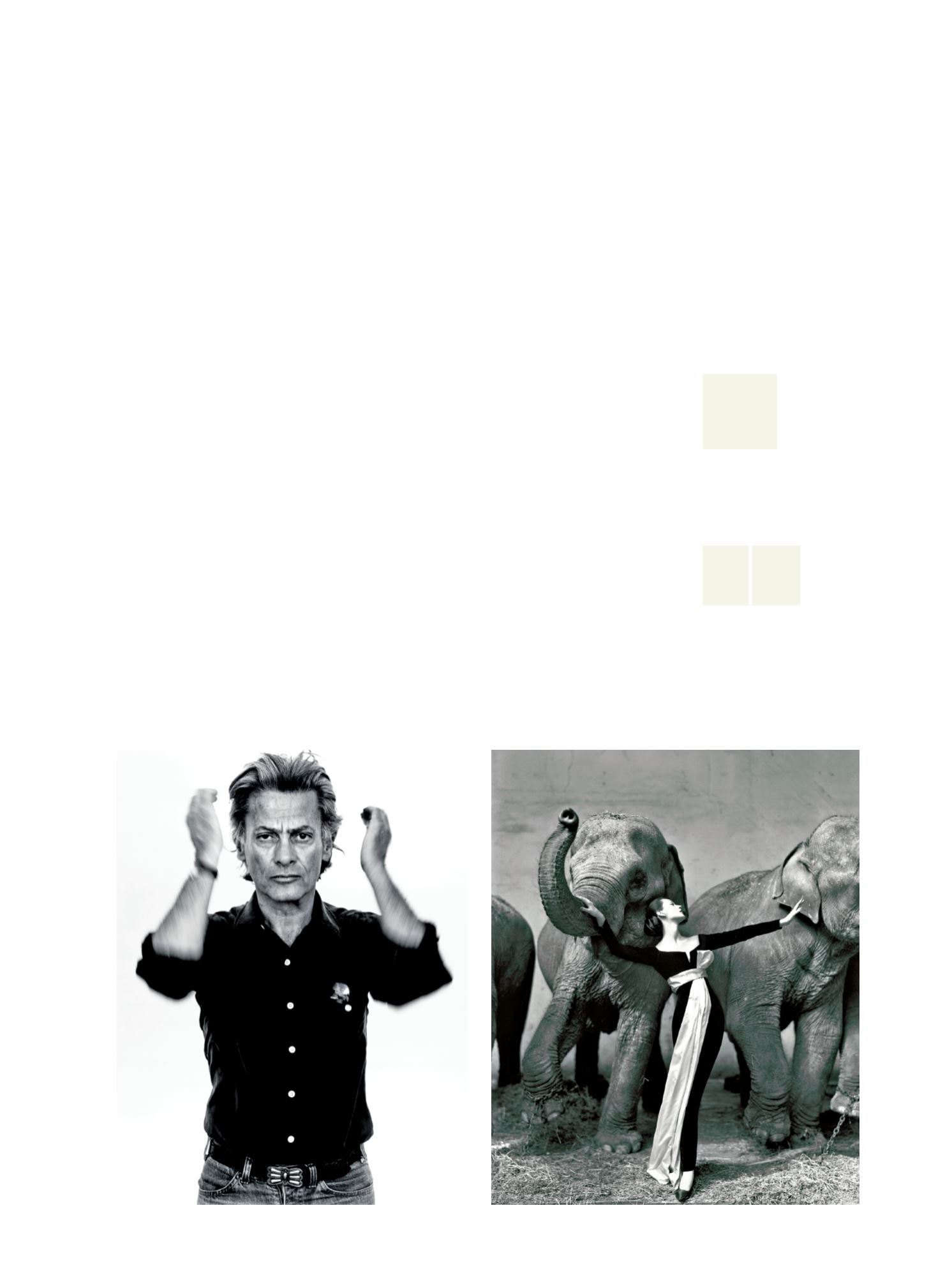
1.
Autoportrait
Provo, Utah, 20 août 1980
Richard Avedon
© 2008 the Richard Avedon Foundation
2.
Dovima et les éléphants
Robe du soir de Dior, Cirque d'Hiver
Paris, 1955
Richard Avedon
© 2008 the Richard Avedon Foundation
(Pág. anterior)
Suzy Parker and Robin Tattersall
Robe de Dior Place de la Concorde
Paris, août 1956
Richard Avedon
© 2008 the Richard Avedon Foundation
los conquistadores •
the conquerors
1
2


