


 57 / 184

·amura·
55
DomQgs Jnt • Jnt DomQass
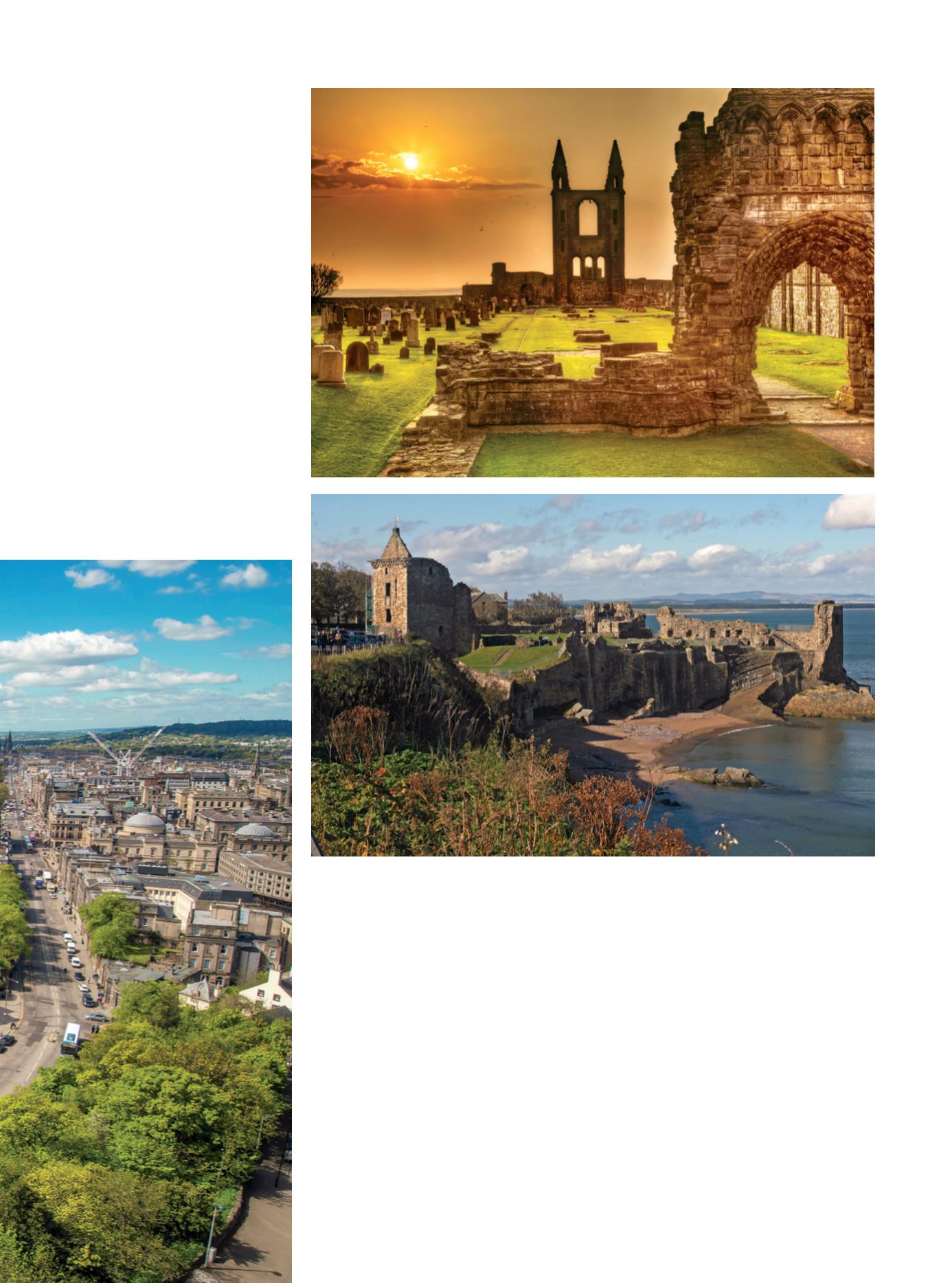
Tanto el castillo como la catedral se construye-
ron durante el siglo XII, época en que floreció el de-
sarrollo político, económico y social en Escocia, pues
miles de peregrinos devotos lle gaban a la ciudad de
St. Andrews para admirar las reliquias, con lo que se
consolidó como una de las ciudades más importantes,
cosmopolitas e influyentes de Europa. Luego, en el
siglo XV se fundó la primera universidad en Escocia,
que era además la tercera en todo el Reino Unido, sólo
después de Oxford y Cambridge. A partir de entonces,
toda construcción estaría ligada de alguna forma con
esta universidad, por lo que su legado se extiende mu-
cho más allá de su campus.
Los siglos XVI y XVII trascienden por la Reforma re-
ligiosa escocesa y la Guerra de los Tres Reinos, donde
las calles se llenaron de rebeliones y batallas que su-
primieron al poder religioso y cambiaron para siempre
la visión de la población escocesa.
The castle, as well as the cathedral, were built
in the XIIth century, a time in which the political,
social, and economic development of this land was
flourishing. Thousands of devoted pilgrims would
arrive to the city of St. Andrews to admire the rel-
ics, making the city a focal point of the Kingdom.
Later, in the XVth century, the first university in
Scotland—and third in the United Kingdom, after
Oxford and Cambridge—opened it’s doors. Since
then, all further constructions are in some way
linked to the university, and thus its legacy ex-
tends well beyond that of the campus itself.
The XVIth and XVIIth centuries transcend the
Scottish Reformation and the Wars of the Three
Kingdoms, a time where the streets were filled
with rebellions and battles that suppressed the re-
ligious powers, and changed forever the vision of
the Scottish people.