los conquistadores •
the conquerors
116
·amura·
Muñoz has been accused of being a storyteller.
There does seem to be a narrative in each work, but
what is certain is that the spectator who becomes
the narrator of his own fiction. This artist provides
clues, the scene, raises the curtain; what happens
next is up to us.
My fiction is as follows: from this room emer-
ges the unsuitability itself of the equivocation.
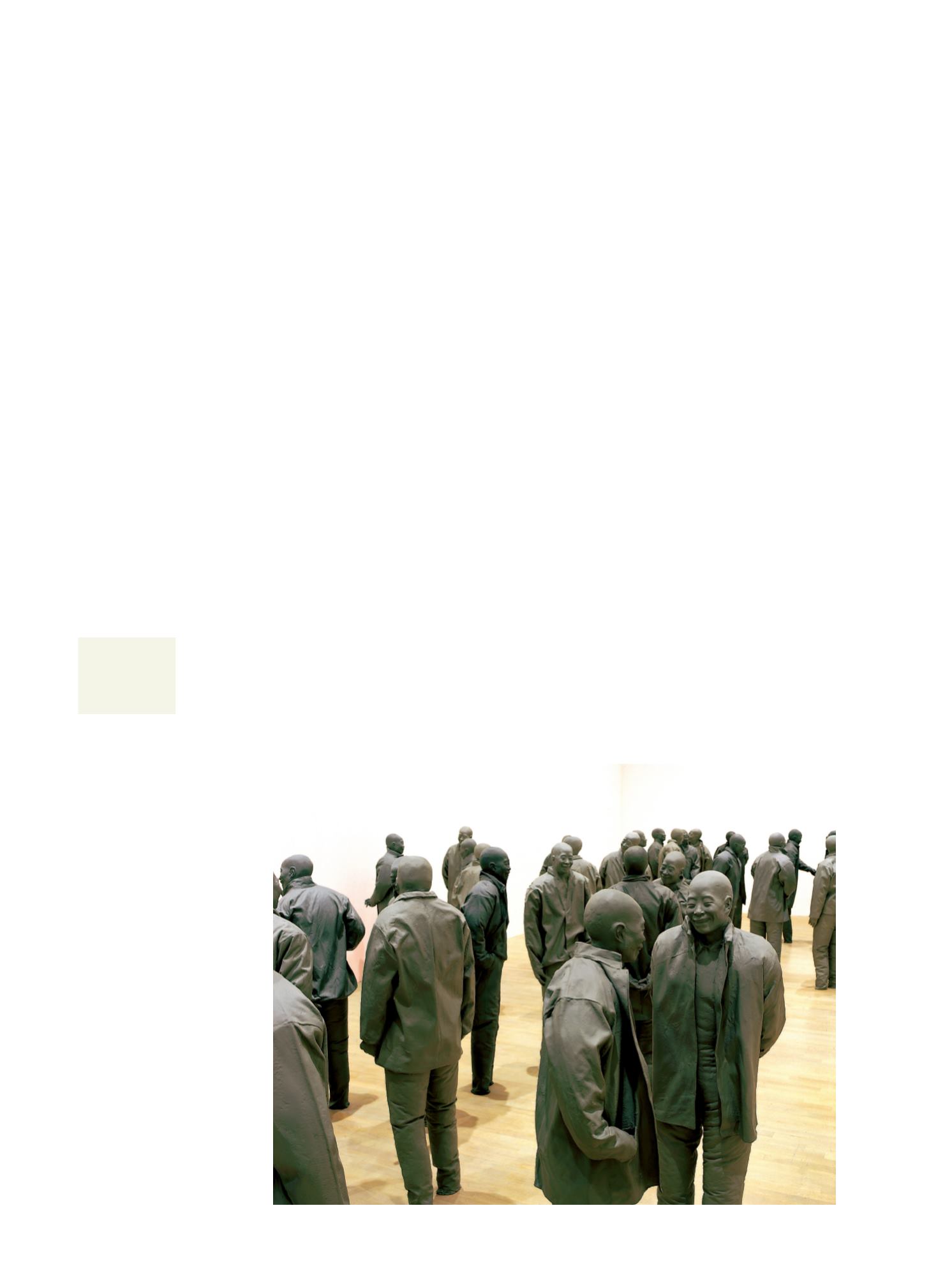
The monochrome figures in gray seem to mirror
themselves comfortably one to the other in a sor-
did silence, while the presence of the spectator
becomes a point of intolerable tension.
It is impossible for us to objetivize this multi-
tude in which we observe such similarity with our-
selves. The works feature characters of regular
stature, clothing that obeys a cultural code and
apparent non-verbal communication. It could deal
with any community of subjects and it would even
seem that we could decipher their gestures and if
so, we could share the same cultural plane.
However, there is an abyss between them and us.
We cannot recognize ourselves neither in nor
among them. This crowd to anthromorphic shapes
throws us to the other side of another plane. We
become “the others”. We become outsiders.
And that unsuitability to ourselves is the equi-
vocation generated by Muñoz’s work. As the artist
himself expressed “The spectator becomes very
much like the object to be looked at, and perhaps
the spectator has become the one who is on view”.
The artist achieves another formof equivocation
with the piece
Conversation Piece
(1996), which
represents a group of figures sitting on sacks that in
turn form their lower extremities. Two of the figures
are conversing, as the title of work suggests, while
the others seem to be paying attention balancing
from the status state towards the talkers. But again
there is uncertainty, confusion, ambiguity and false-
ness. Again, silence occupies the place of conversa-
Se ha acusado a Muñoz de ser un narrador de his-
torias. Y sí. Parece haber una narrativa en cada obra,
pero lo cierto es que el espectador es quien se con-
vierte en el narrador de su propia ficción. El artista da
las pistas, pone en escena, levanta el telón, lo demás
corre por nuestra cuenta.
Mi ficción es la siguiente: de esta sala surge la
inadecuación misma de lo equívoco. Las figuras
monocromas en gris parecen espejearse conforta-
blemente unas a otras en un silencio sórdido, mien-
tras que la presencia del espectador se convierte en
un punto de tensión intolerable.
Nos es imposible objetivar esta multitud en la
que advertimos tanta semejanza con nosotros mis-
mos. Se trata de personajes de estatura regular, ves-
timenta que obedece a un código cultural y una
aparente comunicación no verbal. Podría tratarse de
cualquier comunidad de sujetos, incluso pareciera
que podríamos descifrar sus gestos, y de ser así
compartimos el mismo sustrato cultural. Sin embar-
go, entre ellos y nosotros hay un abismo. No nos
podemos reconocer en ellos ni podemos reconocer-
nos a nosotros mismos entre ellos. Este abarrota-
miento de formas antropomórficas nos arroja del
otro lado de la otredad. Nos convierte en “los otros”.
Nos convierte en
outsiders
.
Y esa inadecuación a nosotros mismos es el equí-
voco que genera la obra de Muñoz. Como lo expresó
el artista: “El espectador se convierte en el objeto a
ser mirado y probablemente el observador se ha con-
vertido en lo que es observado”.
Otra forma de equívoco la logra con la obra
Conversation Piece
(1996), un grupo de figuras asenta-
das sobre costales que hacen las veces de extremida-
des inferiores. Dos de las figuras están conversando,
como lo anuncia el título de la obra, mientras que las
otras parecen poner atención y balancearse desde su
inmovilidad hacia los conversadores. Pero nuevamente
el desacierto, la confusión, la ambigüedad, lo falsario.
Muchas veces /
ManyTimes(detail)
1999
Private collection
© The Estate of JuanMuñoz


