los conquistadores •
the conquerors
114
·amura·
ing from the window of her parents’ fifth.-floor
apartment. Jeanne Hébuterne was in the last
months of pregnancy and left their small daughter
an orphan.
In 1906, he moved to Paris to be in contact with
the pioneers. His early work is influenced by
Fauvism
and
Cubism
and later his influences would
come from Cezanne, Brancusi, African art and from
his own incursion into stone sculpture; but
although it participated tangentially in the leading
edge, his work has a unique character that pre-
vents any –ism from being attached to it
.
Perhaps
for this, his work began share the particular quali-
ties of his style: the elongation of the stiff figure,
mainly the long necks and the slightly inclined
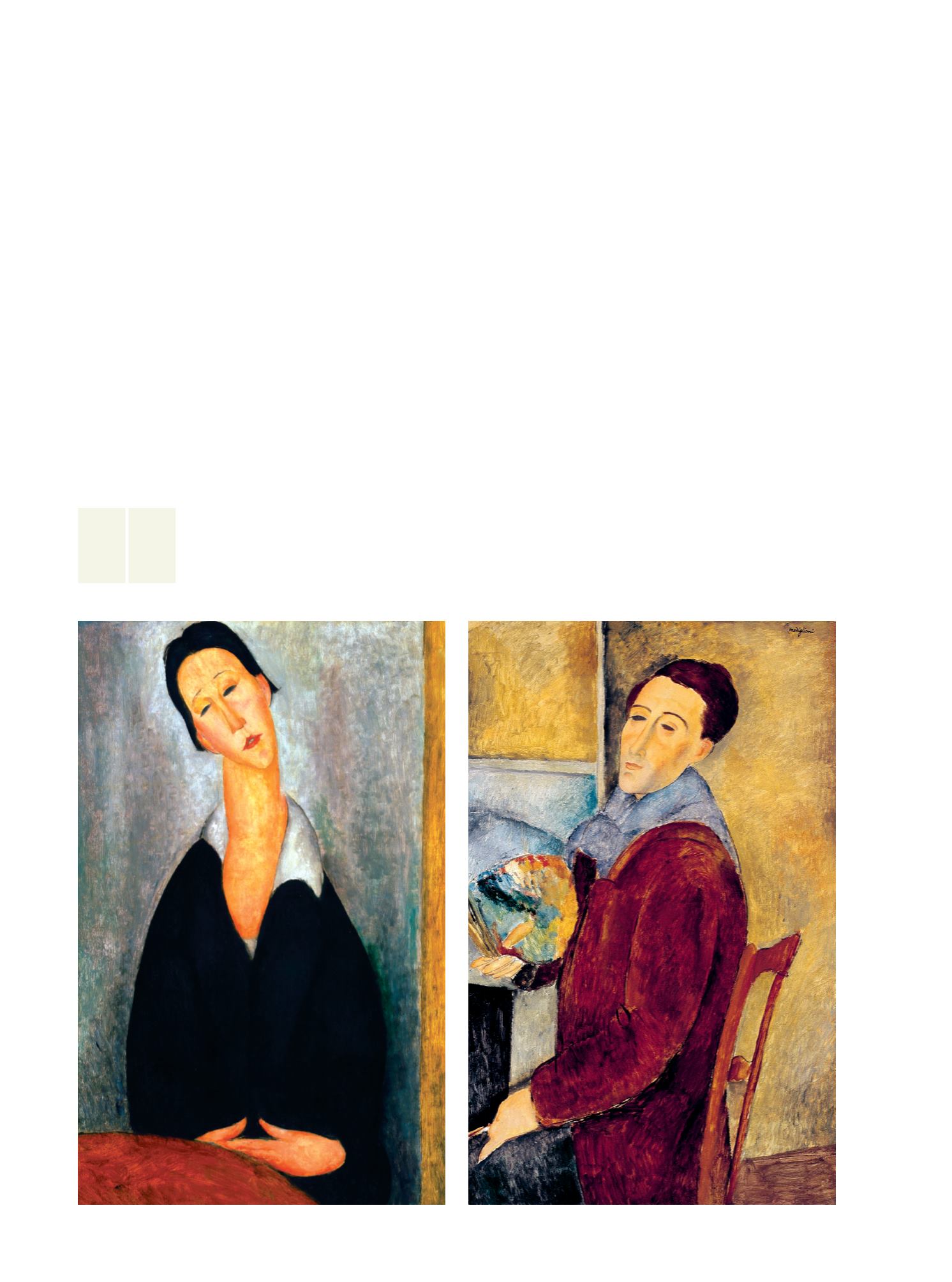
heads. Modigliani is a painter of small and asym-
metrical eyes, sometimes empty, sometimes colored
behind, sometimes looking at us, sometimes acting
as pivots for those that escape the life of the
sitters. The lengthened noses and the diminutive,
half-open mouths radiate an air of solitude.
There is something in Modigliani the portrait
painter that is not shared by his contemporaries. I
think for example, in the Expressionist portraits,
from another latitude but during the same period.
I think of Emil Nolde, of Kirchner, of how the weak
characters make reference to an outpouring of life;
the portraits look like socks devoid of content.
This is not so withModigliani, he simplymakes his
portraits appear as scenes of dead nature, without
a before or after, without life and without death. It
meses de embarazo y dejó huérfana a una pequeña
niña, hija de ambos.
En 1906 se traslada a París entrando en contacto
con la vanguardia. Su obra temprana tiene influencia
del
Fauvismo
y del
Cubismo
, más tarde la influencia
vendrá de Cezanne, de Brancusi, del arte africano y
de su propia incursión a la talla en piedra; pero si
bien, participa de manera tangencial en la vanguar-
dia, su obra tiene un carácter único que no le permi-
te adscribirse a ningún
ismo.
Quizá por ello, el
reconocimiento de su trabajo comenzó en los años
posteriores a su muerte. Los retratos de Modigliani y
sus desnudos comparten la particularidad de lo que
fue su estilo: el alongamiento de la figura reforzado,
principalmente, por los cuellos largos y las cabezas
ligeramente inclinadas. Modigliani es un pintor de
ojos pequeñitos y asimétricos, a veces vacíos, a
veces coloreados del fondo, a veces nos miran; a
veces funcionan como pivotes por los que se escapa
la vida de los retratados. Las narices alargadas y las
bocas diminutas y entreabiertas, irradian un aire de
solitud.
Hay algo del Modigliani retratista que no compar-
ten sus contemporáneos. Pienso por ejemplo en los
retratos que produjo el expresionismo, desde otra lati-
tud pero en la misma época. Pienso en Emil Nolde, y en
Kirchner, en como los personajes desguanzados hací-
an patente una especie de derramamiento de la vida,
los retratos aparecían como calcetines vaciados de
contenido. No sucede eso en Modigliani, él simple-
mente hace aparecer sus retratos como naturalezas
1. Amedeo Modigliani
Retrato de una mujer polaca
Portrait of a PolishWoman
1919
Óleo sobre lienzo /
Oil on Canvas
100.3 x 64.8 cm
Philadelphia Museum of Art
2. Amedeo Modigliani
Autoretrato
/
Self-Portrait
1919
Óleo sobre lienzo /
Oil on Canvas
100 x 64.5 cm
Museu de Arte Contemporânea da
Universidade de Sáo Paulo
2
1


