los conquistadores •
the conquerors
116
·amura·
muertas. Sin antes ni después, sin vida y sin muerte.
No trata de un desbordamiento existencial, trata
quizá de la vida como una mascarada. Es claro que en
el ideal de belleza que persigue mediante su trabajo,
coinciden el retardo, el tiempo suspendido y la espera.
Sus personajes, sobre todo sus mujeres, están inmer-
sas en una atmósfera que las suspende en el borde del
no-ser. Como si un antifaz las revistiera del mismo
grado cero del que se constituye el fondo. Hablo del
grado cero de la vida que son los objetos mismos, las
puertas, los decorados de fondo. Modigliani logró los
retratos más bellos que alguien pudiera pintar, pero
también los más impasibles, los más inconmovibles.
Si sus personajes figuran como naturalezas muertas
es porque en su estancia dan indicios de un recogi-
miento de la vida, de la mascarada retardada que dejó
la vida. No sabemos si sujetos u objetos, los retrata-
dos posan acartonados, estatuarios, pétreos, ingrávi-
dos. Tan sólo cinco años se dedicó a su vocación
escultórica, lo cierto es que ésta nunca le abandona.
Su pintura tiene cualidades escultóricas y dibujísticas
más que pictóricas, lo vemos claramente en las nume-
rosos
Cariátides
que dibujó. Incluso reconocemos en
ellas la línea de Matisse.
Pero volvamos al enigma de la mirada que plan-
tean sus retratos. Modigliani pinta el vacío en los
ojos, como suele hacer el escultor. ¿Están vacíos, lle-
nos, nos miran? Sus personajes devuelven nuestra
mirada al vacío. Como un espejo en el que uno se
buscara sin encontrarse. A veces los atravesamos
como si fueran transparentes, a veces son impene-
trables como la materia sólida, pero en ningún
momento devuelven nuestra mirada. Somos noso-
tros quienes no nos vemos mirar.
is no about existential overflow; it is more about
life as a mask. It is clear that in the ideal of beau-
ty he pursues through his work, delay, suspended
time and the feeling of waiting coincide. His
characters, above all, the women, are immersed
in an atmosphere that suspends them on the
edge of ‘not being’, as if a mask re-dressed them
from the same level zero from which the back-
ground was constructed. I refer to the level zero
of life of the objects themselves: the doors and
the background decorations. Modigliani painted
the most beautiful portraits that anyone could
paint, but also most indifferent, most untrou-
bled. If his characters figure as dead nature, it is
because in their permanence they begin to show
signs of an introspection of life, of the delayed
mask left to them by life. We do not know if they
are subjects or objects, the sitters pose box-like,
statue-like, stone and soft. Although he only dedi-
cated himself to sculpture for five years, the voca-
tion never left him. His painting has sculptural
and drawing more than pictorial qualities, which
we can see in themany
Cariátides
that he drew; we
can even recognize Matisse’s line in them.
But we return to the enigma of the gaze in his
portraits. Modigliani paints the emptiness in the
eyes, as would a sculptor. Are they empty, full,
are they looking at us? His characters return our
gaze to a void; as a mirror in which one looks but
does not find oneself. Sometimes we pass
through as if they were transparent, sometimes
they are impenetrable like solid material, but
they never return our gaze. It is us who we do no
see looking.
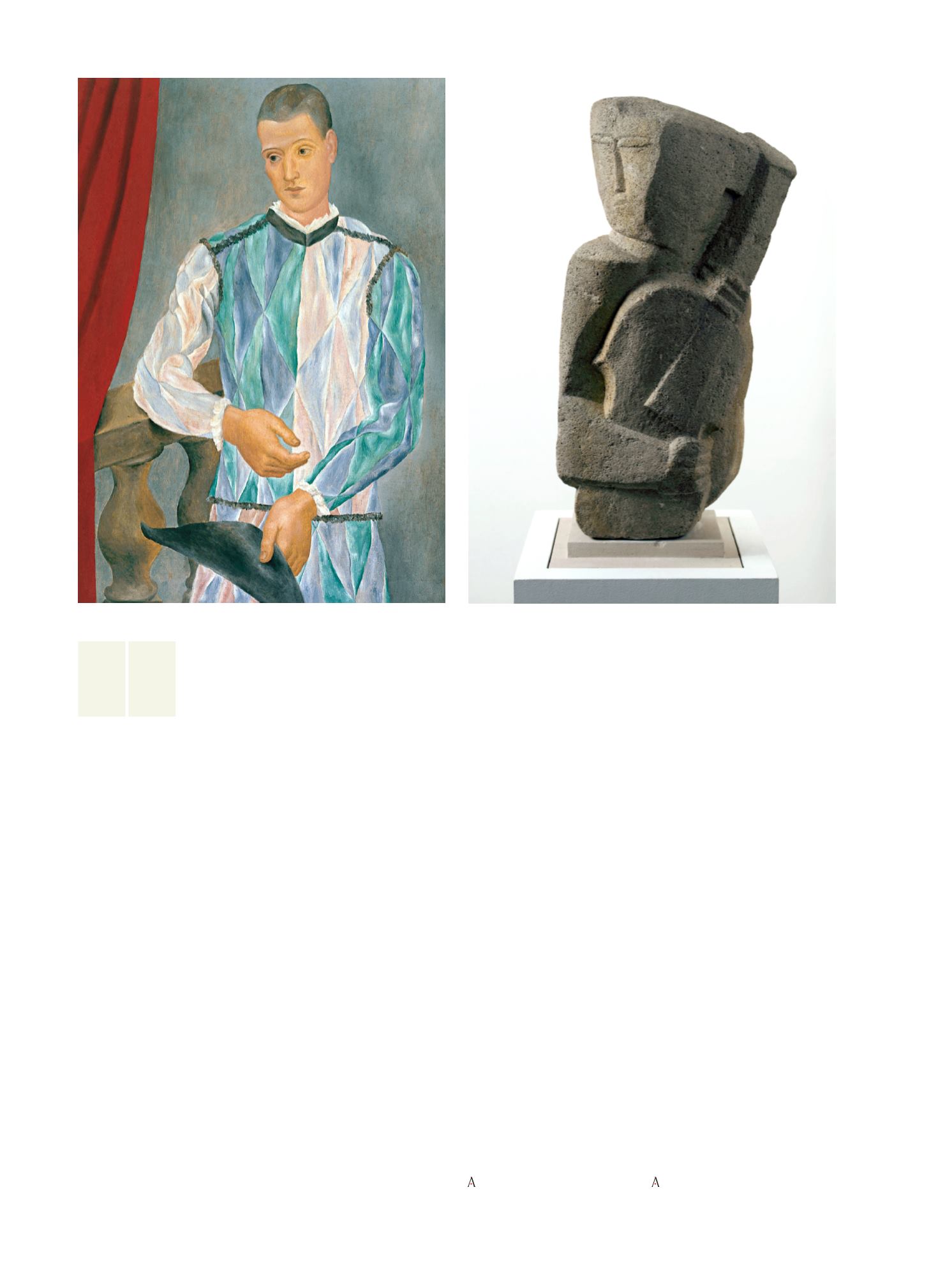
1. Pablo Picasso
Arlequín
/
Harlequin
1917
Óleo sobre lienzo /
Oil on Canvas
116 x 90 cm
Museo Picasso, Barcelona
2. Ossip Zadkine
Músico
/
Musician
c. 1919
Piedra caliza /
Stone
73 x 41 x 28 cm
Musée Zadkine de la Ville de Paris
2
1


