115
·amura·
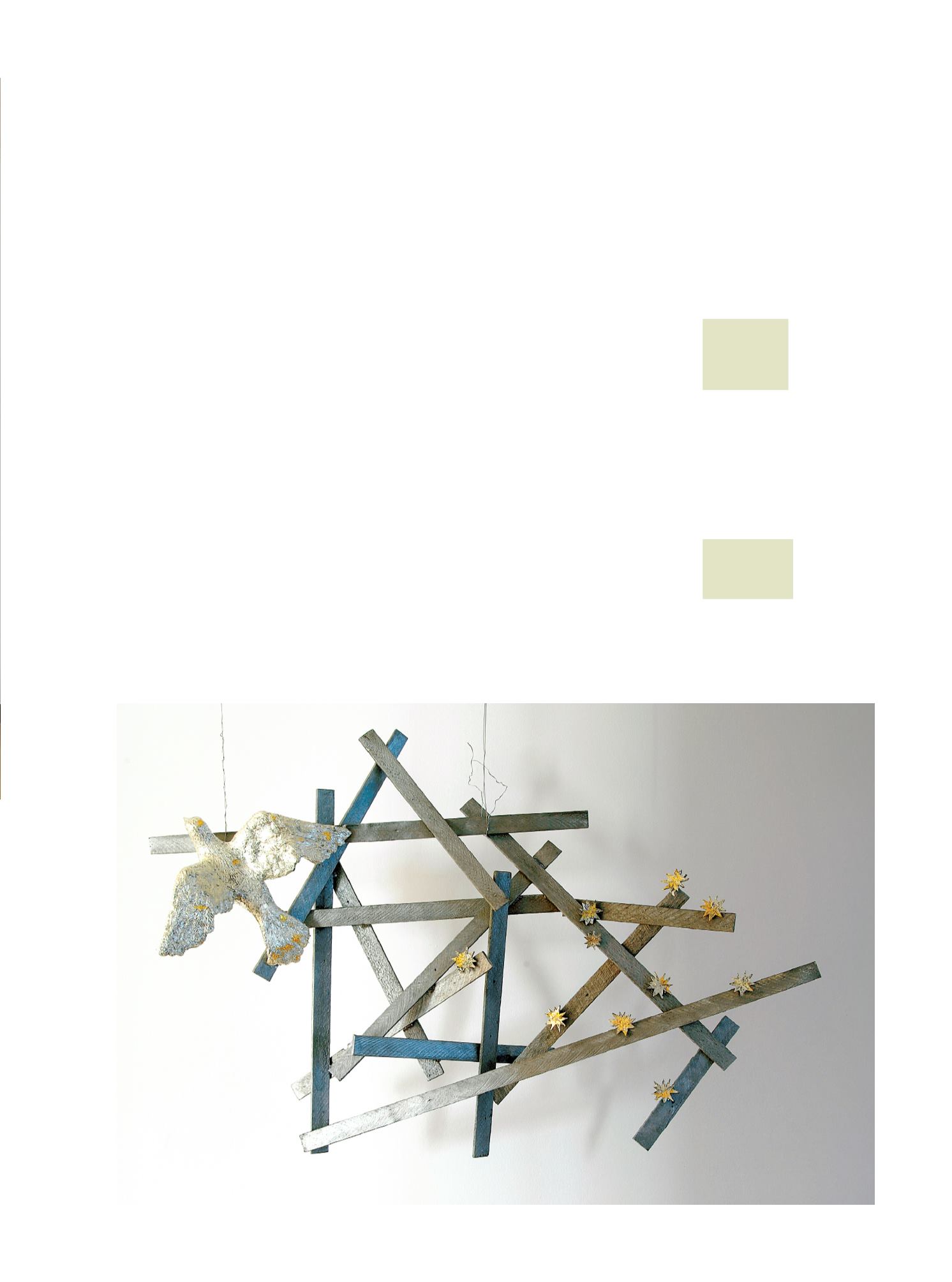
Messenger I
2008
Aluguss mit Blattgold in Weißgold und Gelbgold
Museum Haus Esters, Krefeld, 2008
(Pág. anterior)
Bouquet
2007
Tusche auf Nepalpapier und Seidenpapier mit
Lithokreide
Untitled (Oil Flowers)
2008
Öl auf mundgeblasenem Antikklarglas,
Blattgold und Blattsilber
Installationsansicht Museum Haus Esters,
Krefeld, 2008
los conquistadores •
the conquerors
processes of thebody. It resorts to themyth, possibly,
to accounts for a feminine universe in procedure.
Along 25 years of artistic production, Kiki
Smith has worked with biblical characters, from
the Greek mythology and Egyptian cosmology,
with popular narratives or from the literature. It is
the same Magdalene or Eve, as it is Lilith, Mary,
Medusa or the wife of Lot.
An army of women which shares a specific cor-
porality, it is the knot fromwhich the work of Smith
has been interweaved. Probably investigates about
the origin, maybe it is only about the inscription of
the new account the problem of the femininity
planted since the decade of the 60’s and 70’s.
It is the same as an emptied uterus in bronze
that hundreds of crystal sperms molded one by one
by the hands of the artist. There is a question about
the origin and the myth is not enough, not even the
anatomy, nor the personal history to respond to it. It
is not enough with the strong la matter of the
bronze, or with the softmatter of thewax. Regarding
to the origin, Kiki Smith does not search for an
answer but to amass the materiality of the problem
over and over again, in different solutions.
It has been said sometime: “You choose the los
materials the same way in which you would
choose the words”. This is how each material has
its own meditative tone but, above all, its own
emotional temperature. Fabric, wool, hair, wax,
paper, plaster, bronze, crystal, thread, terra-cotta,
latex, aluminum… The inventory of materials
generates several rapprochements to the prob-
lem of the corporality raised in her work.
During an interview realized in the nineties she
declared: “I think I chose the body as the theme, not
cuerpo. Recurre al mito, posiblemente, para dar cuen-
ta de un universo femenino en gestión.
A lo largo de 25 años de producción artística,
Kiki Smith ha trabajado con personajes bíblicos,
de la mitología griega y cosmología egipcia, con
narrativas populares o de la literatura. Lo mismo
Magdalena o Eva, que Lilith, María, Medusa o la
esposa de Lot.
Un ejército de mujeres que comparten una cor-
poralidad específica, es el nudo a partir del cual se ha
ido entretejiendo el trabajo de Smith. Probablemente
inquiera acerca del origen, tal vez sólo trata de inscri-
bir de nueva cuenta el problema de la feminidad plan-
teado desde la década de los 60 y 70.
Lomismo un útero vaciado en bronce que cientos
de espermatozoides de cristal moldeados uno a uno
por las manos de la artista. Hay una pregunta por el
origen y no basta el mito, ni la anatomía, ni la histo-
ria personal para responder a ella. No basta la mate-
ria dura del bronce, ni la materia blanda de la cera. En
cuanto al origen, Kiki Smith no busca una respuesta
sino amasar la materialidad del problema una y otra
vez, en distintas soluciones.
Ha dicho alguna vez: “Eliges los materiales de la
misma forma en que escogerías las palabras”. Así
cada material tiene su propio tono discursivo pero,
sobre todo, su propia temperatura emocional. Tela,
lana, cabello, cera, papel, yeso, bronce, cristal, hilo,
terracota, látex, aluminio. El inventario de materia-
les genera diversos acercamientos al problema de la
corporalidad planteado en su obra.
En una entrevista realizada en los años
noventa declaró: “Pienso que escogí el cuerpo
como tema, no de manera consciente, sino por-
que es la única forma que todos compartimos, es


