130
los conquistadores •
the conquerours
·amura·
T
he Industrial Revolution ushered in an age of
modernity and deep social changes that led to a
permanent search for the original. Nowadays,
there are people who believe that that era has ended
while others are of the opinion that we are immersed
in an age of postmodernism in which anything goes.
This has provoked a reassessment of how we think
and act.
There is no doubt that the 19th century radically
modified the relationship between production, distri-
bution and consumption of goods and services. There
were also changes in attitudes toward labor relations
as well as in more delicate areas like religion, science,
philosophy and art.
Artists found new forms of expression since they
were no longer obliged to work on religious and gov-
ernment commissions. They also found new buyers
for their work.
A new social class was forming. It settled in the
old cities or “burgs”, the word from which bourgeois,
their inhabitants, is derived. Its influence resulted in
the creation of what we know as today’s modern soci-
ety. And we should not forget that from them sprang
intellectuals, scientists, merchants, industrialists
and a unique generation of artists.
The French Revolution (1789) gave the world a
different perspective regarding the interaction
between human beings. It was a process that was nei-
ther easy or fast: it had to pass through a long period
of adjustments and wars which produced a freer way
of thinking and the conditions that helped to develop
all areas of human expression.
L
a Revolución Industrial trajo consigo la Modernidad y
con ésta cambios sociales profundos, lo que se tra-
dujo como la búsqueda permanente por lo nuevo. En
nuestros días hay quienes piensan que este periodo termi-
nó, mientras que otros creen que estamos inmersos en la
posmodernidad, donde todo cabe y vale, lo que ha provo-
cado reordenamientos en la manera de pensar y de actuar.
Sin duda, el siglo XIX modificó de manera radical las re-
laciones de producción, distribución y consumo de bienes
y servicios. Por supuesto, también hubo transformaciones
en lo laboral y en ámbitos más delicados, como el religioso,
el científico, el filosófico y el artístico.
Respecto al arte, sus exponentes encontraron en su
quehacer variadas formas de expresión, ya que no estaban
sólo dedicados al encargo religioso u oficial, es decir, para
el Estado. No obstante, por otra parte se gestaron nuevos
compradores de su trabajo.
En esos momentos, una nueva clase social se estaba
formando. Se asentaba en las viejas ciudades o “burgos”,
palabra de donde se deriva el nombre dado a sus habitan-
tes, “burgueses”. Por su influencia, estos personajes crean
lo que conocemos como sociedad moderna. Y no hay que
olvidar que en medio de ellos se encontraban los intelec-
tuales, los científicos, los comerciantes, los industriales y
una generación diferente de artistas.
La Revolución francesa (1789) dio al mundo una pers-
pectiva distinta en lo que se refiere a la interacción entre los
seres humanos. No fue un proceso fácil ni rápido, tuvo que
pasar por un largo entramado de ajustes y guerras, lo que
dio como consecuencia formas más libres del pensamiento y
de las condiciones para que se desarrollaran las manifesta-
ciones humanas en todas las áreas.
El mercado del arte
se transforma en Francia
The transformation
of the French art market
Texto /
Text
: Miguel Peraza
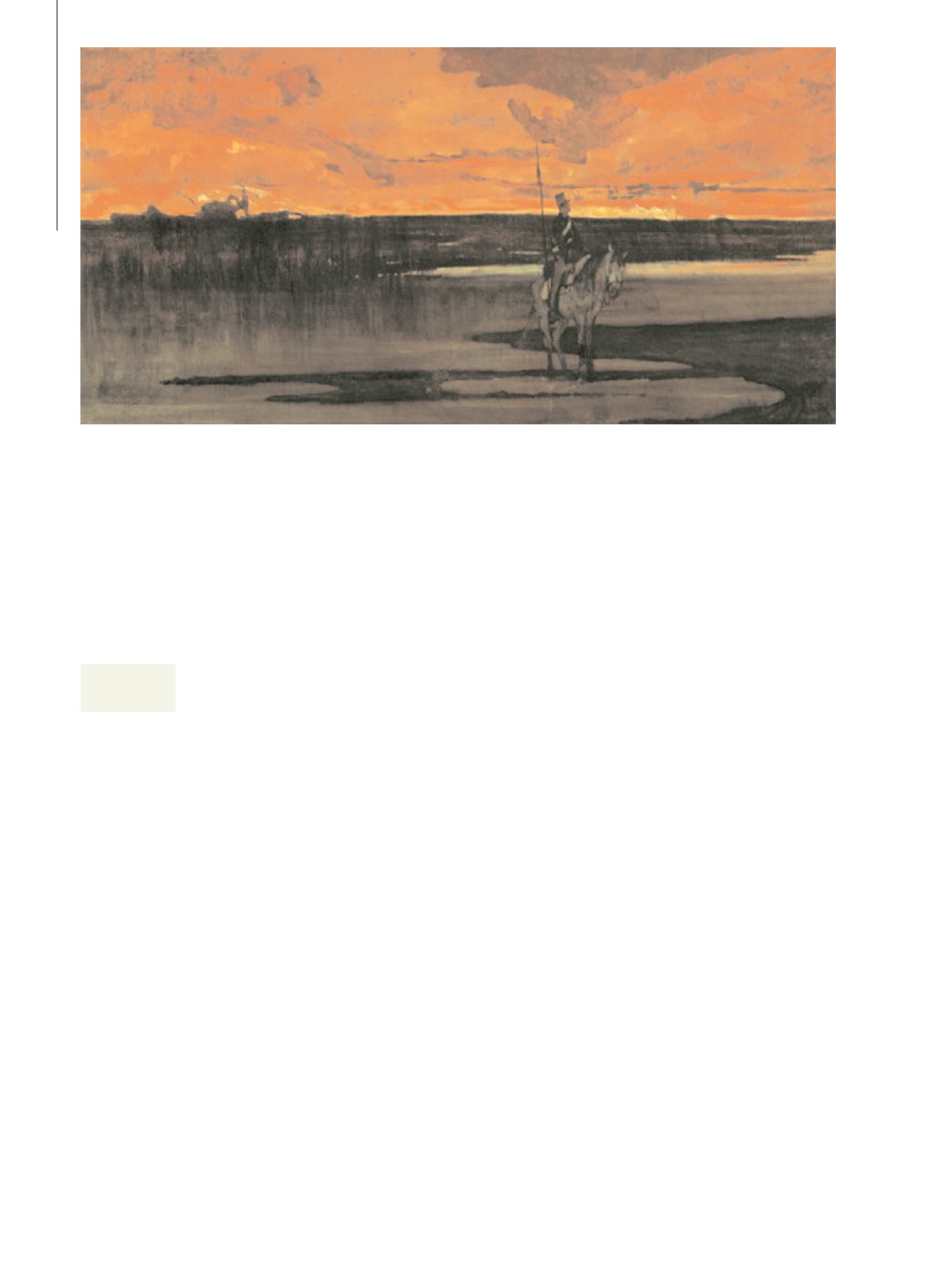
Giovanni Fattori
Lancero junto al mar
Lancer by the Sea
(1895)


