El tiburón tigre es un depredador solitario y predo-
minantemente nocturno, que ataca a todo tipo de pre-
sas, desde peces óseos y calamares a rayas y otros
tiburones, pasando por gasterópodos, crustáceos, ser-
pientes marinas, tortugas marinas, cocodrilos, aves y
mamíferos marinos (marsopas, delfines, cetáceos, etc.)
Estos tiburones se encuentran en aguas tropicales y
subtropicales de Oceanía y el sureste asiático, llegando
por el norte a Japón y por el sur hasta Nueva Zelanda.
Habita también en aguas costeras de todo el Océano
Índico, el Golfo Pérsico y el Mar Rojo.
En América se le encuentra en la costa del Pacífico,
desde el sur de California hasta el norte de Chile (inclui-
das varias islas como las Revillagigedo y las Galápagos),
y en el Atlántico, desde el Río de la Plata hasta Nueva
Inglaterra, siendo particularmente abundante en el
Caribe y el Golfo de México.
La expedición
Después de 10 horas de travesía, amanecimos en
West End en la Gran Bahama. Los tiburones tigre se
presentaron muy pronto, y sin pensarlo dos veces,
nos preparamos para entrar al agua.
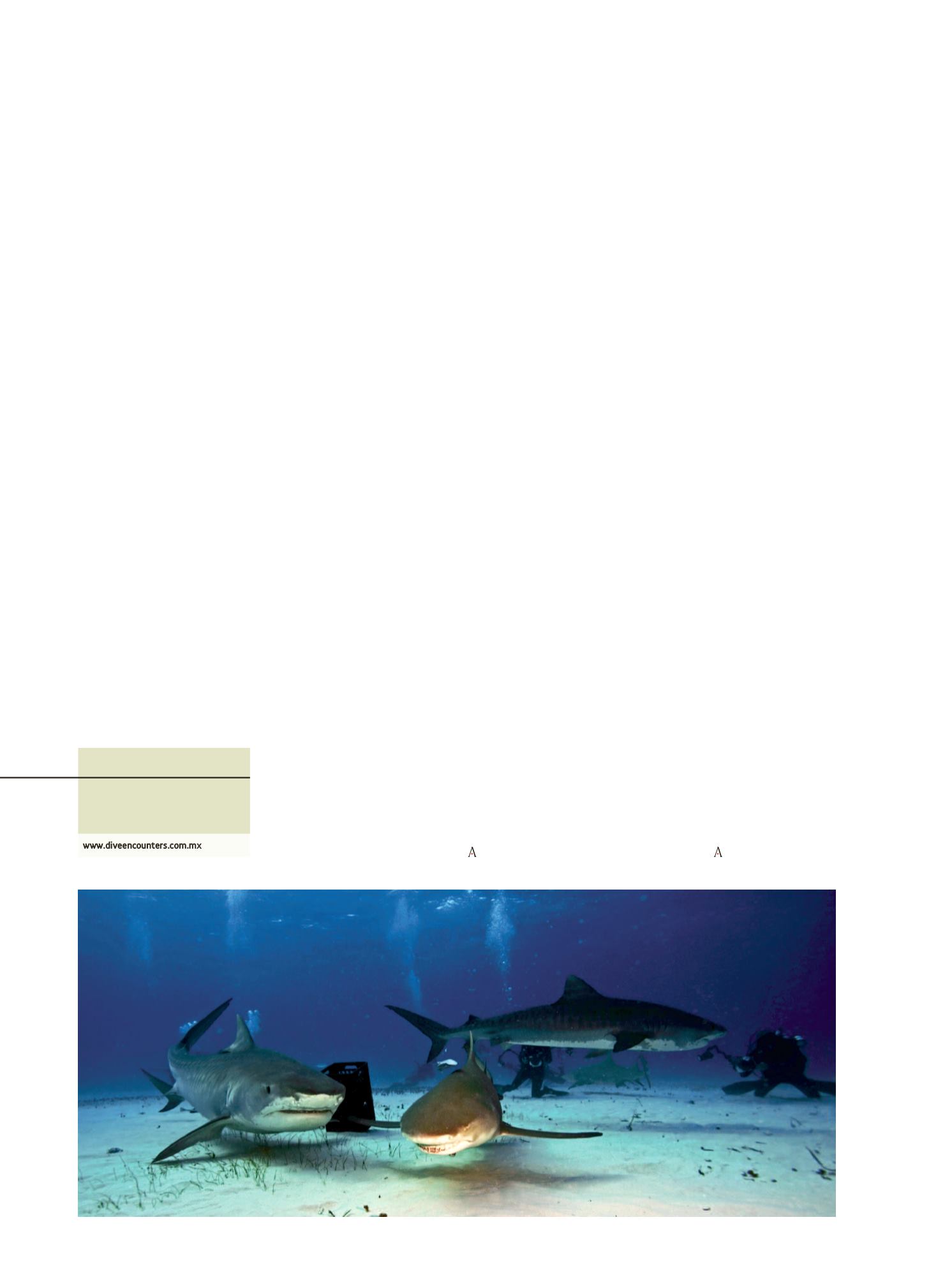
Una vez en el fondo, nos empezaron a rodear más
de 20 tiburones Limón de más de dos metros. Al prin-
cipio, parecía aterrador, pero con el tiempo nos sen-
timos un poco más cómodos, ya que no mostraban
interés en nosotros.
¡Espectacular!
De repente los limones se abrieron y una silueta
de un tiburón más grande con rayas en el dorso como
la de un tigre de la India hizo su aparición: el primer
“Tiburón Tigre” ¡Era espectacular!
A diferencia de los Tiburón Limón, con éste no
nos sentimos cómodos en ningún momento, ya que
más de una vez se acercaba golpeando la cámara.
Cuando creíamos que ya lo habíamos visto todo,
llegó una impresionante hembra de más de ¡cuatro
metros!, era del tamaño de un tiburón blanco. Fueron
dos días en que llegamos a estar rodeados por más
de cuatro tiburones tigre al mismo tiempo.
Al terminar el último buceo, tristemente comen-
zamos a empacar todo el equipo para regresar a casa,
eso sí, con una sonrisa por haber logrado el primer
paso en el proyecto de “fotografiar a los 10 tiburones
más peligrosos del mundo”.
The tiger shark is a lonely predator and mainly
nocturnal, that attacks all sorts of preys, from
bony fishes to striped squid and other sharks,
passing through crustacean gastropods, sea
snakes, sea turtles, crocodiles, birds and marine
mammals, (seals, dolphins, cetacean, etc.)
These sharks are found in the tropical and sub-
tropical waters of Oceania and the Asian southeast,
arriving from the north to Japan and from the
south up to New Zealand. It is also found in the
coastal waters of the whole Indigo Ocean, the
Persian Gulf and the Red Sea.
In America it is found at the Pacific Coast, from
the south of California to the north of Chile
(including several islands like
Revillagigedo and the Galapagos), and the
Atlantic, from the Rio de la Plata to New England,
being the Caribbean and the Gulf of Mexico parti-
cularly abundant.
The expedition
After ten hours of traveling we awoke at West
End at the Big Bahamas. The tiger sharks became
present very soon, and without thinking twice we
prepared ourselves to go into the water.
Once at the bottom, more than 20 lemon sharks
two meters long started to surround us. At first, it
seems terrifying, but with time we felt a littlemore
comfortable, since they showed no interest in us.
¡Spectacular!
Suddenly the lemons opened and a larger sil-
houette of a shark with stripes on its back like an
Indian Tiger appeared: the first Tiger Shark, it was
spectacular!
Unlike the Lemon Shark, with this one we did-
n't felt comfortable at any moment, since more
than once it approached and hit the camera.
When we thought we had seen it all, an amaz-
ing four-meter female arrived! it was the size of a
white shark. Two days more than 4 tiger sharks
surrounded us at the same time.
When we finished our last dice, sadly we began
to pack our gear to head back home, but of course
with a big smile on our face for having achieved
the first step in the project of “photographing the
worlds 10 most dangerous sharks ”.
especies •
species
Contacto
Gerardo del Villar C.
T 3605 1393, 2163 2569
132
·amura·


