especies •
species
107
·amura·
bing the food directly from the bag of their parents;
they use it to transport the load of fish to the nest,
where their offspring await.
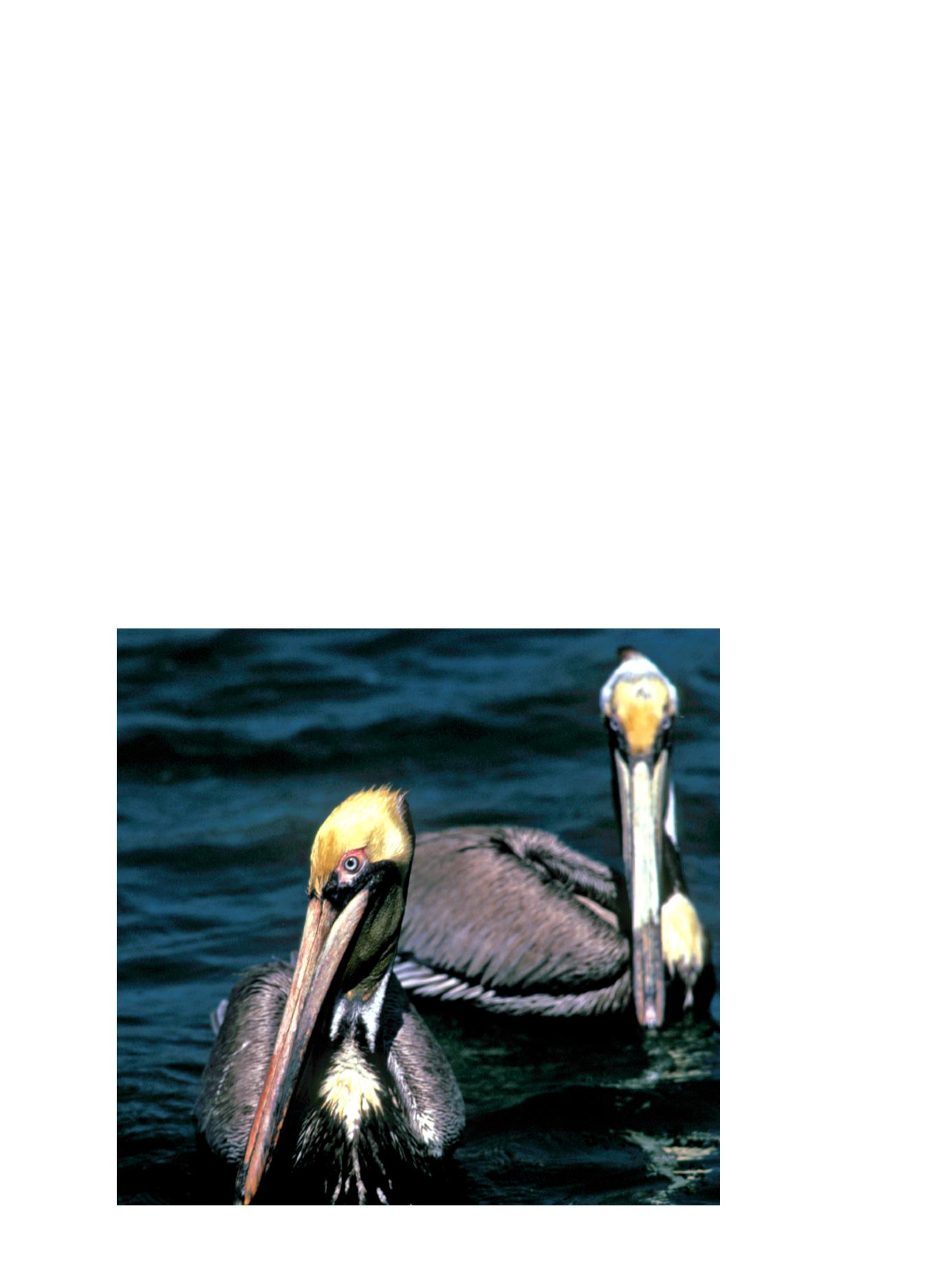
Pelicans can be found inmany of the coastal lines, in
lakes and in rivers. They are social birds that often travel
in crowd with the typical arrow or line formation; they
are also the birds that fly higher when they emigrate.
The white pelicans use the ascending hot air cur-
rents to elevate up to more than 4,000 meters of height
and once there they use the stream currents that are
found in these heights to fly faster towards to or from
the south. The achievement of performing 500 kilome-
ters in 24 hours has been documented. They also nest
in colonies and have the habit of gathering in islands.
In North America there are two species: maroon and
white. The White American pelican nests north from
the United States and in Canada. During the fall it flies
to the southern states of eh United States, looking at
them with relative frequency all winter in the states of
the Gulf of Mexico, including all Florida. Also a great
number of them spend the winter in Mexico and
Guatemala. Some individuals continue the voyage
even more to the south of Central America; the have
been seen in Costa Rica, and it is possible they arrive
until Panama. Usually, during their migration voyages
they fly over ground but there are also data of visitors
in themayor islands of the Caribbean. One small colony
resides all year long in the coasts of Texas.
Since 1985 the total population of this specie has
increased considerably. In some places it is considered
common, in others becomes abundant. A curious case
is the one of Texcoco, that when part of what it was a
enorme capacidad. Los pelícanos más jóvenes se ali-
mentan cogiendo la comida directamente de la bolsa de
sus padres, éstos la utilizan para transportar la carga de
pescado hasta el nido, donde aguardan las crías.
Se pueden encontrar pelícanos en muchas de las
líneas de costa, en lagos y en ríos. Son pájaros sociales
que a menudo viajan en multitud con la típica forma de
flecha o línea, son también de las aves que más alto vue-
lan al emigrar.
Los pelícanos blancos utilizan las corrientes de aire
caliente que ascienden para elevarse hasta más de
4,000 metros de altura y una vez ahí utilizan las corrien-
tes de chorro que hay a esas alturas para volar más rápi-
do hacia o desde el sur. Se ha documentado el logro de
realizar 500 kilómetros en 24 horas. También anidan en
colonias y suelen juntarse en islas.
En Norteamérica contamos con dos especies: marrón y
blanco. El pelícano blanco americano anida al norte de
Estados Unidos y en Canadá. Durante el otoño vuela a los
estados del sur de Estados Unidos, viéndosele con relativa
frecuencia todo el invierno en los estados del Golfo de
México, incluyendo toda la Florida. También un buen núme-
ro de ellos invernan en México y Guatemala. Algunos indi-
viduos continúan la travesía aun más al sur de América
Central; se los ha visto en Costa Rica, y es posible que lle-
guen hasta Panamá. Usualmente, durante sus travesías de
migración vuelan sobre tierra pero también hay datos de
visitantes en las islas mayores del Caribe. Una pequeña
colonia reside todo el año en las costas de Texas.
Desde 1985 la población total de esta especie ha
aumentado considerablemente. En algunos lugares se la
considera común, en otros pasa a ser abundante. Un


