especies •
species
108
·amura·
lake was recovered, although today it is artificial, it has
propitiated the return of these birds to that watershed.
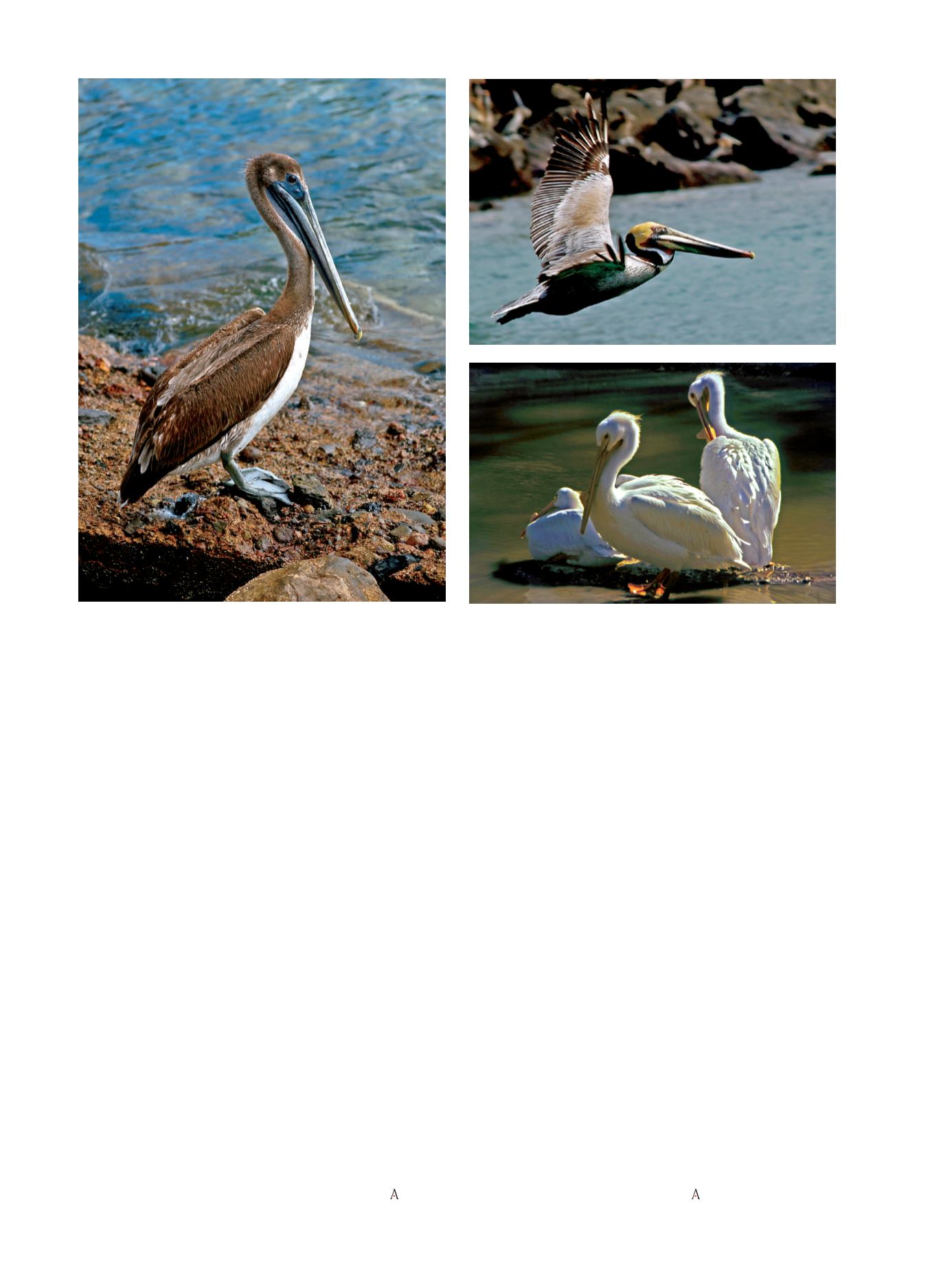
On the other hand, we can find the gray pelican in the
coasts of the Americas. In the Atlantic resides from New
York to the outlet of the Amazon, having been registered
in Nova Scotia to the north, and in Río de Janeiro to the
south. It has been seen in the Bermudas. It is also found
present in all the islands of the Caribbean. In the Pacific it
is located from the island of Vancouver to the south of
Ecuador.
Asubspecies is endemic of theGalapagos Islands. This
pelican is not migrating; it is a kind of species rather
sedentary, where most of the adults remain all year near
the place where they nest. Even though, during the sum-
mer some individuals, many young, transfer from one
place to another, normally throughout the sea coast, it is
not odd to se it some kilometers inland, above all if there
are lakes.
Almost all of them return to their colony, but when
some of them find a habitat where they can survive
they will stay and start a new colony. Of course, many
perish in the attempt. During this season of displace-
ment it is not rare that some individual flies up river
coming to far in the Mississippi, the Colorado or other
river. It is not a migration, it is more an expansion of
the location.
During the storms and tempests it is very common
that some of them get lost and end in remote places,
just as much as in inland as in open sea.
This species was in danger of extinction due to the
contamination and pesticides, but at present it is begin-
ning to recover the population. Although in Mexico its
population has never been at risk there were some
problems and still today there are placeswhere the pollu-
tion still is affecting them.
caso curioso es el de Texcoco, que al recuperar parte de
lo que fue un lago, aunque hoy es artificial, ha propicia-
do el regreso de estas aves a esa cuenca.
Por otro lado, al pelícano pardo lo encontramos en las
costas de las Américas. En el Atlántico habita desde Nueva
York hasta la desembocadura del Amazonas, habiendo sido
documentado en Nueva Escocia al norte, y en Río de Janeiro
al sur. Se lo ha visto en las Bermudas. También se encuen-
tra presente en todas las islas del Caribe. En el Pacífico se
ubica desde la isla de Vancouver hasta el sur de Ecuador.
Una subespecie es endémica de las Islas Galápagos.
Este pelícano no es migratorio; es una especie más bien
sedentaria, donde la mayoría de los adultos permanecen
todo el año cerca del lugar donde anidan. Aun así, duran-
te el verano algunos individuos, muchos jóvenes, se
trasladan de un lugar a otro, normalmente a lo largo de
la costa marina, no es extraño verlo unos kilómetros tie-
rra adentro, sobre todo si existen lagos.
Casi todos retornan a su colonia, pero cuando algu-
nos de ellos encuentran un hábitat donde puedan sub-
sistir se quedan y comienzan una nueva colonia. Claro,
muchos perecen en el intento. Durante esta temporada
de desplazamiento no es raro que algún individuo vuele
río arriba llegando bien lejos en el Mississippi, el
Colorado u otro río. No es una migración, más bien una
expansión de la ubicación.
Durante las tormentas y temporales es muy usual
que algunos se extravíen y terminen en lugares remotos,
tanto tierra adentro como en mar abierto.
Esta especie estaba en peligro de extinción debido a
la contaminación y pesticidas, pero actualmente se está
empezando a recobrar la población. Aunque en México
su población nunca estuvo en riesgo sí hubo algunos
problemas y aún hoy hay lugares donde la contamina-
ción aún los está afectando.


