


 120 / 132

·amura·
Mitos •
Myths
118
There are plenty of ver-
sions of the myth of cre-
ation. The most narrated
legend states that at the
beginning, when there
was only water and obscu-
rity, only the island of gods
floated around the edge of
the world. When the creator
god was asleep, nighttime
befell; if Degei was traversing
the globe, earthquakes shook
the earth and storms broke lose,
and when he woke up, daytime would
come. The popular belief is that the god Degei is still alive and
dwells in a cave in the Nakauvadra mountain range in Viti Levu.
Existen múltiples versiones del mito de la creación. La leyenda más
difundida cuenta que en el principio, cuando solo existía agua y obscu-
ridad, únicamente la isla de los dioses flotaba alrededor del borde del
mundo. Cuando el dios creador dormía, llegaba la noche; si Degei esta-
ba recorriendo el mundo, ocurrían temblores de tierra o
se desataban tormentas, y cuando desper-
taba, llegaba el día. La creencia popular
es que el dios Degei aún vive y habi-
ta en una cueva en la cordillera de
Nakauvadra, en Viti Levu.
Otra leyenda está dedicada a la flor de Tagimaucia, que fue creada
a partir de las lágrimas de una princesa cuyo amor fue truncado por
la oposición de sus padres; o la que cuenta que Rokouka, un hijo del
dios Degei, fue quien creó las islas de Fiyi, rescatándolas del fon-
do del mar. Asimismo, hay historias consagradas a las aventuras del
dios Dakuwaqa, el tiburón sagrado, y aquella que describe el modo en
que fueron creadas las veneradas tortugas de Namuana, entre mu-
chas otras. De acuerdo a una investigación realizada en 1865 por el
misionero Jesse Carey, que se conserva en la Biblioteca de Sidney,
Australia, los fiyianos celebraban por entonces a más de 300 dioses
y héroes, cada cual propietario de su propio mito.
Other legends include the one dedicated to the Tagimoucia flower,
which was created from the tears of a princess whose love was thwart-
ed by her parents’ disapproval; or the one about Rokouka, son of Degei,
as the one who created the Fiji Islands, recovering them from the bot-
tom of the sea. Additionally, there are tales narrating the adventures
of the god Dakuwaqa, the sacred shark, and the one that describes the
way in which the revered turtles of Namuana were created, plus many
others. According to research carried out by missionary Jesse Carey
in 1865, which is preserved in the Sidney Library, in Australia,
Fijians then worshiped more than 300 gods and heroes,
each of them with myths of their own.
10
8
9
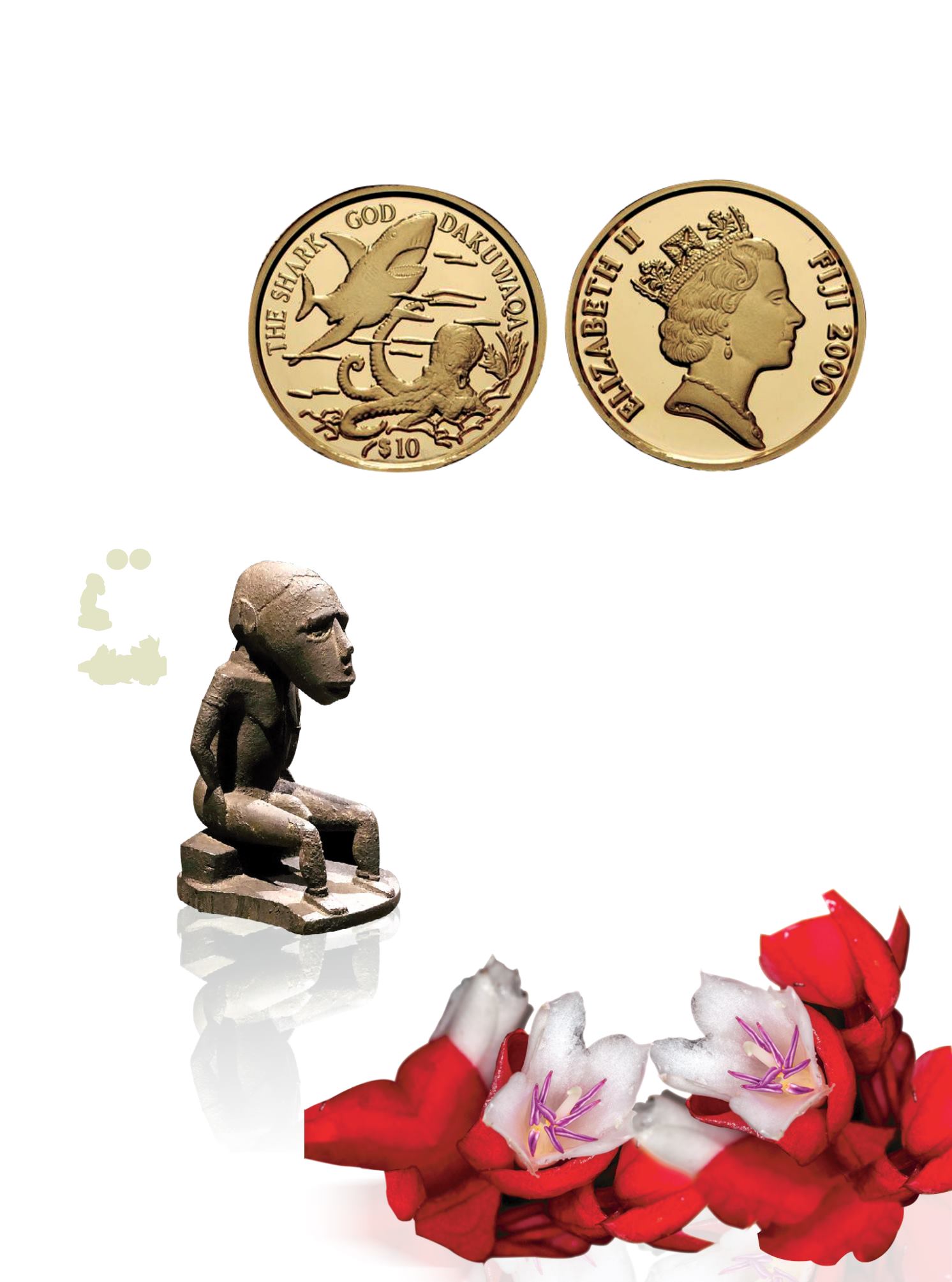
8. Moneda
conmemorativa que
ilustra a Dakuwaqa,
el dios tiburón, y a
la Reina Elizabeth
II de Inglaterra. /
Commemorative
coin depicting
Dakuwaqa, the
shark god, and
Queen Elizabeth II
of England.
9 Figura de madera
del dios tiburón
Dakuwaqa (siglo
XVIII). Museo del
Muelle Branly -
Jacques Chirac,
París. /
Wood figure
of the shark god
Dakuwaqa (18th
century). Musée
du quai Branly -
Jacques Chirac,
Paris.
10. La bella y rara
flor Tagimaucia
(
medinilla
waterhousei
) no
crece en ningún
otro lugar en el
mundo, solo en
las montañas de la
Isla Taveuni, Fiyi. /
The beautiful and
rare Tagimoucia
flower (
medinilla
waterhousei
)
grows nowhere
else in the world,
only in the
mountains of
Taveuni Island.