




 136 / 148

·amura·
134
QMBOetB B[VM •
blue planet
En la zona de Sharm El Shiek se juntan, por un
lado, el golfo de Suez más ancho y más largo, pero
menos profundo sin llegar ni a los 100 m; y por otro, el
golfo Aqaba, que llega casi a los 2 km de profundidad,
creando ambos fuertes corrientes que llevan una gran
concentración de nutrientes, lo que equivale a mucha
vida. Particularmente, en el golfo de Aqaba, por suma-
yor profundidad, los buzos nuevos en la zona deben de
tomar sus precauciones, ya que hay lugares en donde
las corrientes pueden ser tan fuertes hacia abajo, que
las burbujas que soltamos a la hora de exhalar rom-
pen las leyes de la física y lejos de subir, éstas bajan.
Otro dato interesante al que no estaba acostumbrado
es que en este golfo de Aqaba no hay fondo cercano,
a diferencia del mar del Caribe mexicano, que pode-
mos encontrarlo a 30 m, donde realizamos la mayoría
del buceo recreativo. Así es que yo, como videógrafo,
en donde gran parte del buceo lo veo a través de un
lente, cuando veía algún animal pelágico que circulaba
por estas aguas y quería dejarlo grabado en mis cin-
tas, perdía la noción de mi profundidad y no regresaba
sino hasta que mi computadora de buceo empezaba a
hacer el llamado que era tiempo de subir.
Recordemos que gran parte de la vida marina ocurre
en los primeros metros debajo de la superficie, en donde
la luz natural del sol ayuda a su producción. Y es aquí en
estas paredes donde se reúne una gran cantidad de es-
pecies muy coloridas. Eran en los meses de julio y agos-
to, momento en donde gran parte de los grandes anima-
les pelágicos circulan estas aguas. Ya varias historias
de buzos empezaban a confirmar lo que suponíamos,
relatando el haber visto tiburones de varias especies.
In the area where Sharm El Shiek unites, we
located the Gulf of Suez, wide and huge, but shal-
low only 100 m, as well as Gulf Aqaba , it gains up
to nearly 2 km in depth, creating strong currents
that carry high concentration of nutrients, it is
the equivalent of a diverse marine life. Particularly
in the Gulf of Aqaba,due to its greater depth, div-
ers know that within the area certain precautions
must be taken. There are places where the currents
can be strong and pull down the bubbles we release
when exhaling, breaking the laws of physics, mak-
ing it impossible for us to gasp for air. Another in-
teresting fact that I was not used to in the Gulf of
Aqaba, for example, is that it has no ground, unlike
the Mexican Caribbean Sea, where you can find a 30
meter sea floor, used by the majority of people for
recreational diving.
As a videographer, much of the diving idol div-
ing I see through the lens. When I saw some pelagic
animal circulating through these waters I wanted
to leave recorded tapes. I eventually lost track of my
depth; only until my dive computer started to make
the call I knew it was time to climb up.
Remember that much of the marine life oc-
curs in the first few meters below the surface,
where the natural sunlight helps its reproduc-
tion. Here on these walls is where it meets a lot
of very colorful species. During the months of
July and August several of the large pelagic ani-
mals circulate these waters. Several stories of
divers began to confirm this, reporting the sight
of several species of sharks.
3
4
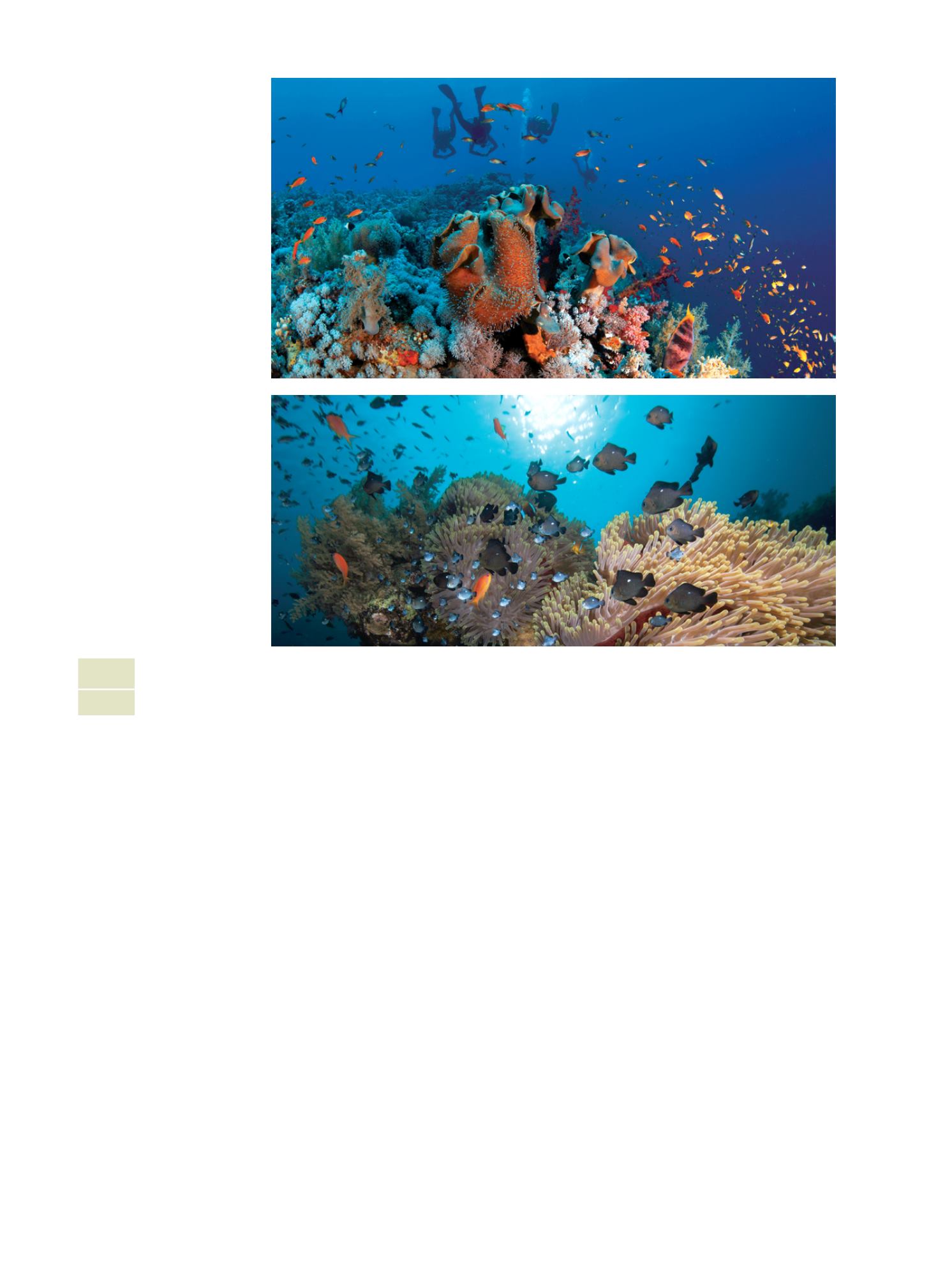
3. Buzos en
el arrecife de
Elphinstone,
disfrutando del
colorido del coral. /
Divers on the reef
of Elphinstone
enjoying the
colorful coral.
4. Coral con banco
de peces a 25 m de
profundidad. /
Coral
with school of fish
at 25 m depth
.