



 119 / 132

·amura·
117
La ruta seguida era difícil y peligrosa, por lo que
España tenía varias flotas de guerra destinadas a la
protección del Galeón. El viaje duraba entre cuatro y
cincomeses, pero en sentido contrario el tiempo se re-
ducía a tan sólo tres. De Manila partía a finales de junio
para evitar la temporada de los monzones, mientras
que de Acapulco salía entre febrero y marzo.
Sin embargo, la capital de Filipinas en realidad no
era más que el puerto de embarque, pues la mayoría
de las mercancías provenían de China, Japón, la India,
Tailandia y Siam. Pero no se piense que esto le restaba
importancia, pues en términos prácticos, la ciudad se
convirtió en el enlace más importante entre Oriente y
Occidente durante muchos años. Las monedas mexica-
nas deplata que llegaban a ella eran rápidamente distri-
buidas por todo el sureste asiático, lo que provocó que
el peso mexicano -al menos en aquella época-, fuera
una divisa aceptada en prácticamente todo el mundo.
Por otro lado, el Galeón propició un intercam-
bio cultural sin precedentes entre México y Filipi-
nas. La talavera poblana o los rebozos multicolo-
res de nuestros trajes típicos provienen de allá,
mientras que la lengua filipina, el tagalo, contie-
ne más de 5,000 palabras en español mexicano,
incluyendo varias en náhuatl.
El último Galeón salió de Manila en 1821 para ja-
más volver. Al llegar a la Nueva España fue incautado
por Iturbide, quien en esos momentos estaba por ob-
tener la independencia de México. Moría así una épo-
ca gloriosa del comercio mundial.
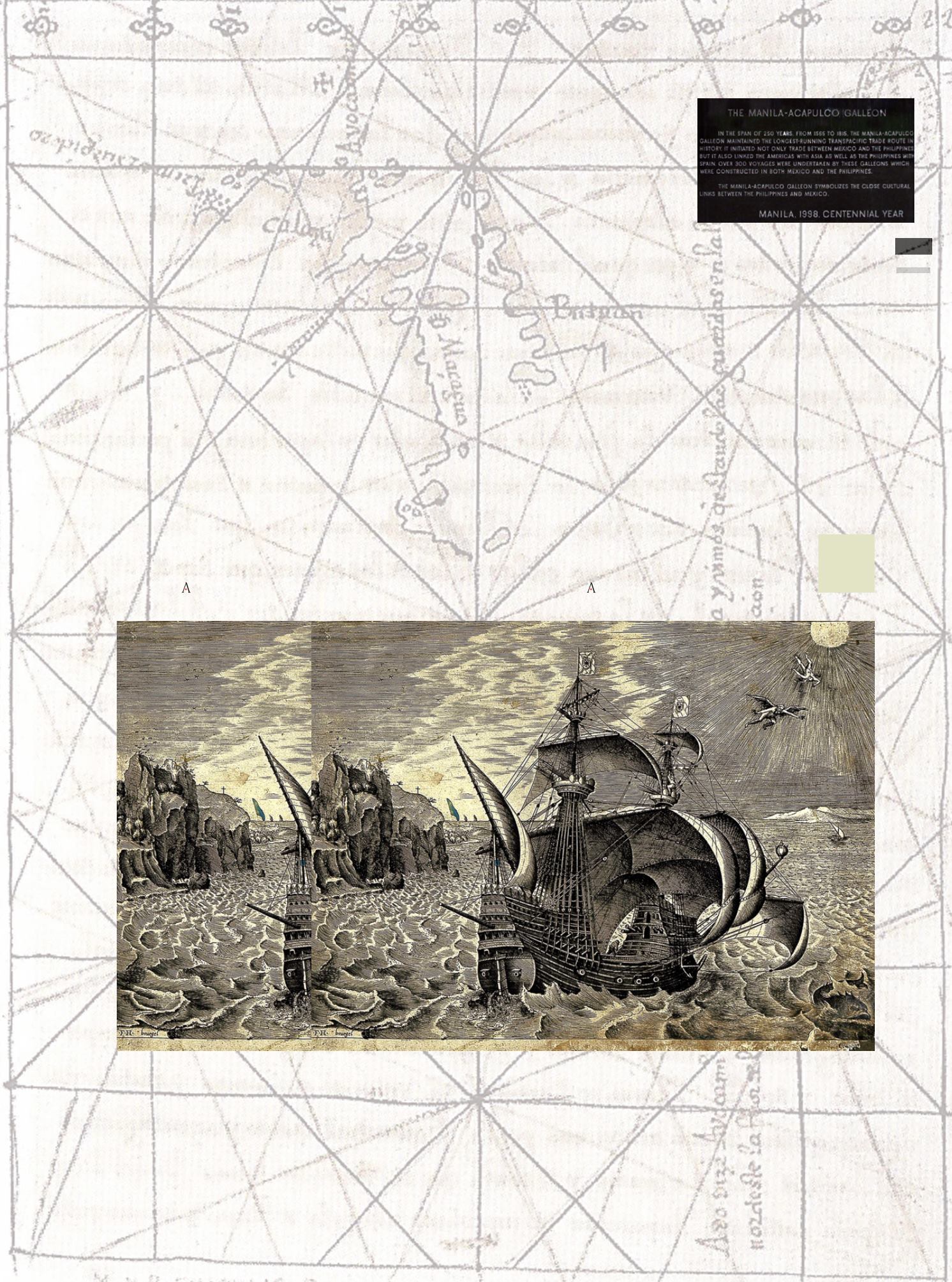
The routewas difficult and dangerous, so Spain
had several war fleets to protect the Galleon. The
trip from Manila to Acapulco lasted between four
and five months, but it was reduced to just three
on the way back. It departed Manila in late June
to avoid the monsoon season, while it sailed from
Acapulco between February and March.
However, the Philippine’s capital was actu-
ally nothing more than the port of shipping,
as most of the products came from China, Ja-
pan, India, Thailand and Siam. But don’t think
this downplayed the trip, because in practical
terms the city became the most important link
between East and West for many years. Mexican
silver coins that came to it were quickly distrib-
uted throughout Southeast Asia, causing that
the Mexican peso -at least at that time-, was an
accepted currency virtually everywhere.
On the other hand the Galleon caused an un-
precedented cultural exchange between Mexico
and the Philippines. Puebla’s Talavera or those
multicolored shawls of our typical costumes come
from there, while the Filipino language, Tagalog,
contains more than 5,000 words in Mexican Span-
ish, including several in Nahuatl.
The last Galleon left Manila in 1821 never to
return. Just arriving at New Spain it was seized by
Iturbide, who at the time was about to gain inde-
pendence for Mexico. Thus a glorious era of world
trade died
.
IereOciB cVMtVrBM •
culture and heritage
5.Diversaspiezasde
arte,comoestearcón,
hacenreferenciao
ilustran la importancia
delGaleóndeManila.
/
Severalpiecesof
art,likethisbunker,
referorillustratethe
importanceofthe
ManilaGalleon.
5