·amura·
138
tips & tops
Texto /
Text
: AMURA • Foto /
Photo
: CEP / siemenes / tonemapped / Paolo Olvera / PAS
Tips & Tops
• Mumbai is the capital of the federal state of Ma-
harashtra, India. Its official currency is the rupee
(INR), subdivided into 100 paise. In banks and au-
thorized money exchange services the main cur-
renciesmay be exchanged. It is illegal to exchange
currency in the black market; it is also advisable
to reject torn bills, for they will not be accepted in
any other place but the Reserve Bank of India.
• A tourist visa is required to enter India the
same as a passport valid for at least 6 months.
Visas can be obtained in any Indian consulate
in the foremost hometowns and are usually
valid for 6 months.
• The Mumbai’s airport is 29 km north of the
city, on a 90 minutes trip. One can arrive in the
city by taxi cab or by EATS buses (public trans-
port.) A car may be rented, with or without a
chauffer, in Silver Cabs or Carzonrent. It is ad-
vised that passengers do not drive personally
around Mumbai.
• Bombay has a tropical climate with two seasons:
wet and dry. BetweenMarch and October, the sum-
mer months, the weather is warm and wet; mon-
soons flood the city mid summer, being July and
August the months that suffer most during the
monsoon period; and one should avoid traveling
to Bombay in those months, there is too much
wetness and the tripmight be ill-starred. Between
November and February, in the wintertime, the
weather is dry and warm, with a few cold spells
produced by cool winds.
• In order to travel to this city as a tourist, it is
very recommendable going dressed in cotton
and light clothing; though, in the wintertime,
between November and March, it is advisable to
wear warm clothes, especially for the nighttime.
Shades would be very useful from May to Sep-
tember, in the rainy season; it is recommended
not forgetting your umbrella and a good coat.
Tips
• Mumbai es la capital del estado federal de Maharas-
htra en la India, su moneda oficial es la rupia (INR),
que se divide en 100 países. En los bancos y en las
oficinas de cambio autorizadas se pueden cambiar
las principales divisas. Es ilegal cambiar moneda en
el mercado negro; asimismo, es aconsejable recha-
zar billetes rotos, ya que no serán aceptados en nin-
gún sitio que no sea el Banco Nacional.
• Es necesario tener un visado turístico para entrar a
India así como un pasaporte con una validez mínima
de seis meses. Los visados se pueden obtener en
cualquier consulado indio en las principales ciudades
de los países de origen.
• El aeropuerto de Mumbai está a 29 km al norte de la
ciudad con una duración del trayecto de 90 minutos.
Se puede llegar a la ciudad en taxi o en los autobu-
ses EATS (transporte público). Se puede alquilar un
coche, con o sin conductor, a través de Silver Cabs
o Carzonrent. Se recomienda a los pasajeros que no
intenten conducir personalmente por Mumbai.
• Bombay tiene un clima tropical, con dos estaciones:
húmeda y seca. Entre marzo y octubre, los meses
de verano, el tiempo de Bombay es cálido y húme-
do, las lluvias monzónicas inundan la ciudad a me-
diados de verano, julio y agosto son los meses que
más sufren durante el monzón, y se debería evitar
viajar a Bombay durante esos meses, ya que hay
demasiada humedad y puede que su viaje resulte
perjudicado. Entre noviembre y febrero, el invierno,
el tiempo es seco y cálido, con ocasionales tempo-
radas frías producidas por los vientos fríos.
• Para viajar a esta ciudad como turista, es impor-
tante ir con ropa de algodón y ligera, durante el
invierno de noviembre y marzo, es aconsejable
llevar ropa de abrigo, en especial para las noches.
Las gafas de sol nos serán de mucha utilidad, de
mayo a septiembre que es época de lluvias, se
recomienda que no olvides tu paraguas y una
buena chaqueta.
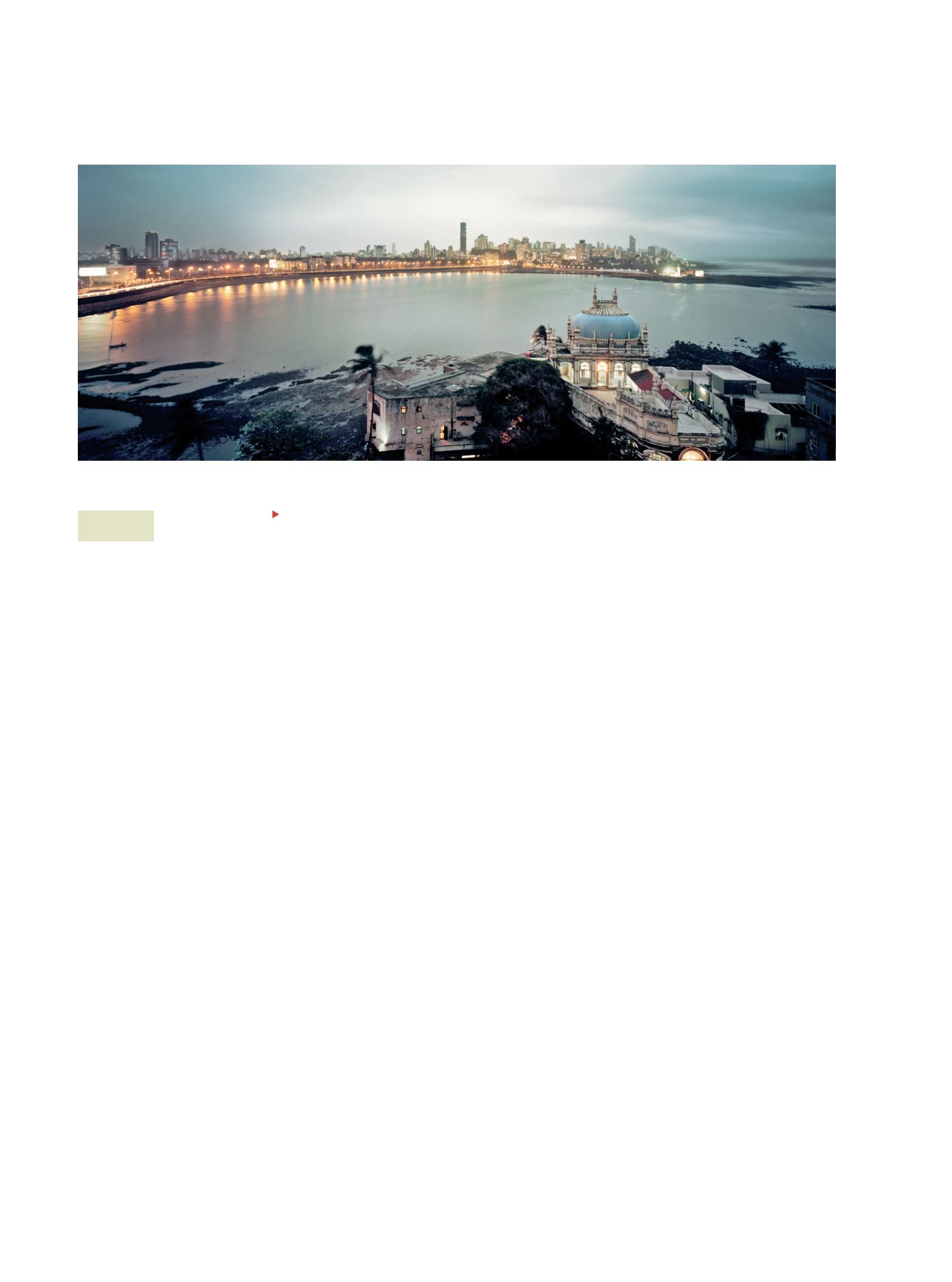
1.Vistapanorámicade
labahíadeMumbai.
/
Panoramicviewof
Mumbaibay.
1


