·amura·
129
personajes •
characters
En 1915 regresó a la India donde continuó su labor
como defensor de los derechos de su pueblo y comen-
zó una nueva etapa en la lucha por la swaraj (autono-
mía) india, convirtiéndose en el máximo representan-
te del movimiento nacionalista de la India. Aunque por
sí mismo, bapú (Papá), como le gustaba que le llama-
ran, fracasó en traer la independencia india, facilitó el
proceso en la caída del Imperio británico.
Con su postulado de resistencia pasiva, que se co-
nociera durante la marcha de la sal o
salt satyagraha
(1930), efectuada en protesta al impuesto sobre un
insumo esencial del pueblo indio (hindúes ymusulma-
nes) y cuya producción era un monopolio regido por el
gobierno de Gran Bretaña. Gandhi sabía que la inde-
pendencia solo se llegaría cuando el dominio británico
perjudicara por igual a toda la sociedad india; fueran
hindúes o musulmanes y sin importar a la casta que
pertenecieran. Así, el impopular impuesto sobre la sal
marcó el principio del fin del colonialismo inglés. Au-
nado a ello, el Congreso Nacional Indio manifestó su
malestar por la negativa británica de conceder el sta-
tus de dominio a la India.
Ese activismo le generó que fuera arrestado en
diferentes ocasiones, tanto en Sudáfrica, durante la
Guerra Boer, como en la India. Sin embargo, para él, ir
a la cárcel era algo honorable pues sabía que luchaba
por una causa justa.
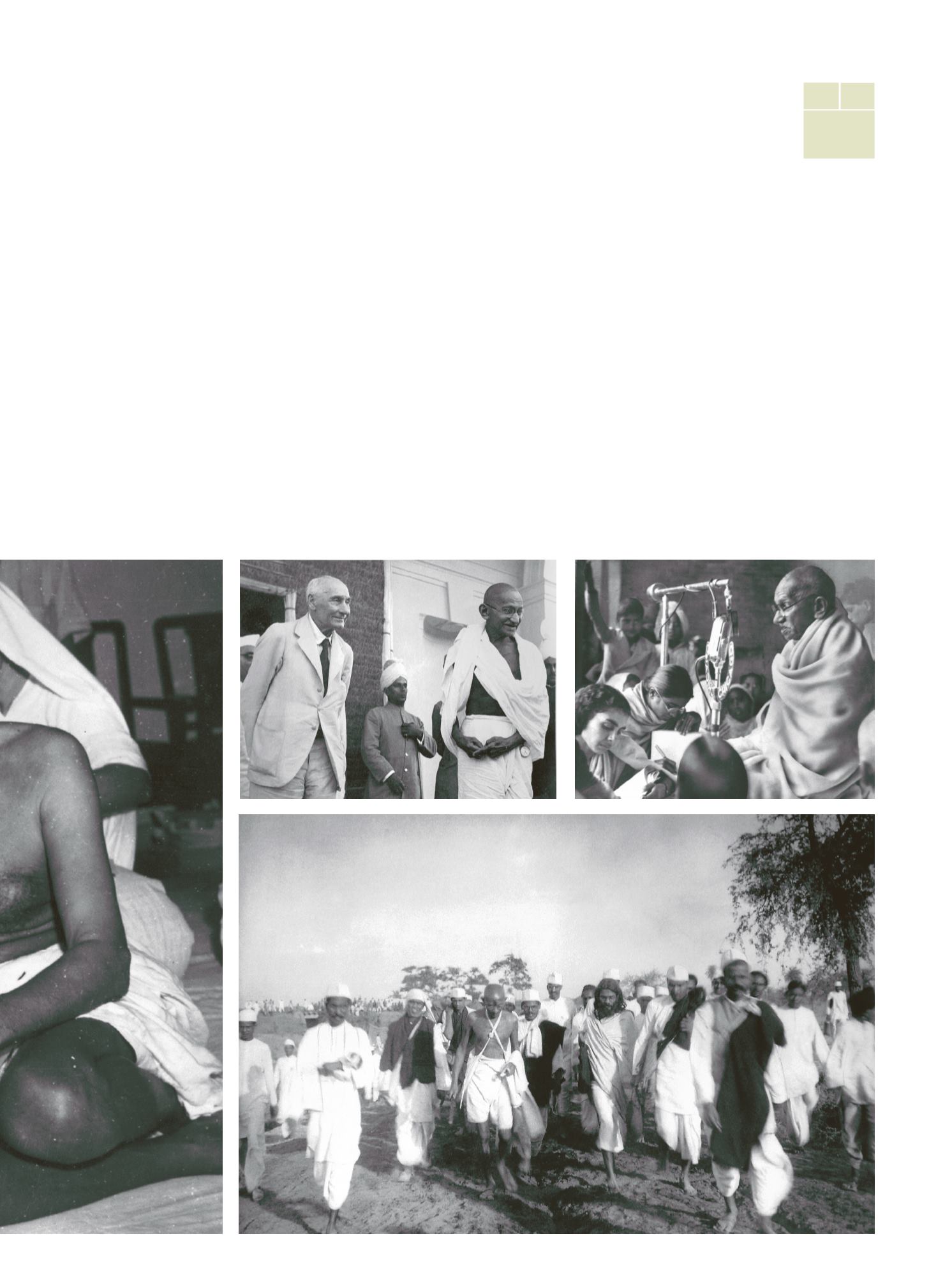
7.Elsecretario
británicoLord
PethicLawrence
conGandhi./
The
BritishSecretary
LordLawrencePethic
Gandhi.
8.MahatmaGandhi,
precursorde la
independencia india
y líderderesistencia
pacífica./
Mahatma
Gandhi,theIndian
independence
precursorand
leaderofpeaceful
resistance.
9.MahatmaGandhi
durante“lamarcha
de lasal”/
Mahatma
Gandhiduringthe
“saltmarch”.
7
8
9
In 1915, he returned to India where he contin-
uedhiswork as a defender of his people’s rights, and
started a new stage in the struggle for the Indian
swaraj (self-rule.) He became the top representative
of the nationalistic movement of India.He liked the
title “Bapu”, “Father”, even if he, on his own, failed
to bring about the independence of India, still he
contributed to the process of the British Empire fall.
Through his passive resistance principle, made
known during the Salt March or Salt Satyagraha
(1930), he protested against the tax levied on such
an essential input for the Indian people (Hindus and
Muslims); its production was a monopoly ruled by the
British Government. Gandhi was aware that the inde-
pendence would come about only when the British
dominance might hurt in the same manner all of the
Indian society; no matter whether Hindu or Muslim,
no matter what caste he or she belonged to. Thus, the
unpopular taxonsaltmarked thebeginningof the end
for the British colonialism. Simultaneously, the Indian
National Congress declared their upset for the British
refusal to grant the dominion status to India.
Such an activism provoked his arrest in differ-
ent times in South Africa, during the Boer War, the
same as in India. For him, however, going to jail was
something honorable, because he was aware he was
fighting for a just cause.


