They have highlighted their attempts to “social
engineering”, thus called Kuan to the idea of build-
ing a “great China”. “The affinity of race, culture and
language is the basis of business relationships”,
stresses Lee Kuan Yew, referring to overseas chinese.
Lee Kuan Yew took the reins of the small
country in Southeast Asia and in a matter of 20
years went on the debate between political sci-
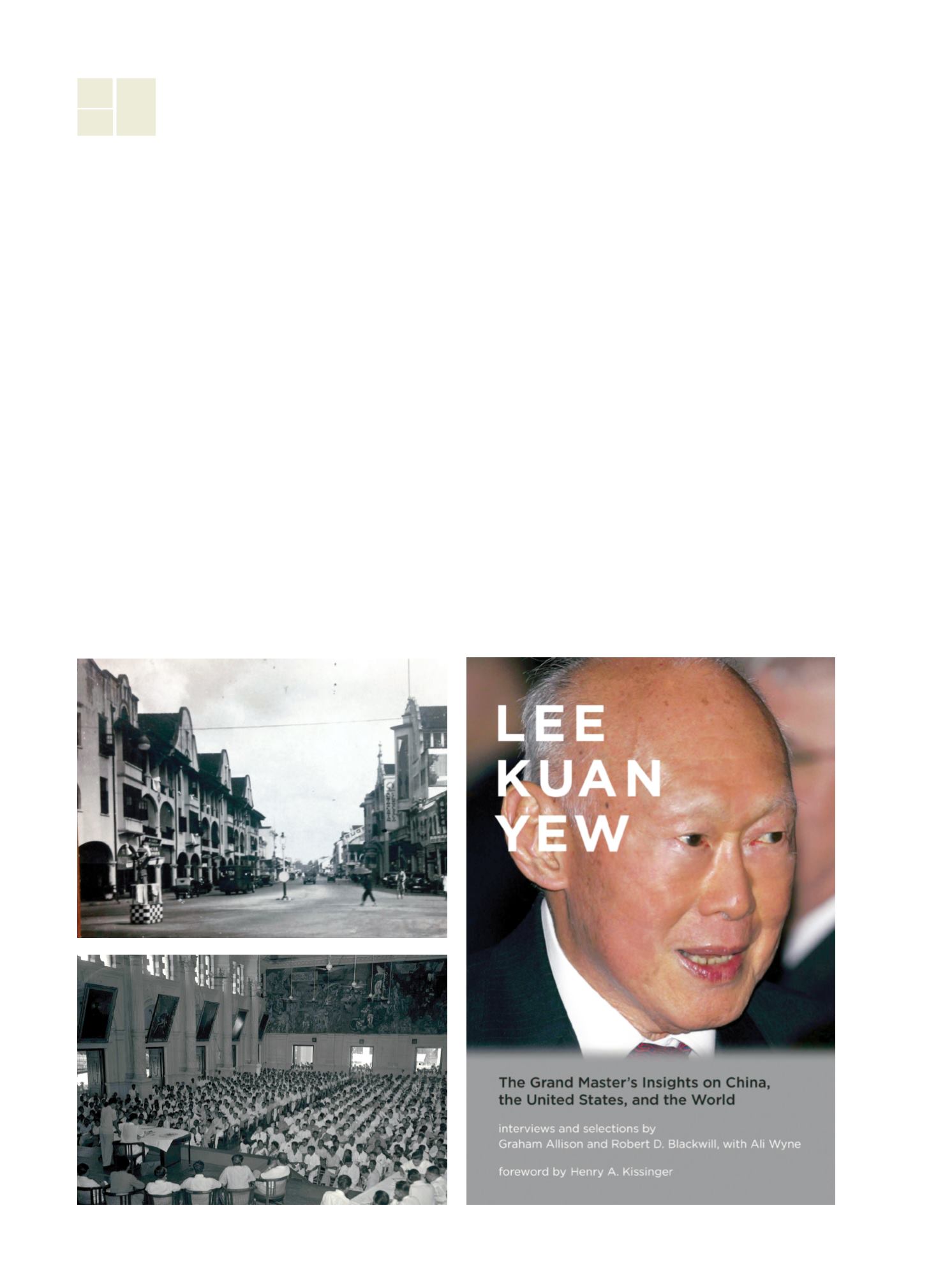
ence theoreticians. The latest book by the former
Prime Minister of Singapore,
“The Grand Master’s
Insights on China, the United States, and the World”
is a constant provocation.
Although he is guilty of the optimism of some
liberals, he does not go indirectly on some ideas
pre-established in the West on the international
agenda, the future of China and The United States,
democracy, multiculturalism and the keys to the
economic miracle in Singapore.
In his view, the English language gives you a
great advantage to us about China. “The use of Eng-
lish enables the United States attract millions of
English speakers with talent fromAsia and Europe”,
he says in the mentioned text.
LeeKuanYewwastheonlyPresidentinSingapore
from1959 until 1990, when by his own, he decided to
leave his post tomake way for the next generation of
politicians. Goh Chok took office in 1990 and created
a Ministry without portfolio for Lee Kuan Yew and
appointed him as Senior Minister. Years later, Goh
Chok Tong decided to leave his post in 2004 and Lee
Hsien Loong, son of Kuan Yew, assumed the position
of PrimeMinister; at that time his fathermoved from
Senior Minister to be called toMinister Mentor.
Han destacado sus intentos de “ingeniería social”,
así llama Kuan a la idea de construir una “Gran China”.
“La afinidad de raza, cultura y lengua es la base de las
relaciones de negocios”, enfatiza Lee Kuan Yew, refi-
riéndose a los chinos en el exterior.
Lee Kuan Yew tomó las riendas del pequeño país del
sureste asiático, y en cuestión de 20 años encendió el
debate entre los teóricos de la ciencia política. El últi-
mo libro del exprimer ministro de Singapur,
“The Grand
Master’s Insights on China, the United States, and the
World”
, (Perspectivas del gran maestro en China, Esta-
dos Unidos, y el mundo) es una provocación constante.
Aunque peca del optimismo de algunos libe-
rales, no se anda con rodeos sobre algunas ideas
preestablecidas en Occidente acerca del orden in-
ternacional, el futuro de China y Estados Unidos,
la democracia, el multiculturalismo y las claves del
milagro económico en Singapur.
A su juicio, el idioma inglés le concede una gran
ventaja a EE. UU. sobre China. “El uso del inglés le
permite a Estados Unidos atraer millones de an-
glohablantes con talento desde Asia y Europa”, afir-
ma en el texto mencionado.
Lee Kuan Yew fue el único mandatario en Singapur
desde 1959 hasta 1990, cuando por su propia volun-
tad decidió dejar el cargo para dar paso a la siguiente
generación de políticos. Goh Chok asumió el cargo en
1990 y creó un ministerio sin cartera para Lee Kuan
Yew nombrándole Senior Minister. Años más tarde,
Goh Chok Tong decidió dejar el cargo en 2004, y Lee
Hsien Loong, hijo de Kuan Yew, asumió el cargo de pri-
mer ministro; en ese momento su padre pasó de ser
llamado Senior Minister a Mentor Minister.
108
·amura·
personajes • characters
3. Singapur, en 1960.
/
Singapore in 1960.
4. “Las percepciones
del Gran Maestro
sobre China, los
Estados Unidos y el
mundo”, el más re-
ciente libro de Lee. /
“The Grand Master’s
Insights on China,
the United States,
and the World”, the
most recent book
by Lee.
5. Formación del
Partido Acción
Popular en 1954. /
Establishment of
the People’s Action
3
5
4


