


 148 / 176

·amura·
146
"rtF •
Art
¿How did you began to paint?
Like many kids I would draw my favourite TV char-
acters, toys, I would do compositions with them. It
all began as a hobby; I had to go through several
stages, the first was caricatures, after that, comics,
which played an important role for me as a sketcher
and illustrator, this is how I began to be a profes-
sional; In 1999, when I was 15 I worked for several
magazines, amongst them Rolling Stone. Then I
made storyboards for short films and music vid-
eos as well as some character designing. I always
considered myself as a sketcher, not a painter, al-
though I had experienced with diverse techniques
I hadn’t done so with painting. After I studied in
the San Carlos Academy, I began to paint with oil
to turn myself into a painter. Under the direction of
my teacher, Rocío Romero, I was ready to apply this
technique into my art. What came later was a lot of
practice and experimenting.
Why did you choose to paint and
not other artistic expression?
Due to the fact that I saw I could do great things, express
myself in a differentway thanwith ink andpencils. Today I
paint a lot, although I haven’t given upwith the ink. There
really isn’t a technique that I like more than the other, it
all depends on what I will portray; I choose my technique
based on that, lately it has been oil. Music is another great
passion ofmine, I play the guitar since I was 10 years old, I
sing and I also love the piano. I also enjoy writing, and -al-
thoughsomeareincomplete-IhaveseveralstoriesIwrote
way back; I love cinematography, this took me through a
phase of approaching graphic screenwriting.
¿Cómo empezaste a pintar?
Como la mayoría de los niños, dibujaba a mis perso-
najes favoritos de televisión, así como juguetes, y
hacía composiciones con ellos. Inició como un hobby,
pasé por varias etapas, siendo la primera la carica-
tura, luego, los cómics jugaron un papel importante
como dibujante, pues fue cuando inicié profesional-
mente como ilustrador. En 1999, a los 15 años, tra-
bajaba para varias revistas, entre ellas Rolling Stone.
Luego hice
storyboards
para cortometrajes, video
clips musicales y diseño de personajes. Siempre me
consideré un dibujante, no un pintor, pues aunque
había experimentado con diversas técnicas, aún no
lo había hecho como tal en la pintura. Posteriormen-
te, tras mi paso por la Academia de San Carlos, me
inicié en el óleo para convertirme en pintor. Así, bajo
la dirección de la maestra Rocío Romero, estuve listo
para aplicar esta técnica a mi arte, lo que vino des-
pués fue mucha práctica y experimentación.
¿Por qué escogiste pintura y no
otra expresión artística?
Debido a que vi que podía hacer cosas más gran-
des, expresarme de una forma diferente. Hoy en día
pinto al óleo más que otra cosa, aunque no dejo los
lápices y la tinta.
La música es otra de mis pasiones, toco la guitarra
desde hace más de 10 años, canto y me gusta mucho
el piano.
También me gusta escribir y aunque siguen in-
completos, tengo algunos cuentos que empecé hace
años; el cine me encanta, ello me llevó a tener un acer-
camiento en mi etapa de guionista gráfico.
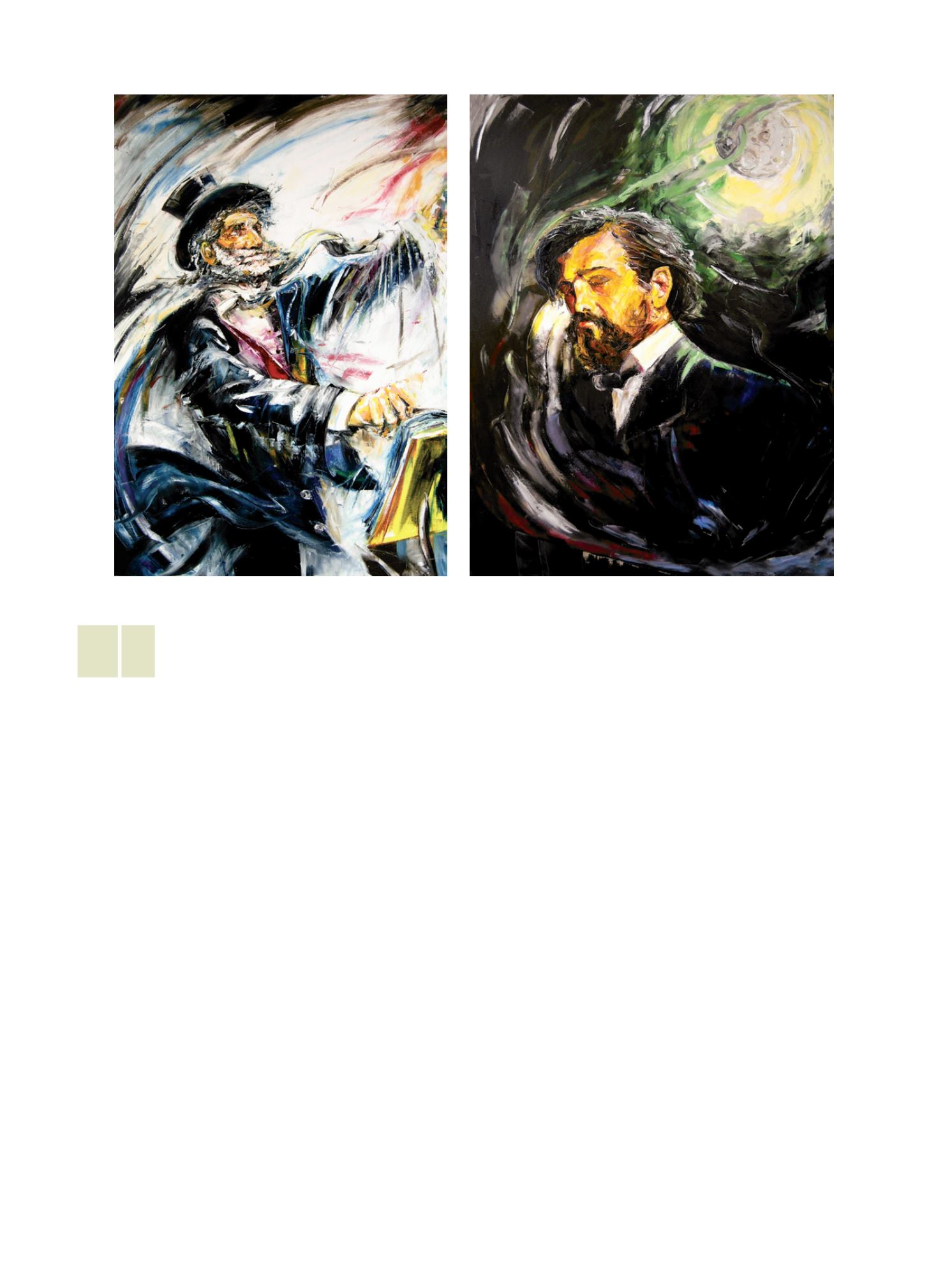
6. Verdi,2011(tríptico1/3)
Óleossobretela//
Oilon
canvas
60X100cm
Verdi,elgrancompositorde
óperas. /
Verdi,thegreatopera
composer.
7.Debussy,2010
Óleosobretela/
Oilon
canvas
91X122cm .
Debussy,elmás
grandeexponentedel
impresionismomusical.
/
Debussy,thegreatest
exponentofmusical
impressionism.
6
7