


 149 / 176

·amura·
147
"rtF •
Art
If I wasn’t a professional painter I would be a mu-
sician; music is an important part of my work, for
example, my series of Classical Musicians, is based
on some of the greatest composers of history, I
created it while I was listening to pieces from great
masters like Beethoven, Ravel or Paganini; I wished
to “translate” the essence of each of them. In the
same way pictoric creations exist based on literary
works, from The Bible to novels. When the arts com-
plement each other you can achieve great things.
Do you remember the first time
you felt the need of portraying?
I don’t, but I always the need to paint, it was something
quite natural forme. My parentswould keep everything
I sketched since I was little and I have boxes full of that,
reason why it wasn’t something fortuitous. Someday I
will make an exhibit with that material.
Today, when you create, where
do you find your muse?
Inspiration has arrived in different forms; if we
speak merely of creation, it comes from various
travels, music, movies, books, women or my own
feeling and ideas. When we are talking about tech-
nique and the progress inmywork; I amself-taught,
I learned by observing and trying to emulate the
artists I admire. This is how I achieved proportions,
effects, shapes, etc. I usually see the great artists as
a source of inspiration. More than something unob-
tainable; it pushes me to improve my compositions
and question myself: can I get that level
of realism?
I also believe that inspiration is something you find
working and when you have a clear objective toward
what you wish to achieve, what you want to commu-
nic
ate and provoke in the spectator. What happens
is that I get new ideas, especially if my objective is
so vast, I don’t need inspiration from other sources.
Si no fuera pintor profesional, sería músico. La mú-
sica tiene un papel importante en mi obra, por ejemplo,
mi serie
Músicos clásicos
, basada en los más grandes
compositores de la historia, la pinté mientras escucha-
ba las composiciones de maestros como Beethoven,
Ravel o Paganini; quería “traducir” la esencia de cada
uno de ellos a la pintura. De igual manera existen crea-
ciones pictóricas basadas en obras literarias, desde la
biblia hasta novelas. Cuando las artes se complemen-
tan entre sí, se pueden lograr cosas increíbles.
¿Recuerdas la primera vez que
sentiste la necesidad de plasmar?
No la recuerdo, pero siempre tuve la inquietud por
pintar, era algo natural en mí. Mis papás guardaron
todo lo que dibujaba desde pequeño y tengo cajas
llenas de eso, por lo que no fue algo fortuito. Algún
día haré una exposición con ese material.
Hoy, tu hacer, tu crear, ¿en dónde en-
cuentra a sumusa?
La inspiración me ha llegado de diferentes formas;
si hablamos meramente de creación viene de viajes,
música, películas, libros, mujeres o de mis propios
sentimientos e ideas. Cuando se trata de la técnica y
el progreso en mi trabajo, como autodidacta, puedo
decir que aprendí observando y tratando de emular
a los artistas que admiro. Así logré proporciones,
efectos, formas, etc., suelo ver el trabajo de los gran-
des artistas como una fuente de inspiración, más
que como algo inalcanzable; me incita a mejorar mis
composiciones al cuestionarme: ¿Puedo alcanzar ese
nivel de realismo? También creo que la inspiración la
encuentras trabajando y cuando tienes claro tu ob-
jetivo, lo que quieres lograr, comunicar o causar en
el espectador. Sucede que me llegan ideas nuevas,
sobre todo si tengo un objetivo grande y no necesito
buscar inspiración en otros lugares.
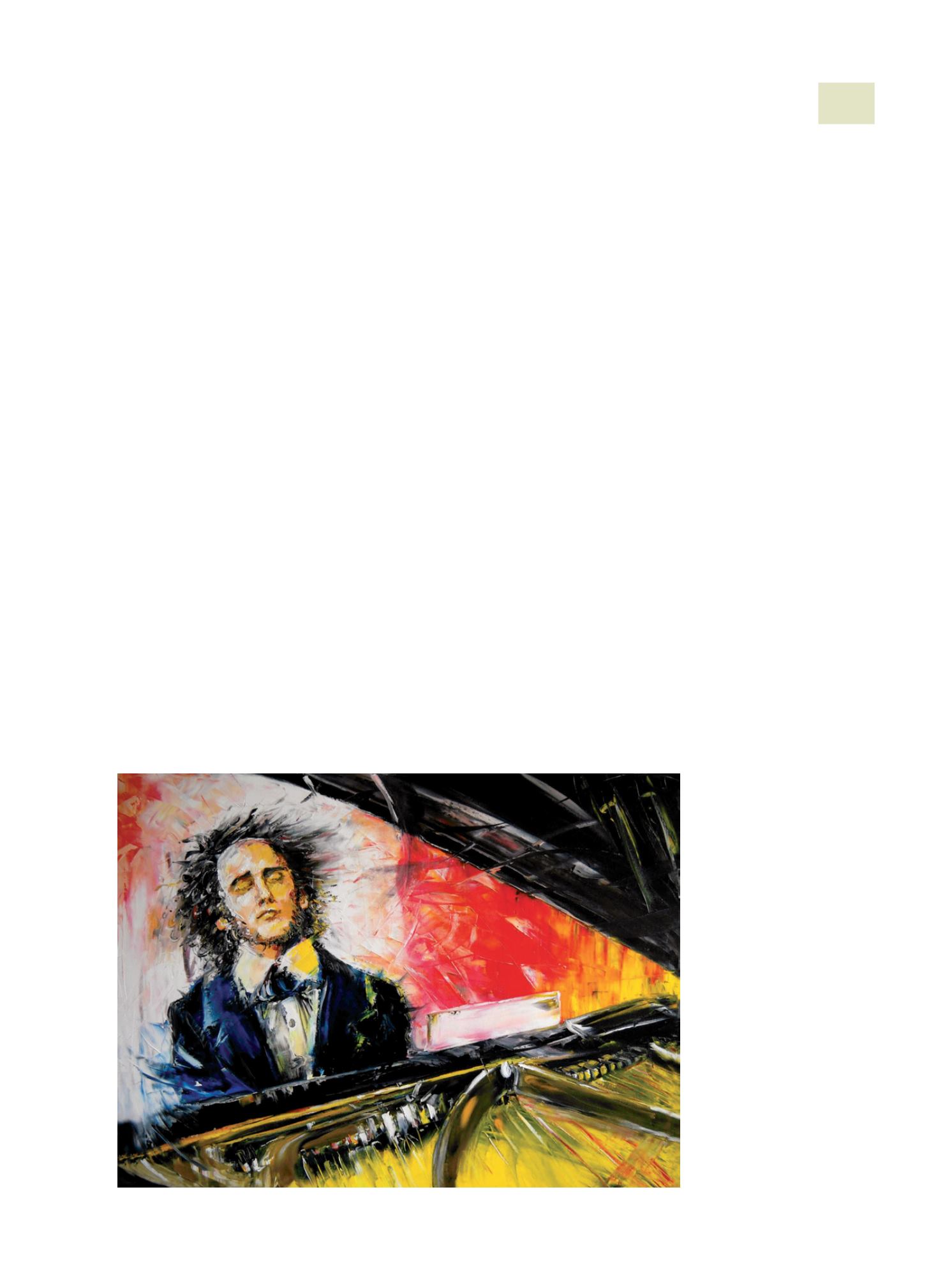
8.Mendelssohn,2010
Óleosobretela/
Oilon
canvas
101X76cm.
Mendelssohn,desde
edadestempranas
mostrósutalento
musical./
Mendelssohn,from
anearlyageshowed
hismusicaltalent.
8