117
los conquistadores •
the conquerors
·amura·
the successive avant-garde oils through to the
complete overspill of art with regard to depth
and width throughout the 20th century.
If we unite the Impressionist concept to the
sea, so expensive for the readers of our maga-
zine, refined works of great beauty, works that
give a 360º turn to art and its history of more
than 500 continuous years. Impressionism is
about paintings and an art is that came out of
workshops to show nature, not as it is, but how
we see it, how we perceive it and how we feel it.
All good sailors know that the cover of the sea is
not always the same; that its texture and appear-
ance varies at different times of the day, with
each slight change in the weather; they know
that the atmosphere, the light and the atmos-
phere are never the same. The Impressionists
wanted to show this and they achieved it.
Of course, Impressionism has its ancestors
and not only with regard to landscape cultivated
broadly as a genre from the 17th-century, espe-
cially in the Low Countries, but also as an expres-
sive experiment that went beyond realism. The
English William Turner (1775-1851) recovers the
Dutch tradition of marine scenes from the previ-
ous century, offering atmospheric art charged
with romanticism. One of his contemporaries,
the extraordinary John Constable (1776-1837)
had already noted landscape as a theme:
No two
days were two hours seemed alike. From cre-
ation, there had never been two leaves that were
identical.
Eugène Boudin (1824-1898) would introduce
Claude Monet to the theme of landscape that
then, in the second half of the 19th century, did
y a la que seguirían las sucesivas oleadas van-
guardistas hasta el desbordamiento total del arte
en cuanto a profundidad y anchura a lo largo del
siglo XX.
Si unimos el concepto impresionista al tema
del mar, tan caro para los lectores de nuestra
revista, nos encontramos con obras de gran belle-
za, trabajos que daban al arte y su historia de más
500 años continuados un giro de 360 grados. Son
cuadros y autores que salieron de los talleres para
mostrar la naturaleza, no como es sino como la
vemos, como la percibimos, como la sentimos.
Todo buen navegante sabe que el color del mar
nunca es igual, que su textura y apariencia varían
con cada hora del día, con cada leve cambio climá-
tico, sabe que la atmósfera, la luz, el ambiente
nunca son iguales, todo eso querían mostrar los
impresionistas, y vaya que lo lograron.
Por supuesto que existen antecedentes del
impresionismo, y no sólo en cuanto al paisaje
como género cultivado ampliamente desde el
siglo XVII en especial en los Países Bajos, sino
también como experimentación expresiva que iba
más allá del realismo. El inglés William Turner
(1775-1851) recupera la tradición holandesa de
escenas marinas del siglo anterior, ofreciendo un
arte atmosférico, cargado de romanticismo. Otro
contemporáneo suyo, el extraordinario John
Constable (1776-1837) ya apuntaba respecto al
paisaje como tema:
Nunca se parecen entre sí dos
días o dos horas. Desde la creación, no ha habido
dos hojas que sean idénticas.
Eugène Boudin (1824-1898) introducirá a
Claude Monet en el tema del paisaje que enton-
ces, en la segunda mitad del siglo XIX, no era nada
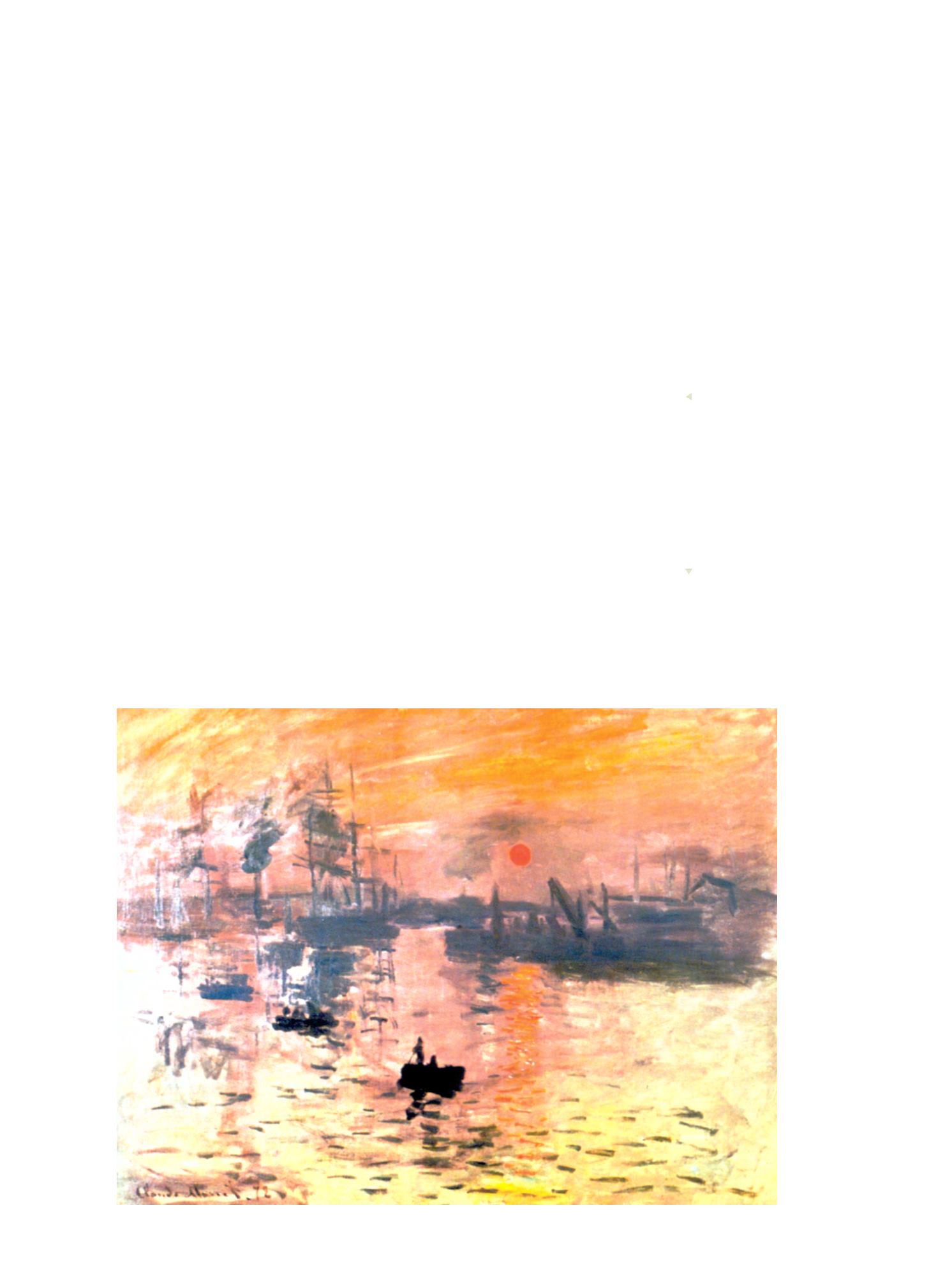
Impresión: sol naciente
Claude Monet
48 x 63 cm
Óleo sobre lienzo
Museo Marmottan, París
1872
Impression: sunrise
Claude Monet
48 x 63 cm
Oil on canvas
Marmottan Museum París
1872
Regatas de Argentuil
Claude Monet
60 x 80.5 cm
Óleo sobre lienzo
Museo de Orsay, París
1872
Regatas de Argentuil
Claude Monet
60 x 80.5 cm
Oil on canvas
Orsay Museum, París
1872


