los conquistadores •
the conquerors
118
·amura·
Texto /
Text:
Miguel Peraza • Foto /
Photo
: Archivo
T
he list of foreign artists who have come to
Mexico to study, perfect their technique or
broaden their knowledge is important and long.
Occasionally, some of them succumbed to their des-
tiny and settled here permanently. Mexico attracted
these artists because of its schools, customs, climate
and possibilities of economic development in relation
to other Latin American countries during the 20th
century. These are the main reasons why Mexican
cities received the benefit of the influence and talent
of artists frommany corners of the world.
It is important to mention that many came and
stayed because of Mexico’s proximity to the United
States. Although there is some truth in this, it is also
false. Most of the time it is a mirage. This is not the
case of the masters that I will mention. They were
conquered by what they found in this country or they
were straying from dictatorships, living their exile
from another perspective.
Let us remember the “niños de Morelia” (children
of Morelia), orphans who arrived here fleeing from the
Spanish Civil War and who settled in the capital of
Michoacán. Among them were children who devel-
oped talents in different artistic areas. One of them
was Julián Martínez, a sculptor who created more
than a hundred works of art that adorn many of
Mexico’s state capitals and municipalities. One of his
most important sculptures is the monument of
General Emiliano Zapata, on Paseo Tollocan, on the
outskirts of Toluca, State of Mexico. It is beautiful and,
because of its size, one of the biggest equestrian
sculptures on the continent.
And what about Remedios Varo? She was born in
Catalonia, Spain in 1913and lived in Mexico from
E
s extensa e importante la lista de artistas extranje-
ros que han llegado a México a estudiar, a perfeccio-
nar sus técnicas, a ampliar y aplicar sus
conocimientos. En ocasiones, algunos de ellos fueron lle-
vados por el destino a habitar de manera permanente en el
país. Es decir, México atrajo la atención y la presencia de los
artistas debido, entre otros factores, a las escuelas, las cos-
tumbres, el clima, las mayores posibilidades de desarrollo
económico —en relación con otros países de América Lati-
na durante el siglo XX—. Son éstos los principales factores
por los cuales diferentes ciudades recibieron el beneficio
de la influencia y el talento de creadores de diversas latitu-
des del planeta.
Por supuesto que hay un aspecto que no podemos de-
jar de mencionar, y es que muchos vinieron y se quedaron
porque creyeron que era importante la cercanía geográfica
con Estados Unidos de América. Si bien esta idea puede ser
verdadera, de que desde aquí es más fácil conquistar ese
mercado, hay cierta falsedad en ella, hay un espejismo en
la mayoría de las ocasiones. No es el caso de los maestros
que a continuación menciono, en su momento más bien
fueron conquistados por sus propios hallazgos en el país o
se localizaron a suficiente distancia de dictaduras, vivien-
do su exilio desde otra perspectiva.
Recordemos a los huérfanos que llegaron de la Guerra
Civil española, que fueron conocidos como “los niños de
Morelia”, ciudad en la que se localizara su residencia. Entre
éstos se formaron talentos en diversas disciplinas artísti-
cas y uno de ellos es JuliánMartínez, artífice demás de una
centena de esculturas urbanas para casi todas las capitales
y muchos municipios del país. Destaca el monumento al
general Emiliano Zapata, a la entrada del Paseo Tollocan,
camino a Toluca, en el Estado de México. Es una de las obras
ecuestresmás grandes de nuestro continente, en términos
Arte exiliado en México
Exiled art in Mexico
Francisco Zuñiga
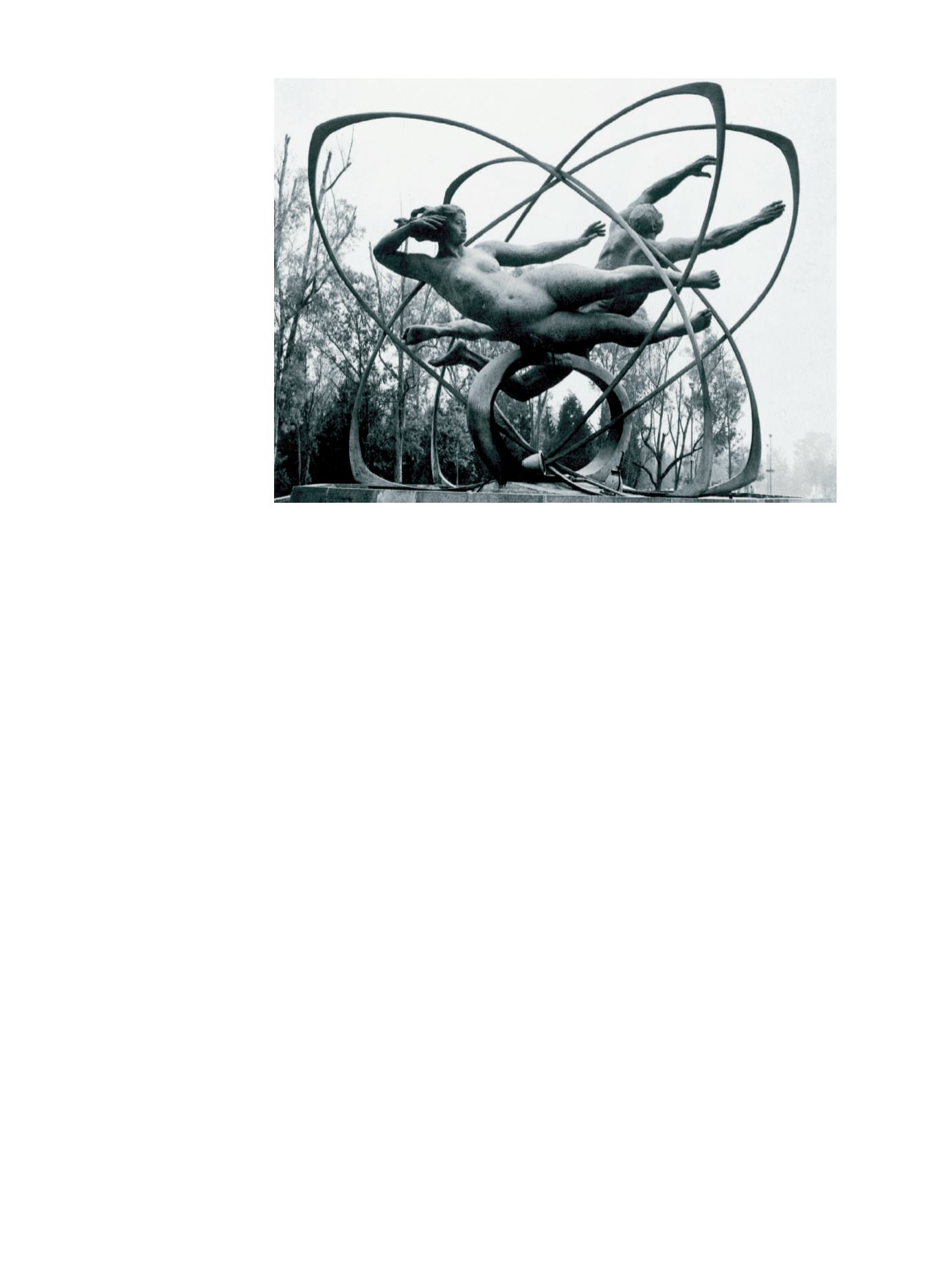
Física nuclear
Bronce
1964


