planeta azul •
blue planet
96
·amura·
have the opportunity to coexist with the joyful south-
ern sea lions in their natural habitat. The extraordi-
nary, fearless females approach divers, showing off
their marine abilities, while the large males impede,
with a loud bark in our face, an attempt to pass the bar-
rier of their territory which, to us, is invisible.
For those lovers of the small beings that live at the
bottom of the Sea of Cortez, La Paz is a great place for
observing the small, shell-less creatures that seem to
bear on their bodies brightly colored, feathered head-
dresses. I am, of course, referring to nudibranches.
In the middle of the water, driven by soft marine
currents, different types of jelly fish travel great dis-
tances. Contrasting in size and shape, near La Paz you
can observe huge marine mammals such as great
Blue, Gray and Humpbacked whales, the formidable
Orca or killer whale, and the always cheerful, playful
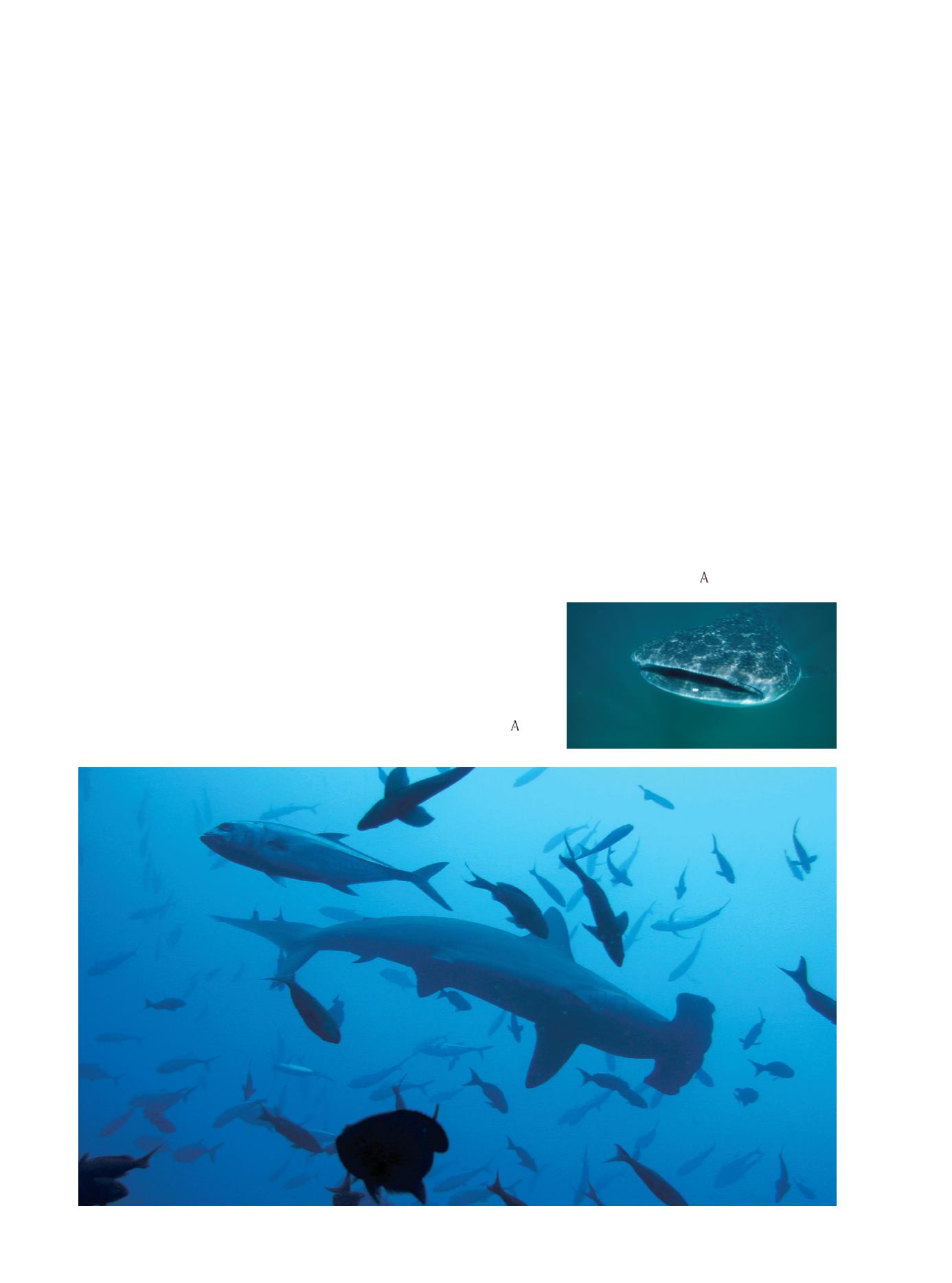
dolphins. El Bajo, a reef that put La Paz on the inter-
national dive spot map, is the place to observe great
schools of inimitable hammer sharks which, until
recently, were thought to inhabit only in the waters of
the faraway Cocos Island or the mystical Galapagos.
At certain times of the year, in the waters near La
Paz you can witness an incredible act of nature: coex-
isting with the gentle whale shark, the world’s
biggest fish, which arrives year after year to enjoy the
serenity of these waters. And what can we say about
the giant manta rays that reach up to fivemeters from
tip to tip and can weigh more than a ton? For all this
and more, La Paz is a must for all lovers of the fabu-
lous sport called diving.
Al explorador submarino le esperan grandes sorpre-
sas cuando se sumerge en sus claras y templadas
aguas, porque tiene la oportunidad de convivir con los
siempre alegres lobos marinos en su ambiente natural.
Las hembras se acercan a los buzos sin temor, mostran-
do sus habilidades acuáticas, mientras que los grandes
machos impiden con un fuerte aullido que rebasemos la
barrera, para nosotros invisible, de su territorio.
La Paz es un excelente sitio para observar tanto a
los pequeños como a los inmensos seres que habitan el
fondo del mar, lo cual hace la dicha de los amantes de
esta actividad. Por ejemplo, ver a los nudibranquios,
esos minúsculos caracoles sin concha que parecen lle-
var en sus cuerpos unos penachos plumosos de brillan-
tes colores. También aquí es muy disfrutable ver
diferentes tipos de aguamala, que recorren grandes dis-
tancias impulsadas por suaves corrientes marinas.
Contrastando en tamaño y forma, en las cercanías de
La Paz los grandes mamíferos del mar nos regalan sus ac-
tuaciones, y así se goza al ver a los diferentes tipos de ba-
llena, la azul, la gris y la jorobada, a la temible orca o ballena
asesina y a los siempre alegres y juguetones delfines.
En cierta temporada del año, en aguas cercanas a La
Paz podemos participar de un acto natural increíble:
convivir con el pez más grande del mundo, el gentil ti-
burón ballena. Éste llega año tras año a La Paz, a disfru-
tar de la tranquilidad de este sitio único. Y qué decir de
los encuentros con las mantas gigantes, que llegan a
medir hasta cinco metros de extremo a extremo y a pe-
sar más de una tonelada.
Uno de los arrecifes que puso a La Paz en el mapa
mundial de buceo es el que se conoce como “El Bajo”, lu-
gar en que podemos observar a las grandes escuelas de
los inconfundibles tiburones martillos. Hasta hace poco
se creía que esto se presenciaba solamente en la lejana
Isla de Cocos o en las míticas Galápagos. Por todo esto,
y más, es indiscutible que La Paz es un sitio obligado pa-
ra los amantes del buceo, fabuloso deporte que encuen-
tra en esta parte del territorio mexicano las condiciones
ideales para gozar al máximo de la naturaleza.


