especies •
species
92
·amura·
AN ENDURING
MIRACLE
A reef grows at a rate of 30 mil-
limeters a year, which might
not seem like much. But this
growth rate, though modest,
has been enough to form
impressive structures on both
Mexican coasts. However, its
present growth might not be
enough to counter the losses
resulting from the activity of
human beings around the reefs
as well as accidents, like boats
that sink or crash into them.
This is how humans are
destroying in seconds what
nature took centuries to sculpt.
cles turned upwards. On the other hand, medusas
are free-moving and look like umbrellas with ten-
tacles around the edge.
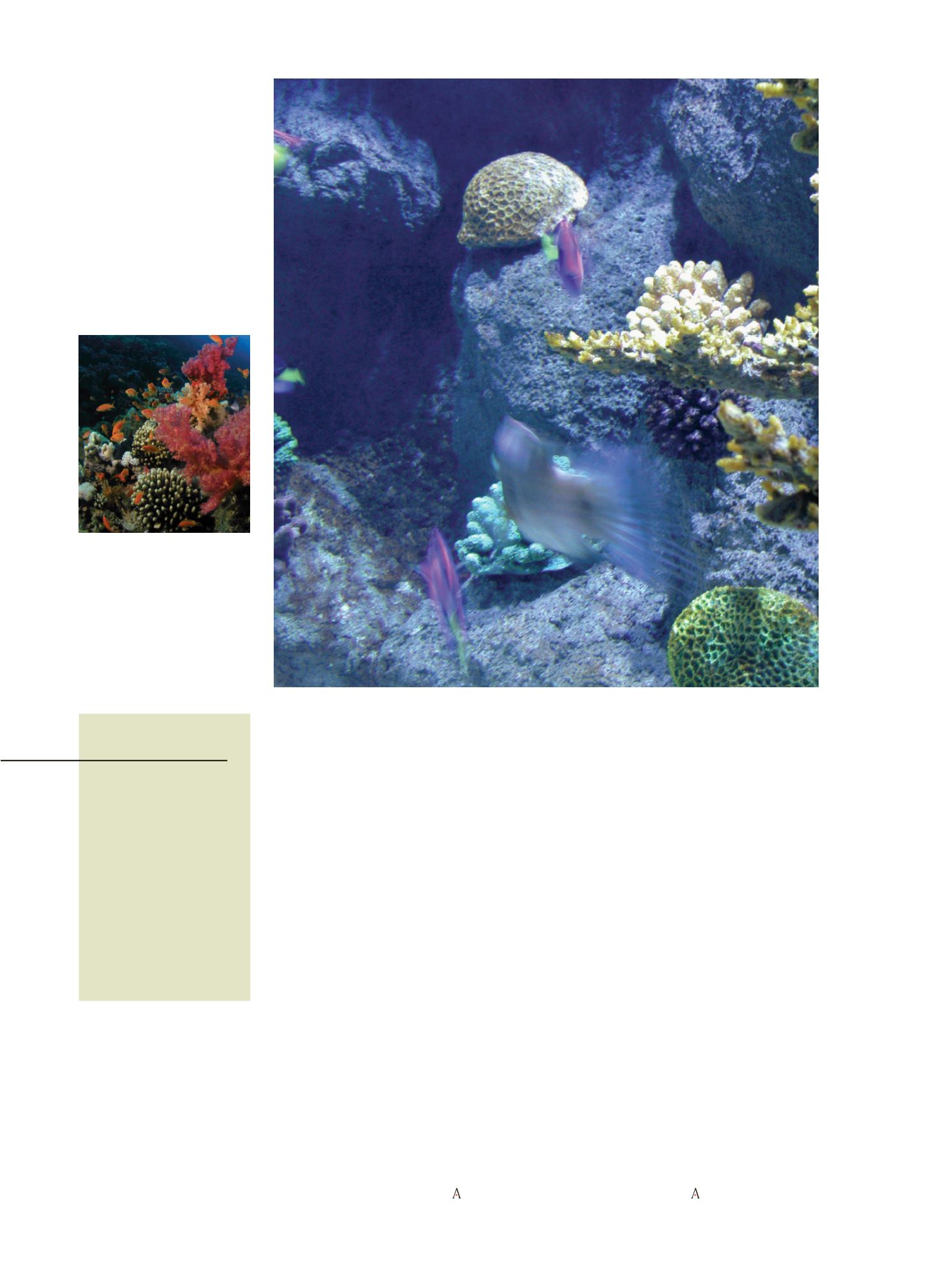
Corals can be formed by one polyp or hundreds
or thousands of them, in which case they are
called “colonies”. In the colony, each polyp is an
identical genetic copy of the other: in other words,
they are clones. Whether solitary of part of a
colony, polyps are contained within a type of cup
called “coralite”.
Corals are a fusion of many organisms that,
with the help of their tentacles, are able to trap
other organisms and swallow them—they are car-
nivorous. They can also feed on suspended parti-
cles and assimilate organic compounds that are
diluted in the water.
They reproduce in a variety of ways either
continuously or only during a season. For some,
fertilization is internal, for others, external. In
some species, the sexes are differentiated and
there are males and females, which makes them
gonocoric, while others are hermaphrodites:
both male and female. Additionally, reproduc-
tion can also be asexual: in this case, the colony
grows by simply dividing the polyps. This frag-
mentation is a way of increasing the number of
colonies in an area: each fragment has the poten-
tial to form a new colony which, at the same time,
is part of the original colony since they are
genetically identical.
la boca y los tentáculos vueltos hacia arriba. En cambio,
las medusas son de vida libre y tienen apariencia de
sombrilla, en el borde de la cual tienen los tentáculos.
Los corales pueden estar formados por un solo indi-
viduo o por cientos o miles de pólipos (en cuyo caso se
denominan “colonias”). Cada uno de los pólipos que for-
man la colonia es una copia genéticamente idéntica de
otro; es decir, son clones. Ya sean solitarios o coloniales,
los pólipos están contenidos en una especie de copa lla-
mada “coralite”.
Los corales son una amalgama de muchos organismos
a la vez, ya que son capaces de capturar a pequeños orga-
nismos con ayuda de sus tentáculos y engullirlos, por lo que
son carnívoros. Además, pueden alimentarse de partículas
en suspensión y de bacterias, y asimilar compuestos orgá-
nicos diluidos en el agua circundante.
La reproducción en estos organismos es muy varia-
da. Se pueden reproducir de manera continua o sólo du-
rante una temporada. En algunos la fertilización es
interna, mientras que en otros es externa. Los sexos en
algunas especies están separados, por lo que son gono-
córicos o bien son macho y hembra a la vez (es decir, her-
mafroditas). Adicionalmente, la reproducción también
puede ser de tipo asexual; en tal caso, el crecimiento de
una colonia se da por simple división de los pólipos. La
fragmentación funciona como medio para aumentar el
número de colonias en un área, ya que cada fragmento
tiene el potencial de dar origen a una nueva colonia, que
de alguna manera es muchas veces la misma colonia, ya
que serían genéticamente iguales.


