



 129 / 148

Una reputación creciente
cste es el £Qeriodo medio¤ en el Rue Beethoven evolu-
ciona como comQositor, creando mgs trabaKos Rue ha-
blaban de la lucha Z la revoluciwn. Un eKemQlo claro de
esto es su Tercer Sinfonía, llamada Eroica £heroica¤ , la
cual le dedicw al líder revolucionario de Cwrcega, NaQo-
lewn BonaQarte. Beethoven se volviw mgs irritable Z de
cargcter irascible con el Qaso de los avos.
Usualmente era visto caminando alrededor de Vie-
na del mismo modo Rue hi[o el comQositor +ohannes
Brahmsmgs tarde, gvido fangtico de Beethoven , inmerso
ensuQensamiento, QarecíaungenioeYcnntrico. : loera
…
Fue en 1809 Rue varios QrínciQes Z archiduRues le
dieron a Beethoven una renta vitalicia, Qero swlo si se
Ruedaba en Viena, hecho Rue aceQtw, Qor lo Rue se ins-
talw en esta ciudad toda la vida.
Beethoven escribiw mgs sinfonías incluZendo la
2uinta Sinfonía , cuartetos Qara cuerdas, Z su |nica
wQera, Fidelio, desQuns de varios avos.
Esto nos acerca a los |ltimos avos de su vida...
Compositor Maestro
Los |ltimos avos en la vida de Beethoven fueron tu-
multuosos, la historia de todas las leZendas. 1ara
1815 era casi comQletamente sordo, Z sus Qobres mo-
dales Z aQariencia física se resRuebraKaron.
Sus trabaKos de este Qeriodo son intelectuales e
intensos. De¬nitivamente la Qie[a mgs famosa de este
tiemQo fue su Novena Sinfonía cuZo movimiento ¬nal
es la £0da a la Alegría¤ . ComQuso su |ltimo cuarteto de
cuerdas en este Qunto, hecho Rue conmocionw al mun-
do musical Qor su comQleKo Z moderno sonido.
Comen[w a comQoner e idear su Dncima Sinfonía
mientras Zacía en su lecho de muerte, Qero nunca lo-
grw comQletarla.
Ludwig van Beethoven muriw en mar[o de 1827,
desQuns de cuatro oQeraciones de estwmago Rue ter-
minaron en infecciwn. Veinte mil Qersonas se alinea-
ron en las sombrías calles de Viena ese día, en el fune-
ral de uno de los genios mgs grandes Rue Qisw la tierra.
A growing reputation
This “middle period” is where Beethoven evolved
as a composer, creating more heroic works
depicting struggle and revolution. The big-
gest example of this is the Third Symphony,
called Eroica (Italian for “heroic”), which he
dedicated to the Corsican revolutionary leader
Napoleon Buonaparte.
He would often stomp around Vienna (like
later Viennese composer and Beethoven fanatic
Johannes Brahms), deep in thought, looking like
an eccentric genius. Which, I suppose, he was...
In 1809 various Princes and an Archduke
gave Beethoven a lifetime annuity, but only if he
stayed in Vienna. He readily agreed and settled
there for the rest of his life.
Beethoven wrote more symphonies (including
the Fifth Symphony), string quartets, and his only
opera Fidelio over the next couple of years as well.
This leads us to the last years of his life...
Master Composer
The final years of Beethoven’s life were tumultuous,
the story of legends. By 1815 he was almost com-
pletely deaf, and his poor manners and personal ap-
pearance were even worse.
His music from this period is very intellectual
and intense. Definitely the most famous piece from
this time is his Symphony 9 (whose final movement
has the “Ode to Joy”).He composed his last string
quartets at this point, which shocked the musical
world with their complex and modern sound.
He began to sketch out a Tenth Symphony
whilst suffering on his deathbed, but he never
got to complete it.
Ludwig van Beethoven died in March 1827,
after four operations on a stomach wound
which eventually got infected. Twenty thousand
mourners lined Vienna’s somber streets at the
genius’s funeral.
QerToOBKeT •
characters
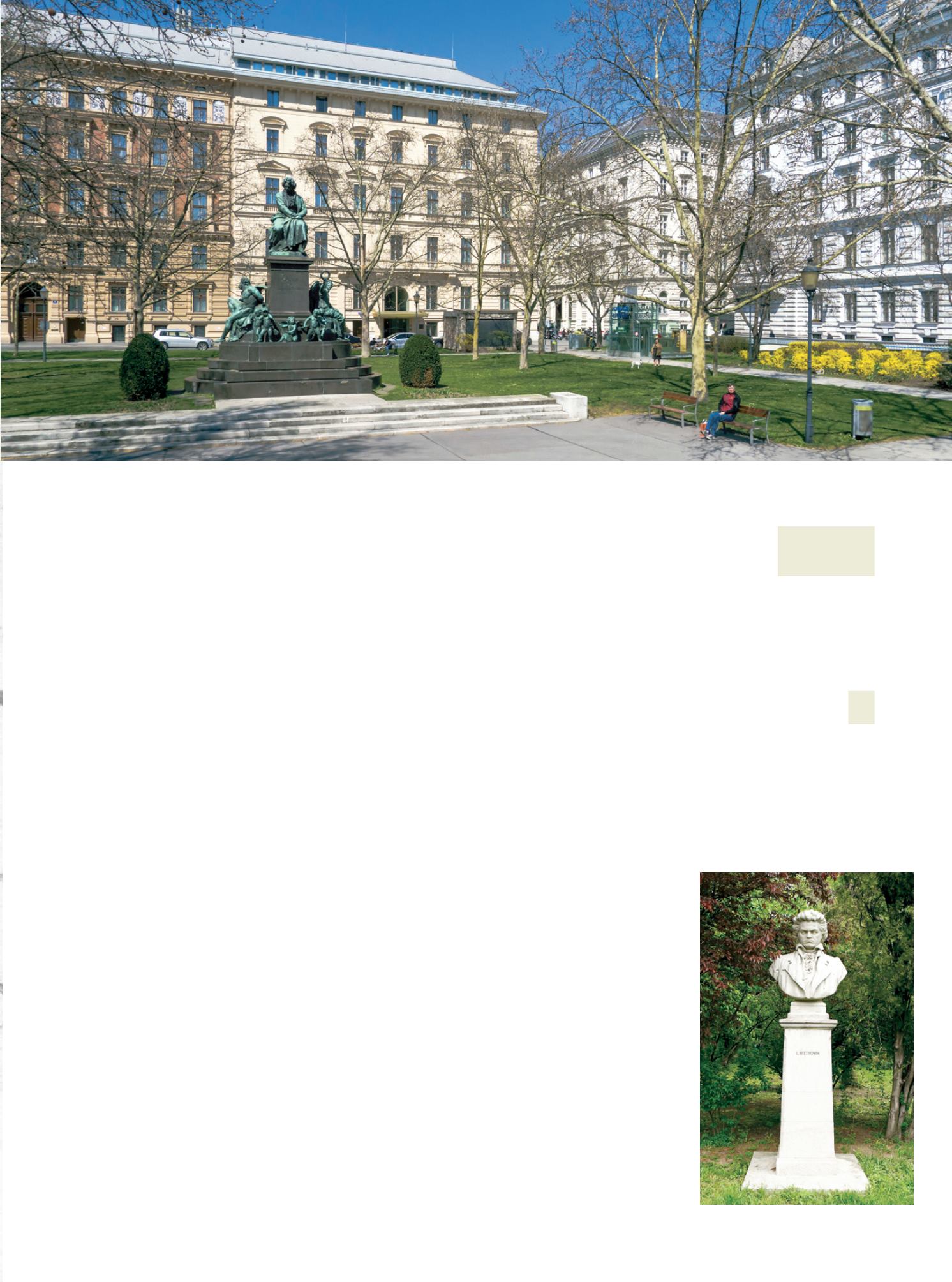
5.Estatuade
Beethovenen la
BeethovenQlat[,en
Vienna,Austria./
Statueof
Beethoveninthe
Beethovenplatzin
Vienna,Austria.
6.BustodeBeethoven
enRumanía./
BeethovenBustin
Romania.
5
6
·amura·
127