


 43 / 148

·amura·
41
comQgT iOt • iOt comQBTT
1ara 1871, Berlín se convertiría en la caQital de
1rusia, luego de la Guerra Franco-1rusiana, lo Rue de-
tonw el mgYimo desarrollo de la ciudad en todos los
sentidos. De este Qeriodo en adelante, se consolidw
el territorio de Alemania, Rue Qara la 1rimera Guerra
Mundial Za tomaba Qartido en las coaliciones, donde
fungiw como aliado de Bulgaria, el ImQerio Austro-
h|ngaro Z el ImQerio 0tomano, conocido como Blo-
Rue Central o Frente Balcgnico Z derrotado en 1981
Qor las Fuer[as Aliadas.
La ReQ|blica de Weimar se instaurw en Alemania
tras el ¬n del II Reich Z durw casi 15 avos, desde la
Constituciwn de 1919, hasta 1933, avo en Rue Hitler
se convirtiera en Canciller, desencadenando la Se-
gunda Guerra Mundial ¡Kunto con otras causas- Qara
1939, cuando Alemania invadiw 1olonia. Berlín sufriw
las consecuencias, sobre todo al ¬nal de la guerra,
cuando fue bombardeada Z Qor comQleto invadida.
En 1945, Alemania fue dividida Qara ser con-
trolada Qor los Qaíses aliados:
EE.UU., Francia, Gran
Bretava Z la URSS, Ruedando Berlín en territorio so-
vintico. Con la nueva coaliciwn entre
EE.UU., Francia
Z Gran Bretava, surgiw en 1949 la ReQ|blica Fede-
ral de Alemania RFA , lo cual ocasionw Rue la Uniwn
Sovintica reaccionara creando la ReQ|blica Demo-
crgtica Alemana RDA , estableciendo los Qrimeros
acentos de lo Rue sería la Guerra Fría.
Este conteYto no swlo comQlicaría las cosas
entre los bandos dentro de Berlín, Rue tambinn
estaba dividida, sino tambinn generaría conflictos
derivados en otros Qaíses como Cuba, Corea, Viet-
nam, µfrica, el Medio 0riente Z otros fenwmenos
geoQolíticos Rue involucraron a una gran Qarte del
Qlaneta Z Rue a|n desencadenan consecuencias,
reactivando vieKas rivalidades Z generando un
comQleKo escenario Qara todo el mundo.
By 1871, Berlin would convert into the Prussian
capital after the French-Prussian War, this deto-
nated into themaximumdevelopment of the city in
every definition. From this period forward, the Ger-
man territorywaswas consolidated, which byWorld
War I had already take a side in several coalitions,
where it functioned as ally of Bulgaria, the Austro-
Hungarian Empire and the Ottoman Empire as well,
known as the Central Block or the Baltic Front and
defeated in 1918 by the Allied Forces.
The Weimar Republic was established in Germa-
ny after the II Reich and it lasted almost 15 years,
since the Constitution of 1919, until 1933, when
Hitler was named Chancellor, unleashing Second
World War -along other causes-. Shortly after, in
1939 Germany would invade Poland. Berlin suffered
the consequences, specially by the end of the war,
when it was bombarded and invaded in it’s totality.
In 1945, Germany was separated in order to be
controlled by the Allied Countries: U.S.A., France,
Great Britain and the URSS, Berlin would remain
within Soviet territory. With the new coalition com-
posed by the United States, France and Great Brit-
ain, the Federal Republic of Germany emerged (FRG),
which caused the Soviet Union to react and create the
Democratic Republic of Germany (DRG), establishing
thefirst accents ofwhatwould turn into theColdWar.
This context not only would complicate things
between both groups within Berlin, which was also
divided, but it would also generate conflicts origi-
nated in countries and continents like Cuba, Ko-
rea, Vietnam, Africa and the Middle East as well as
other geopolitical phenomenons that involved a
large portion of the world and that still carry con-
sequences, reactivating old rivalry and generating
a complex scenario for Europe entirely.
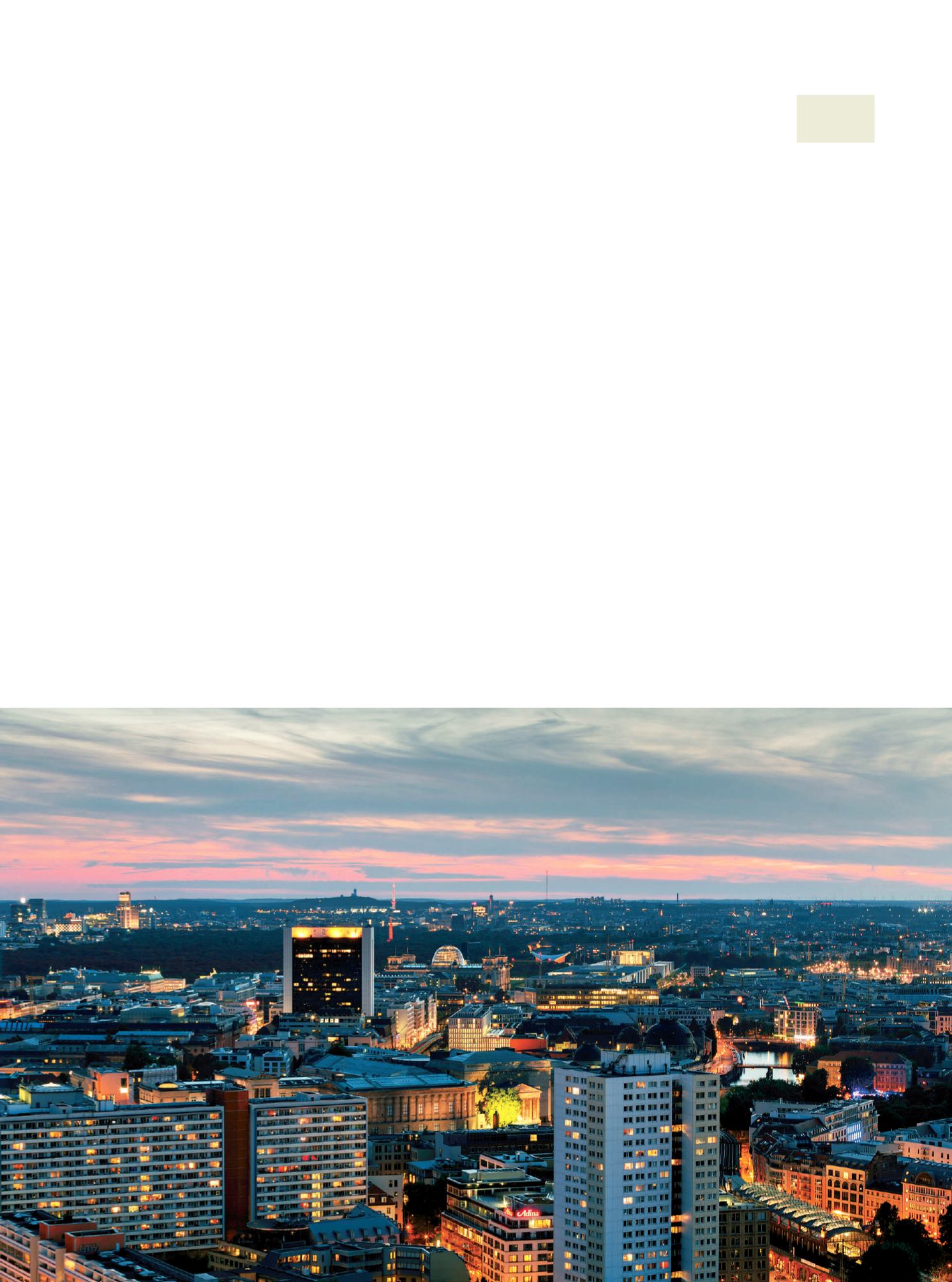
13. La caQital
alemana es un centro
de vanguardia en
todos los sentidos al
día de hoZ. /
TheGermancapitalis
acenterofvanguard
ineverywaytoday.
13