83
planeta azul •
blue planet
·amura·
cucumber” as it is know, an inhabitant of this place
fromwhere it gets its food, it walks slowly and fear-
lessly of its predators since its body is protected by a
layer if thick and wrinkly skin.
In open waters and propelling themselves by
swimming, we found small beings that give off their
own lights, the “aguasmalas” or medusas as they are
known. At mid depths, there are enormous banks of
sardines, which give the sensation of life and magic
to the transparent waters of the Gulf of Mexico. The
master of camouflage is without doubt the flounder
fish, which we discovered on the sandy bottoms
thanks to its eyes, which it uses as periscopes.
Anyone would feel attracted by the tiny crea-
tures that live on the coral beds, whether by their
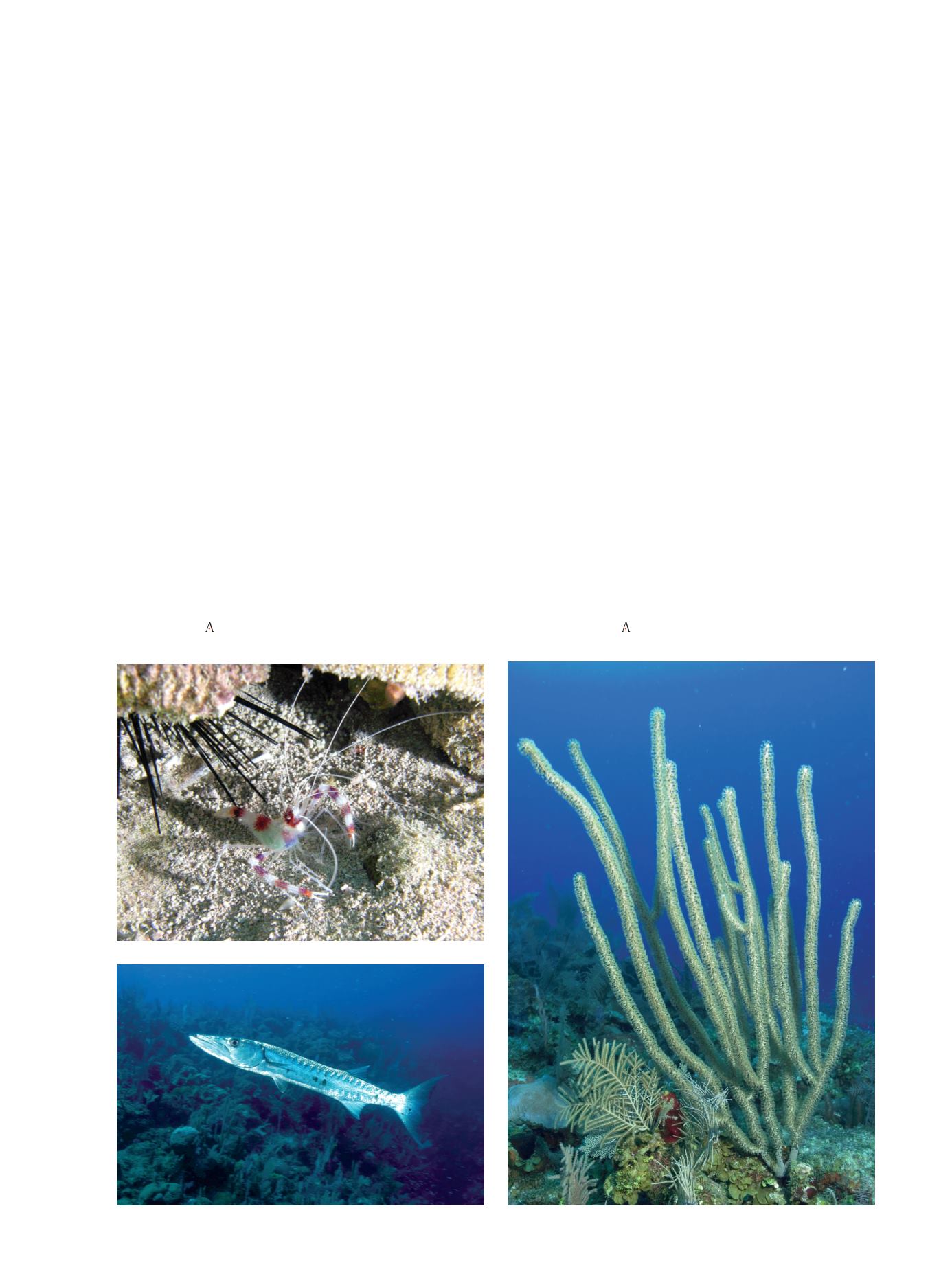
colors or whimsical shapes, like ghostly shrimps.
Lost in the sandy depths, we found a unique,
almost fictional character: the hermit crab devour-
ing a succulent dish.
At the bottom, ,we did not find anymetal treas-
ures, but instead brilliantly colored fish, such as
the well-known young angel fish, which in its
adulthood is known as the queen angel fish and its
relative, the gray angel fish.
Water corals are very attractive to divers but
much care is needed because they sting on contact.
Whip coral has been used for a long time for the
production of handicrafts and is therefore an
endangered species.
It is evident that life is born and multiplies
every day in the pleasant waters of the Gulf of
Mexico, where we were able to dive in the area
surrounding the controversial Laguna Verde
nuclear plant.
atraparlos. En los fondos arenosos observamos al
conocido como pepino de mar, habitante de ese lugar
de donde obtiene su comida, camina lentamente y sin
miedo a los depredadores, pues su cuerpo está blinda-
do por una capa de piel gruesa y corrugada.
En aguas abiertas y nadando a manera de propul-
sión encontramos a pequeños seres que destellan
sus propias luces, las aguasmalas. A media agua
habitan enormes bancos de sardinas, las cuales le
dan una sensación de vida y magia a las transparen-
tes aguas del Golfo de México. El maestro del camu-
flaje es sin duda alguna el pez lenguado, al cual
pudimos descubrir en los fondos de arena gracias a
sus ojos, que utiliza como periscopios.
Cualquiera se siente atraído por las pequeñas cria-
turas que viven en los fondos coralinos, ya sea por su
colorido o por sus caprichosas formas, como camarones
de fantasía. Perdido en los fondos arenosos encontra-
mos a un singular personaje que parece de ficción: el
cangrejo ermitaño.
En el fondo no encontramos tesoros enmetal pero
sí peces de brillantes colores, como es el conocido
angel juvenil, que ya en su estado adulto se conoce
como angel reina, y a su pariente el angel gris.
Los hidrocorales son llamativos para los buzos,
pero se tiene que tener mucho cuidado con ellos
pues son urticantes a su contacto. El coral de látigo
se ha utilizado desde hace mucho tiempo para la
fabricación de artesanías, por tal motivo se vio gra-
vemente amenazado.
Es evidente que la vida nace y se multiplica cada
día en las amables aguas del Golfo de México, donde
pudimos sumergirnos en la zona que rodea a la con-
troversial Planta Nuclear Laguna Verde.


