·amura·
99
planeta azul •
blue planet
Pasan algunos minutos antes de que la gran escue-
la se detenga por completo otra vez, dándonos uno de
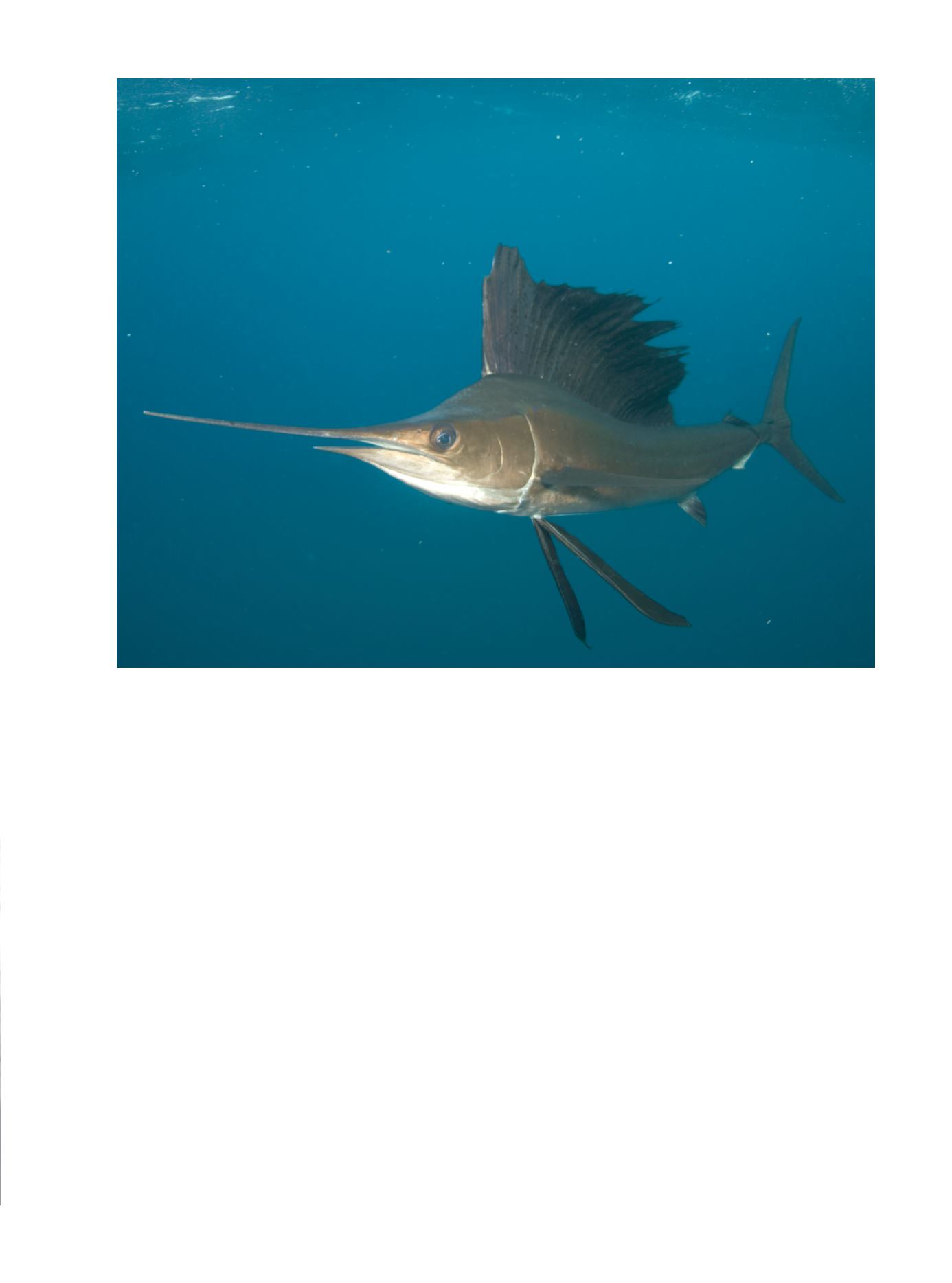
los espectáculos más impresionantes: el pez vela en
plena cacería. Más que alimentarse, parecen ejecutar
una hermosa danza acuática. Contemplo al coloso, que
puede llegar amedir hasta 2.5metros de punta a punta,
conduciendo a sus presas a la cercanía de la superficie
para poder comerlas con más facilidad. Con la ayuda
de su pico, el depredador se abre paso entre el grupo
de sardinas para crear una célula más pequeña, que
sea más controlable, ya que las presas zigzaguean para
evitar ser capturadas, y se protegen dentro del grupo
moviéndose a gran velocidad, y como una sola unidad.
De nueva cuenta corro con mucha suerte al pre-
senciar esta danza, ya que tanto los peces vela como
las sardinas son migratorios, y sus poblaciones se dis-
tribuyen ampliamente en diversos océanos. Pero de
enero a junio, los Istiophorus platypterus y las Sardi-
nellas aurita se encuentran pez a pez en este lecho de
mar. Tanto para el depredador como para su presa, la
plataforma continental constituye el hábitat perfecto.
Las aguas son poco profundas, ricas en plancton, y las
corrientes oceánicas entre Cuba y Yucatán prometen
comida abundante.
La cacería se engalana con un hermoso y letal
cambio en el depredador. Los peces vela, que suelen
viajar separados, unen sus fuerzas. Cada ataque se
acentúa con un asombroso destello de la aleta dorsal,
que mide más del doble del perfil del cazador. Un cen-
tello iridiscente, a menudo en franjas azul plateado,
enfatiza el efecto.
Spend a few minutes before the grand school
gets to a complete stop again, giving us one of
the most impressive performances: sailfish in full
chase. More than feeding itself, it seems to run a
beautiful water dance. I look at the colossus, which
can reach up to 2.5 meters from tip to tip, driving
their prey to the proximity of the surface to eat
themmore easily.
With the help of its peak, the predator makes
its way through the group of sardines to create
a smaller cell, which is more controllable, since
the prey zigzag to avoid being captured and pro-
tect themselves within the group moving at high
speed and as a single unit.
Once again I´
m lucky to witness this dance,
as both sailfish and sardines are migratory, and
their populations are widely distributed in vari-
ous oceans. But from January to June, the winged
Istiophorus and Sardinella aurita are found fish to
fish in this seabed. Both for the predator and the
prey, the continental shelf is the perfect habitat.
The shallow waters are rich in plankton, and ocean
currents between Cuba and Yucatan promise abun-
dant meal.
The hunt is adorned with a beautiful and lethal
change in the predator. Sailfish, who often travel
separately, join forces. Each attack is accented
with a stunning flash of dorsal fin, which is more
than double the hunter’s profile. A flickering iri-
descent, often in silvery blue stripes, emphasizes
the effect.


