planeta azul •
blue planet
84
·amura·
see what we liked most in a very small area and a few of
us chose to observe and classify the different corals.
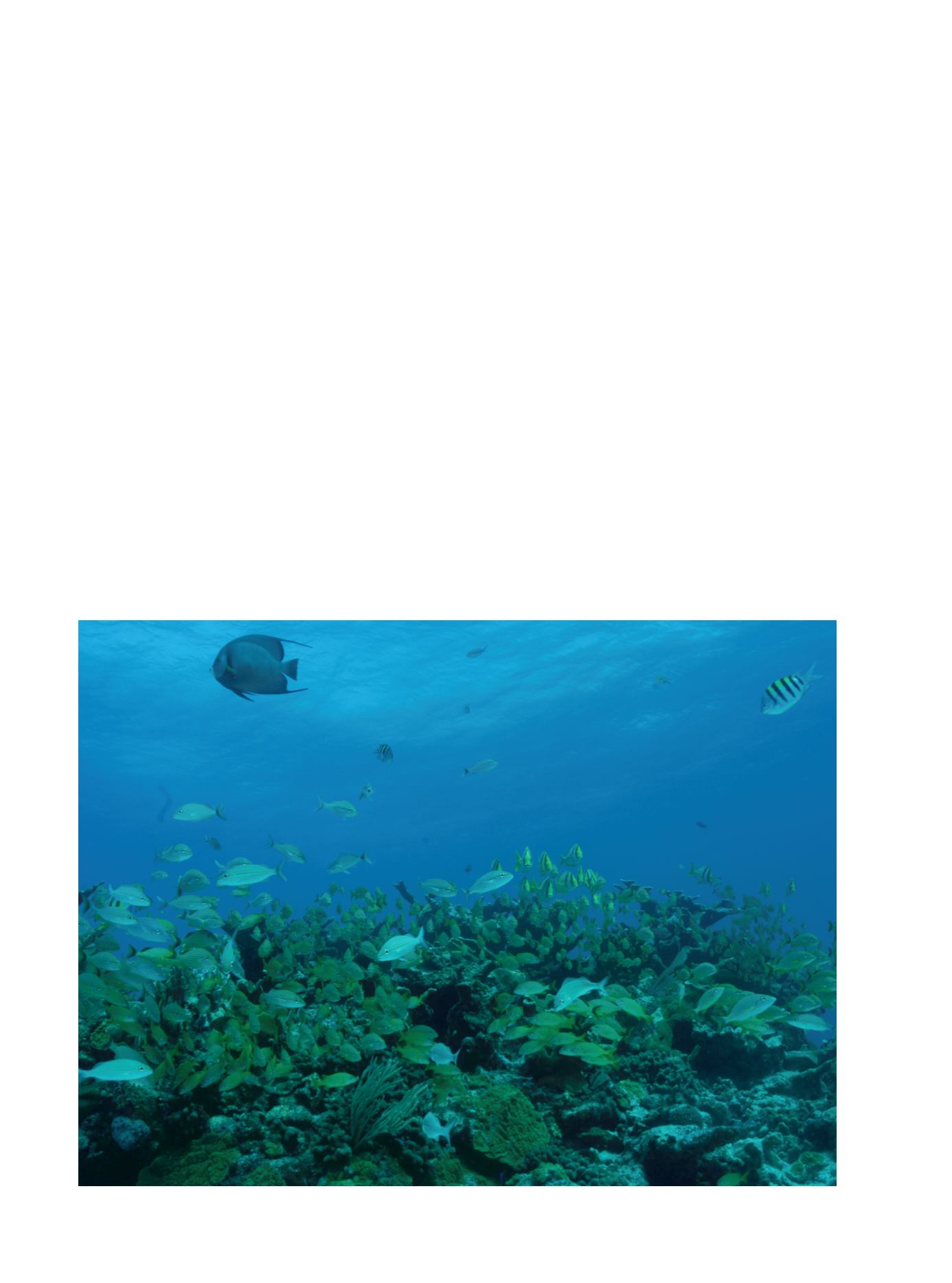
Coral and fishes
From the coral lovers, I learned that these forms are
not rocks, but living organisms that are very impor-
tant for the ecosystem, since they are the main reef
builders. The reef building characteristic is due to
that the organisms’ skeletons form a rigid calcium
carbonate framework on the substrate and all the
structures together constitute different habitats
used as a refuge for reef organisms such as snails, lob-
sters, crabs, starfish, slugs and fish.
The coral takes on different forms depending on
the species and the depth at which it is distributed
The most well-known forms are staghorns, brains,
pillars, candelabras, hands and flowers.
Another group of divers paid more attention to the
variety of fish that inhabit the reefs and their exclama-
tions of amazement could be heard when seeing the
sizes and shapes of fish that paraded before their eyes.
Most of these fish can be considered as resident, includ-
ing typically territorial species such as the trigger fish,
the blue tang, butterfly fish and all kinds of angelfish.
All the species use the reef as a refuge, to obtain food
and even in some cases as a breeding area, whereas oth-
ers, such as gray rays, jurels, coronados and barracudas
are merely visitors that swim around the reef.
Diving on sunken ships
One of the dives that united the whole group was a
dive to the sunken ships. >From the first dive, to the
remains of a galleon known as the "40 cannons", our
Corales y peces
De estos amantes de los corales aprendí que esas for-
maciones no son piedras, sino organismos vivos muy
importantes para el ecosistema, pues son los principa-
les constructores de los arrecifes.
Esto último se debe a que sus esqueletos forman
una armazón rígida de carbonato de calcio sobre el sus-
trato, y todas estas estructuras en su conjunto consti-
tuyen diferentes hábitat utilizados como refugio por
otros organismos arrecifales, por ejemplo: caracoles,
langostas, cangrejos, estrellas de mar, babosas y peces.
Los corales presentan diferentes formas, depen-
diendo de la especie y de la profundidad en la que se dis-
tribuyen. Las formas más conocidas son las de cuernos,
cerebros, pilares, candelabros, manos y flores.
Otro grupo de buzos fijó más su atención en la va-
riedad de peces que habitan en los arrecifes, y se podían
oír sus exclamaciones de asombro ante los tamaños y
las formas que desfilaron ante sus ojos. Muchos de es-
tos peces pueden ser considerados como residentes,
hallando entre ellos especies típicamente territoriales
(pez ballesta, cirujano azul, pez mariposa y las clases de
pez ángel).
Todos ellos utilizan al arrecife como refugio, para
obtener su alimento, e incluso en algunos casos como
zona de reproducción. Mientras que otros (como manta-
rrayas grises, jureles, coronados y barracudas), son visi-
tantes que deambulan por el arrecife.
El buceo en barcos hundidos
Uno de los buceos que unió a todo el grupo fue el de los
barcos hundidos. Desde el primer buceo, en los restos
de un galeón conocido como "el 40 cañones", nuestra


