


 98 / 132

·amura·
96
especies •
species
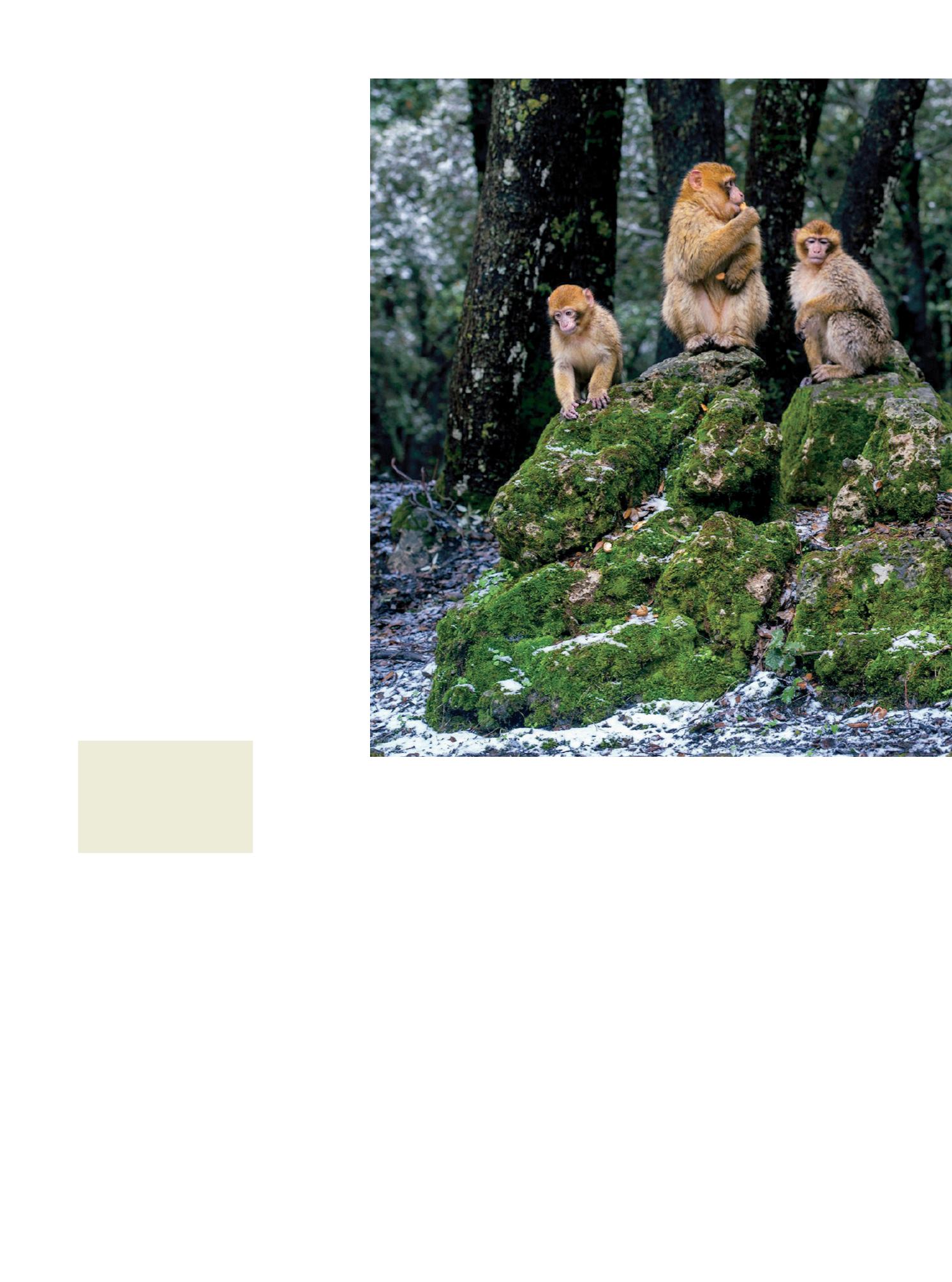
1.Los macacos de Berbería se han convertido en
un símbolo de identidad Británica en Gibraltar. /
The Barbary macaques have become a symbol
of British identity in Gibraltar.
U
nos cuentan que son los
descendientes de primates
que habitaron el sur de Eu-
ropa hace 5.5 millones de
años, otros que fueron lle-
vados por los moros (o mu-
sulmanes africanos) cuando
cruzaron el Estrecho de Gi-
braltar durante la conquista
de la península ibérica que inició en el año 711. Otros
afirman que fueron los mismos ingleses quienes lle-
varon a estos primates a Gibraltar en el siglo XVIII,
pero nadie está seguro de cuál teoría es la correcta.
Otra leyenda cuenta que se originaron en el norte de
África e inmigraron a través de un túnel de 24km que
conectaba Gibraltar con Marruecos. Sin importar cuál
versión sea la más acertada, los macacos de Gibraltar
se han convertido en un verdadero símbolo de identi-
dad británica.
Tanto el gobierno de Gibraltar como el del Reino
Unido se han dedicado a la preservación de los maca-
cos en lo alto de la famosa Roca que se levanta en el
centro de Gibraltar, ya sea por respeto a la especie o
por mantener la leyenda viva. Casualmente, los des-
censos en la población de macacos han coincidido con
momentos históricos donde la soberanía inglesa en
este territorio se vio amenazada de una forma u otra.
En 1913, un año antes del inicio de la primera guerra
mundial, los macacos se redujeron a solo diez espe-
címenes, y el gobernador de Gibraltar, Sir Alexander
Godley, importó ocho hembras del norte de África
para incrementar los números de primates. De forma
similar, durante el primer año de la segunda guerra
mundial, la especie se vio amenazada una vez más
cuando se reportó que solo quedaban siete, y el pri-
mer ministro del Reino Unido, Winston Churchill, dio
instrucciones de llevar más hembras a la reserva de la
Roca. En 1944, estableció que la población de los ma-
cacos debía permanecer sobre 24.
Se han hallado restos
óseos de macacos de
Berbería en las cenizas
de Pompeya
.
Therehavebeen
findingsof Barbary
macaque remainsbeneath
thevolcanic ash inPompeii
.
L
egend says that as long as the Barbary macaques (
macaca sylvanus
)
remain at the Rock of Gibraltar, it will belong to the British. This is
why their presence in Gibraltar unravels countless stories and theo-
ries about their possible origin. Some say that they are the descen-
dants of primates that used to inhabit the south of Europe 5.5 mil-
lion years ago; others say the Moors (or African Muslims) took them
there when they crossed the Strait of Gibraltar during the Umayyad
conquest of Hispania, which began in 711. Others claim that it was
the British themselves who took these primates to Gibraltar in the
18th century, but no one is sure which theory is the right one. Another legend says that
they originated in the North of Africa and they immigrated through a 24km tunnel that
connected Gibraltar and Morocco. In the end, it doesn’t matter which version is the most
accurate, the Gibraltar monkeys have become a true symbol of British identity.
The governments of both Gibraltar and the United Kingdomhave worked for the pres-
ervation of the macaques at the upper region of the famous Rock that rises at the center
of Gibraltar, either out of respect for the species or to keep the legend alive. Curiously,
decreased numbers in the macaque population have concurred with historical moments
when British sovereignty over this territory was threatened in some way or another. In
1913, a year before the beginning of World War I, the population of macaques had been
reduced to only ten individuals, and the governor of Gibraltar, Sir Alexander Godley, im-
ported eight female monkeys from the north of Africa to increase their numbers. Sim-
ilarly, during the first year of the Second World War, the species was threatened again
when it was reported that there were only seven monkeys left, and the prime minister of
the United Kingdom, Winston Churchill, ordered for more female monkeys to be taken to
the natural reserve at the Rock. In 1944, he established that macaque population should
always remain above 24.
1